Department of Internal Medicine and Preventive Medicine, Ewha Womans University School of Medicine, Seoul, Korea.
J Korean Med Sci. 2010 Dec;25(12):1784-91. doi: 10.3346/jkms.2010.25.12.1784. Epub 2010 Nov 24.
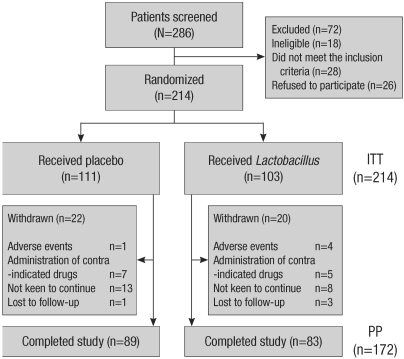
Antibiotic-associated diarrhea (AAD) is a common complication of antibiotic use. There is growing interest in probiotics for the treatment of AAD and Clostridium difficile infection because of the wide availability of probiotics. The aim of this multicenter, randomized, placebo-controlled, double-blind trial was to assess the efficacy of probiotic Lactobacillus (Lacidofil® cap) for the prevention of AAD in adults. From September 2008 to November 2009, a total of 214 patients with respiratory tract infection who had begun receiving antibiotics were randomized to receive Lactobacillus (Lacidofil® cap) or placebo for 14 days. Patients recorded bowel frequency and stool consistency daily for 14 days. The primary outcome was the proportion of patients who developed AAD within 14 days of enrollment. AAD developed in 4 (3.9%) of 103 patients in the Lactobacillus group and in 8 (7.2%) of 111 patients in the placebo group (P=0.44). However, the Lactobacillus group showed lower change in bowel frequency and consistency (50/103, 48.5%) than the placebo group (35/111, 31.5%) (P=0.01). Although the Lacidofil® cap does not reduce the rate of occurrence of AAD in adult patients with respiratory tract infection who have taken antibiotics, the Lactobacillus group maintains their bowel habits to a greater extent than the placebo group.
抗生素相关性腹泻(AAD)是抗生素使用的常见并发症。由于益生菌的广泛可用性,人们对益生菌治疗 AAD 和艰难梭菌感染越来越感兴趣。这项多中心、随机、安慰剂对照、双盲试验的目的是评估益生菌 Lactobacillus(Lacidofil® cap)预防成人 AAD 的疗效。2008 年 9 月至 2009 年 11 月,共有 214 例呼吸道感染患者开始接受抗生素治疗,随机分为接受 Lactobacillus(Lacidofil® cap)或安慰剂治疗 14 天。患者在 14 天内每天记录大便频率和粪便稠度。主要结局是在入组后 14 天内发生 AAD 的患者比例。Lactobacillus 组有 4 名(3.9%)患者发生 AAD,安慰剂组有 8 名(7.2%)患者发生 AAD(P=0.44)。然而,Lactobacillus 组的大便频率和稠度变化(50/103,48.5%)低于安慰剂组(35/111,31.5%)(P=0.01)。虽然 Lacidofil® cap 并不能降低接受抗生素治疗的呼吸道感染成年患者 AAD 的发生率,但 Lactobacillus 组比安慰剂组更能维持其肠道习惯。