Alastruey Jordi
Departments of Bioengineering and Aeronautics, Imperial College, London SW72AZ, UK.
Cardiovasc Eng. 2010 Dec;10(4):176-89. doi: 10.1007/s10558-010-9109-9.
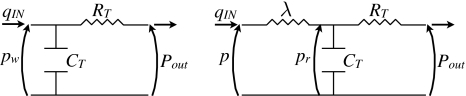
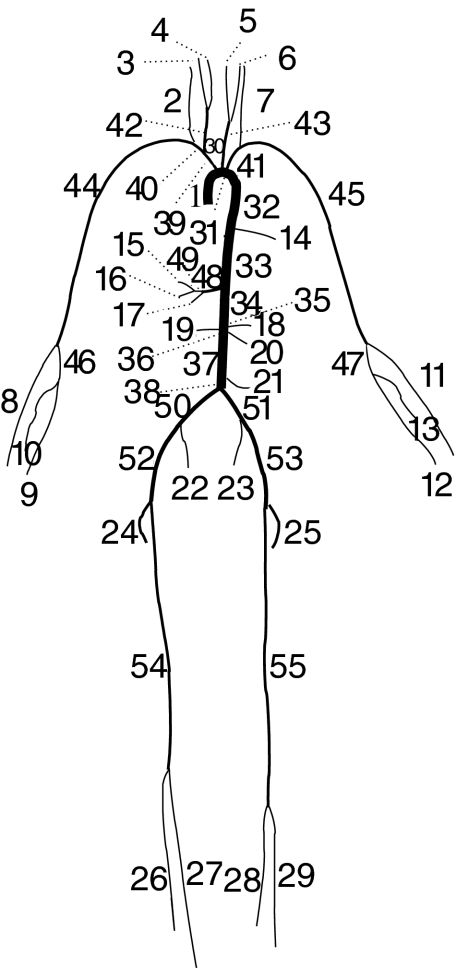
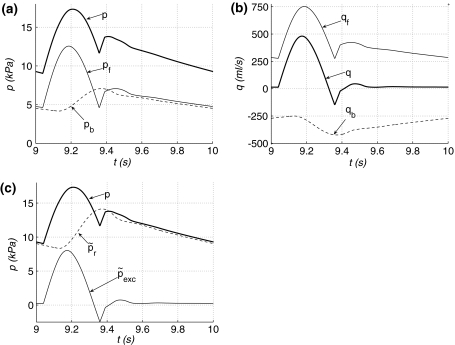
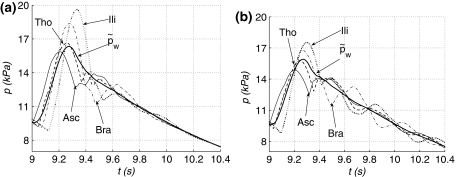
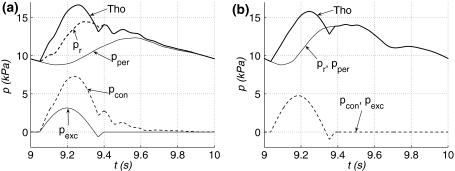
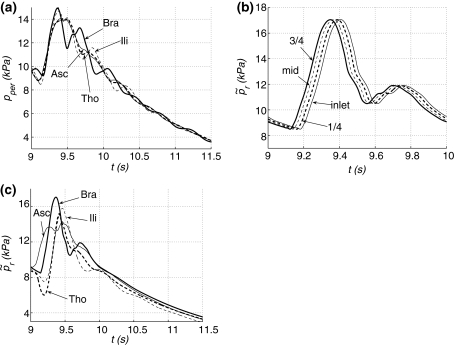
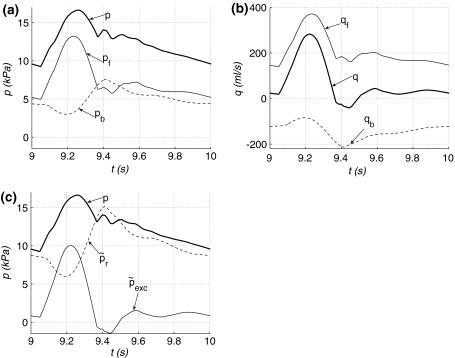
Several works have separated the pressure waveform p in systemic arteries into reservoir p(r) and excess p(exc) components, p = p(r) + p(exc), to improve pulse wave analysis, using windkessel models to calculate the reservoir pressure. However, the mechanics underlying this separation and the physical meaning of p(r) and p(exc) have not yet been established. They are studied here using the time-domain, inviscid and linear one-dimensional (1-D) equations of blood flow in elastic vessels. Solution of these equations in a distributed model of the 55 larger human arteries shows that p(r) calculated using a two-element windkessel model is space-independent and well approximated by the compliance-weighted space-average pressure of the arterial network. When arterial junctions are well-matched for the propagation of forward-travelling waves, p(r) calculated using a three-element windkessel model is space-dependent in systole and early diastole and is made of all the reflected waves originated at the terminal (peripheral) reflection sites, whereas p(exc) is the sum of the rest of the waves, which are obtained by propagating the left ventricular flow ejection without any peripheral reflection. In addition, new definitions of the reservoir and excess pressures from simultaneous pressure and flow measurements at an arbitrary location are proposed here. They provide valuable information for pulse wave analysis and overcome the limitations of the current two- and three-element windkessel models to calculate p(r).
为了改进脉搏波分析,一些研究通过风箱模型计算储器压力,将体循环动脉中的压力波形p分离为储器压力p(r)和过剩压力p(exc)两个分量,即p = p(r) + p(exc)。然而,这种分离背后的力学原理以及p(r)和p(exc)的物理意义尚未明确。本文利用弹性血管中血流的时域、无粘和线性一维(1-D)方程对其进行了研究。在55条较大的人体动脉分布模型中求解这些方程表明,使用双元件风箱模型计算的p(r)与空间无关,并且可以很好地用动脉网络的顺应性加权空间平均压力来近似。当动脉分支对向前传播的波传播匹配良好时,使用三元风箱模型计算的p(r)在收缩期和舒张早期与空间有关,并且由所有起源于末梢(外周)反射部位的反射波组成,而p(exc)是其余波的总和,这些波是通过在没有任何外周反射的情况下传播左心室射血得到的。此外,本文还提出了根据任意位置的同步压力和流量测量对储器压力和过剩压力的新定义。它们为脉搏波分析提供了有价值的信息,并克服了当前双元件和三元风箱模型计算p(r)的局限性。