Biophysics Graduate Group, University of California, Berkeley, Berkeley, CA 94720, USA.
Mol Biol Cell. 2011 Feb 15;22(4):457-66. doi: 10.1091/mbc.E10-10-0841. Epub 2010 Dec 17.
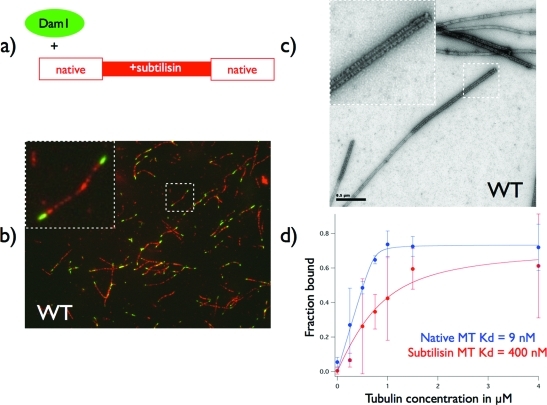
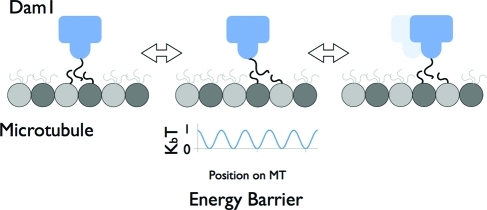
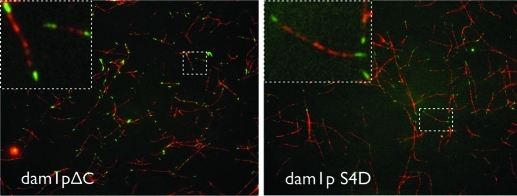
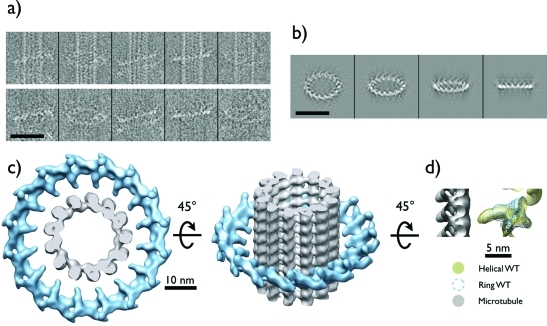
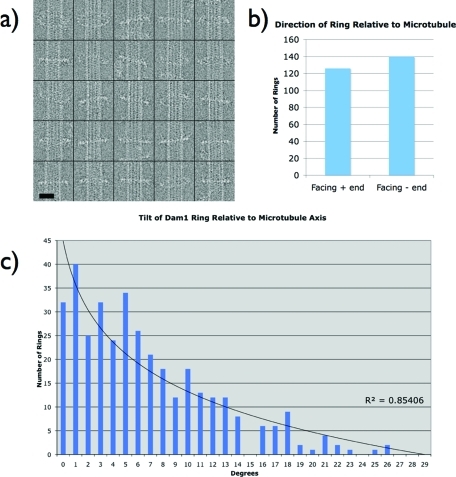
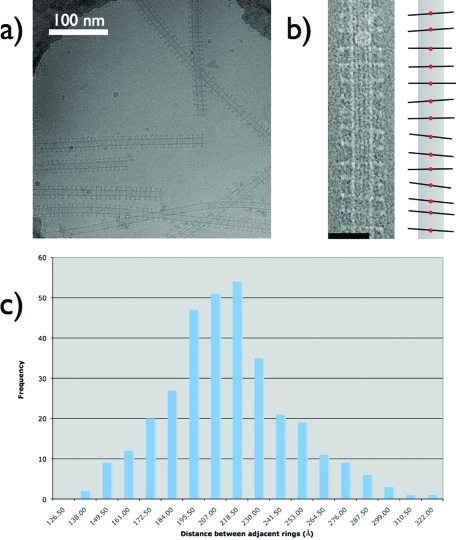
There has been much effort in recent years aimed at understanding the molecular mechanism by which the Dam1 kinetochore complex is able to couple microtubule depolymerization to poleward movement. Both a biased diffusion and a forced walk model have been proposed, and several key functional aspects of Dam1-microtubule binding are disputed. Here, we investigate the elements involved in tubulin-Dam1 complex interactions and directly visualize Dam1 rings on microtubules in order to infer their dynamic behavior on the microtubule lattice and its likely relevance at the kinetochore. We find that the Dam1 complex has a preference for native tubulin over tubulin that is lacking its acidic C-terminal tail. Statistical mechanical analysis of images of Dam1 rings on microtubules, applied to both the distance between rings and the tilt angle of the rings with respect to the microtubule axis, supports a diffusive ring model. We also present a cryo-EM reconstruction of the Dam1 ring, likely the relevant assembly form of the complex for energy coupling during microtubule depolymerization in budding yeast. The present studies constitute a significant step forward by linking structural and biochemical observations toward a comprehensive understanding of the Dam1 complex.
近年来,人们做出了很多努力来理解 Dam1 动粒复合物将微管解聚与向极运动偶联的分子机制。已经提出了一种偏向扩散和强制行走模型,并且 Dam1-微管结合的几个关键功能方面存在争议。在这里,我们研究了参与微管-Dam1 复合物相互作用的元素,并直接在微管上可视化 Dam1 环,以推断它们在微管晶格上的动态行为及其在动粒上的可能相关性。我们发现 Dam1 复合物优先与天然微管结合,而不是缺乏酸性 C 端尾巴的微管。对微管上 Dam1 环的图像进行统计力学分析,应用于环之间的距离和环相对于微管轴的倾斜角度,支持扩散环模型。我们还展示了 Dam1 环的 cryo-EM 重建,这可能是复合物的相关组装形式,用于在芽殖酵母中微管解聚过程中的能量偶联。目前的研究通过将结构和生化观察联系起来,朝着全面理解 Dam1 复合物迈出了重要的一步。