Unidad de Fisiopatología Renal y Cardiovascular, Instituto Reina Sofía de Investigación Nefrológica, Universidad de Salamanca, Salamanca, Spain.
BMC Med. 2010 Dec 20;8:86. doi: 10.1186/1741-7015-8-86.
Endoglin is involved in the regulation of endothelial function, but there are no studies concerning its relation with hypertension- and diabetes-associated pathologies. Thus, we studied the relationship between plasma levels of soluble endoglin and cardiovascular alterations associated with hypertension and diabetes.
We analyzed 288 patients: 64 with type 2 diabetes, 159 with hypertension and 65 healthy patients. We assessed the relationship of soluble endoglin plasma levels measured by enzyme-linked immunosorbent assay with basal glycemia, glycosylated hemoglobin, blood pressure, endothelial dysfunction (assessed by pressure wave velocity), hypertensive retinopathy (by Keith-Wagener classification), left ventricular hypertrophy (by Cornell and Sokolow indexes), cardiovascular risk and target organ (heart, vascular, kidney) damage.
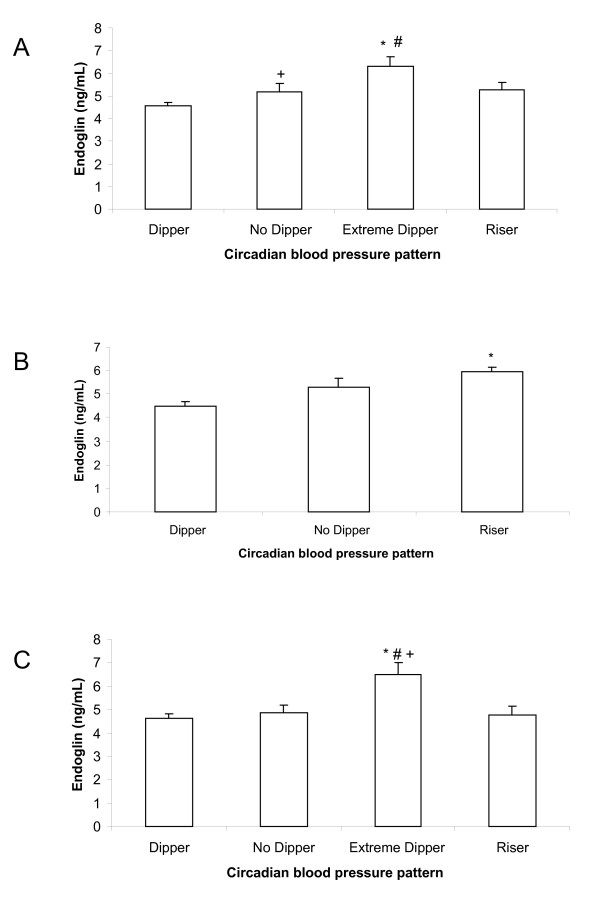
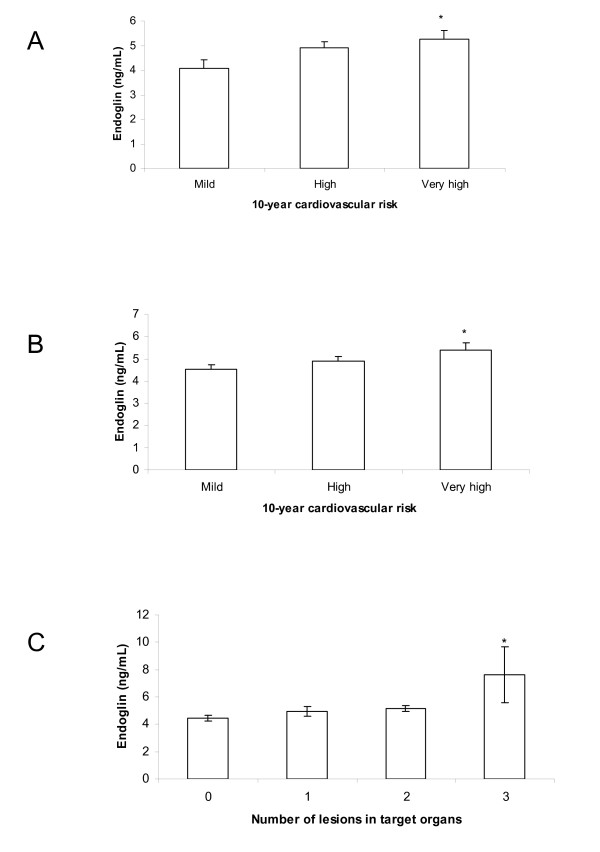
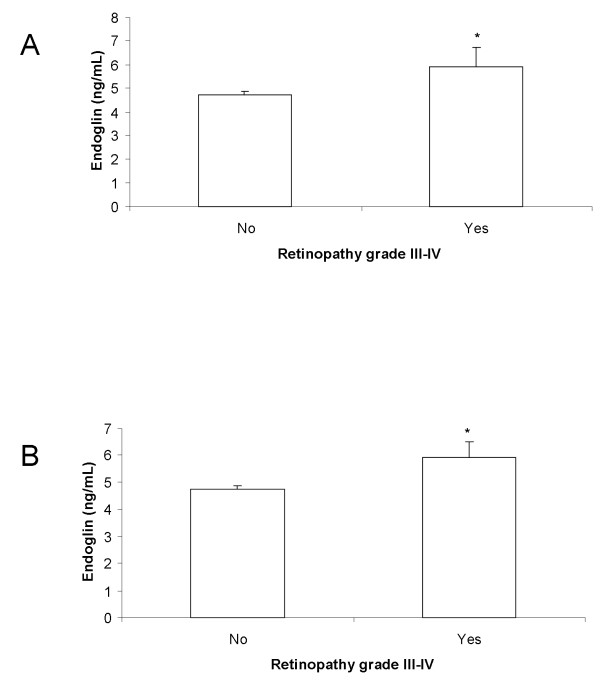
There are significant correlations between endoglin and glycemia, systolic blood pressure, pulse pressure, pressure wave velocity and electrocardiographically assessed left ventricular hypertrophy. Endoglin levels were significantly higher in patients with diabetes who had nondipper and extreme dipper circadian blood pressure patterns than in dipper circadian patterns, in patients with hypertension and diabetes who had riser pattern than in the other patients, and in patients with diabetes but not hypertension who had extreme dipper pattern than in dipper, nondipper and riser groups. There was also a significant correlation between plasma-soluble endoglin and lower levels of systolic night-day ratio. Higher endoglin levels were found in patients with diabetes who had retinopathy, in patients with diabetes who had a high probability of 10-year cardiovascular risk, and in patients with diabetes and hypertension who had three or more damaged target organs (heart, vessels, kidney) than in those with no organs affected.
This study shows that endoglin is an indicator of hypertension- and diabetes-associated vascular pathologies as endothelial dysfunction and cardiovascular damage.
内皮糖蛋白(endoglin)参与内皮功能的调节,但目前尚无关于其与高血压和糖尿病相关病变关系的研究。因此,我们研究了可溶性内皮糖蛋白与与高血压和糖尿病相关的心血管改变之间的关系。
我们分析了 288 名患者:64 名 2 型糖尿病患者,159 名高血压患者和 65 名健康患者。我们通过酶联免疫吸附试验(ELISA)测量可溶性内皮糖蛋白的血浆水平,评估其与基础血糖、糖化血红蛋白、血压、内皮功能障碍(通过压力波速度评估)、高血压性视网膜病变(通过 Keith-Wagener 分类)、左心室肥厚(通过 Cornell 和 Sokolow 指数)、心血管风险和靶器官(心脏、血管、肾脏)损伤的关系。
内皮糖蛋白与血糖、收缩压、脉压、压力波速度和心电图评估的左心室肥厚之间存在显著相关性。在具有非杓型和极端杓型昼夜血压模式的糖尿病患者中,内皮糖蛋白水平显著高于杓型昼夜模式的患者;在具有 riser 模式的高血压和糖尿病患者中,内皮糖蛋白水平显著高于其他患者;在具有极端杓型模式的糖尿病患者中,内皮糖蛋白水平显著高于杓型、非杓型和 riser 组的患者。血浆可溶性内皮糖蛋白与收缩压夜间/日间比值降低也存在显著相关性。在患有糖尿病视网膜病变的患者、10 年心血管风险高的糖尿病患者以及患有三种或更多受损靶器官(心脏、血管、肾脏)的糖尿病和高血压患者中,内皮糖蛋白水平显著高于无器官受累的患者。
本研究表明,内皮糖蛋白是与高血压和糖尿病相关血管病变的标志物,如内皮功能障碍和心血管损伤。