Gruene Tim, Sheldrick George M
Department of Structural Chemistry, Georg-August-University Göttingen, Tammanstrasse 4, D-37077 Göttingen, Germany.
Acta Crystallogr A. 2011 Jan;67(Pt 1):1-8. doi: 10.1107/S0108767310039140. Epub 2010 Nov 11.
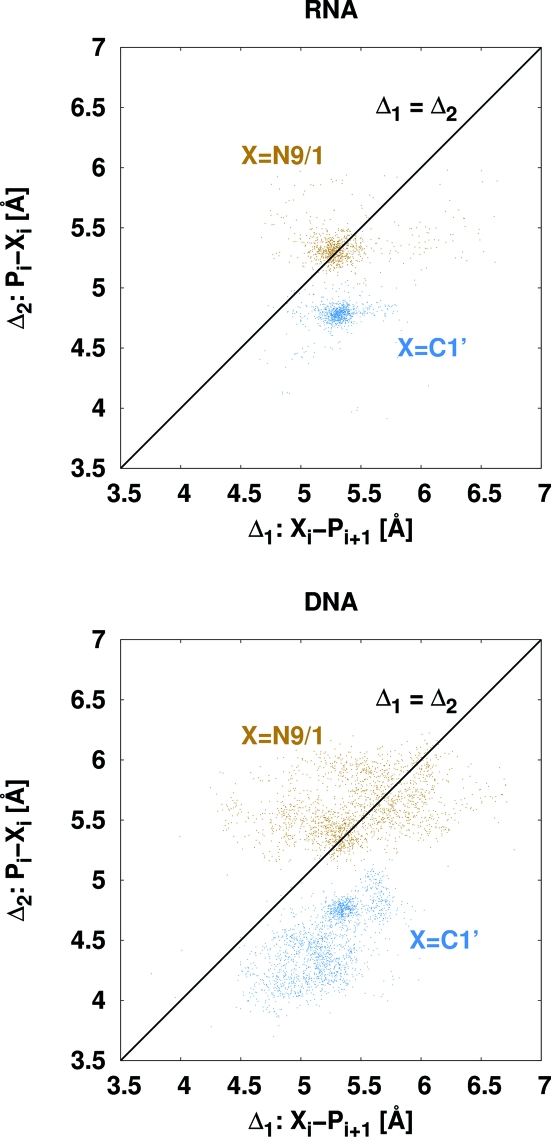
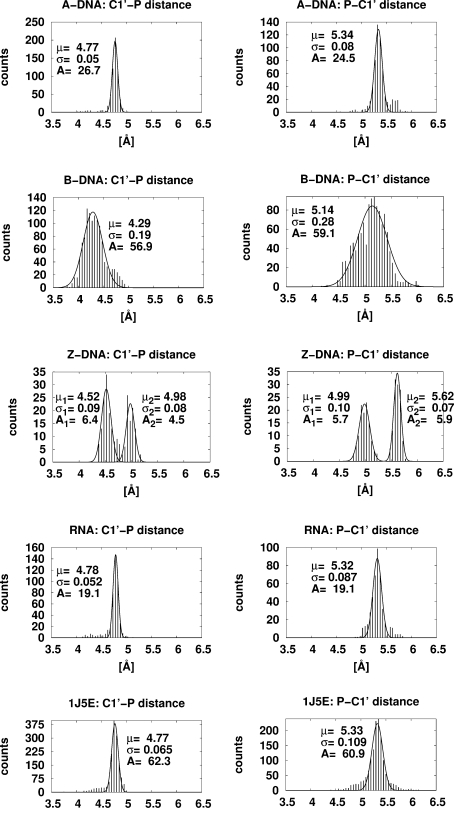
Medium- to high-resolution X-ray structures of DNA and RNA molecules were investigated to find geometric properties useful for automated model building in crystallographic electron-density maps. We describe a simple method, starting from a list of electron-density 'blobs', for identifying backbone phosphates and nucleic acid bases based on properties of the local electron-density distribution. This knowledge should be useful for the automated building of nucleic acid models into electron-density maps. We show that the distances and angles involving C1' and the P atoms, using the pseudo-torsion angles \eta' and \theta,' that describe the ...P-C1'-P-C1'... chain, provide a promising basis for building the nucleic acid polymer. These quantities show reasonably narrow distributions with asymmetry that should allow the direction of the phosphate backbone to be established.
研究了DNA和RNA分子的中高分辨率X射线结构,以寻找对晶体学电子密度图中的自动模型构建有用的几何特性。我们描述了一种简单的方法,从电子密度“斑点”列表开始,基于局部电子密度分布的特性来识别主链磷酸盐和核酸碱基。这些知识对于将核酸模型自动构建到电子密度图中应该是有用的。我们表明,使用描述...P-C1'-P-C1'...链的伪扭转角η'和θ',涉及C1'和P原子的距离和角度为构建核酸聚合物提供了一个有前景的基础。这些量显示出具有不对称性的相当窄的分布,这应该允许确定磷酸盐主链的方向。