Laboratory of Cancer Biology and Genetics, National Cancer Institute, Bethesda, MD 20892, USA.
Pharmacogenomics J. 2012 Apr;12(2):119-27. doi: 10.1038/tpj.2010.87. Epub 2010 Dec 21.
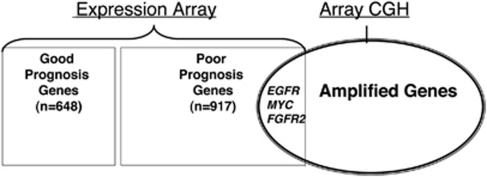
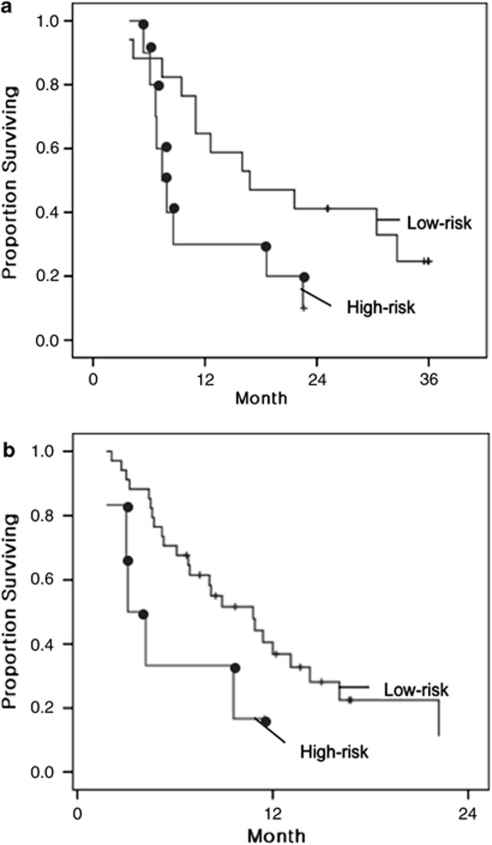
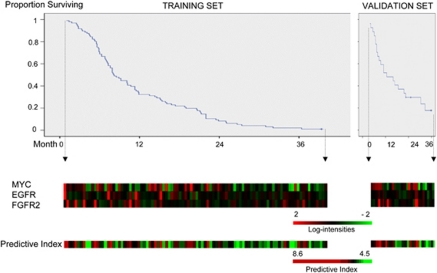
To identify transcriptional profiles predictive of the clinical benefit of cisplatin and fluorouracil (CF) chemotherapy to gastric cancer patients, endoscopic biopsy samples from 96 CF-treated metastatic gastric cancer patients were prospectively collected before therapy and analyzed using high-throughput transcriptional profiling and array comparative genomic hybridization. Transcriptional profiling identified 917 genes that are correlated with poor patient survival after CF at P<0.05 (poor prognosis signature), in which protein synthesis and DNA replication/recombination/repair functional categories are enriched. A survival risk predictor was then constructed using genes, which are included in the poor prognosis signature and are contained within identified genomic amplicons. The combined expression of three genes-MYC, EGFR and FGFR2-was an independent predictor for overall survival of 27 CF-treated patients in the validation set (adjusted P=0.017), and also for survival of 40 chemotherapy-treated gastric cancer patients in a published data set (adjusted P=0.026). Thus, combined expression of MYC, EGFR and FGFR2 is predictive of poor survival in CF-treated metastatic gastric cancer patients.
为了确定预测胃癌患者对顺铂和氟尿嘧啶(CF)化疗临床获益的转录谱,前瞻性地收集了 96 例 CF 治疗转移性胃癌患者的内镜活检样本,在治疗前进行了高通量转录谱和阵列比较基因组杂交分析。转录谱鉴定出 917 个基因,这些基因与 CF 治疗后患者生存不良相关(预后不良标志),其中蛋白质合成和 DNA 复制/重组/修复功能类别丰富。然后使用包含在预后不良标志中的基因构建生存风险预测因子,这些基因包含在鉴定的基因组扩增子中。在验证组中,三个基因(MYC、EGFR 和 FGFR2)的联合表达是 27 例 CF 治疗患者总生存的独立预测因子(调整后的 P=0.017),也是发表数据集中 40 例化疗治疗胃癌患者生存的独立预测因子(调整后的 P=0.026)。因此,MYC、EGFR 和 FGFR2 的联合表达可预测 CF 治疗转移性胃癌患者的不良生存。