Austrian Academy of Sciences, Institute of Technology Assessment, Vienna, Austria.
Part Fibre Toxicol. 2010 Dec 21;7:42. doi: 10.1186/1743-8977-7-42.
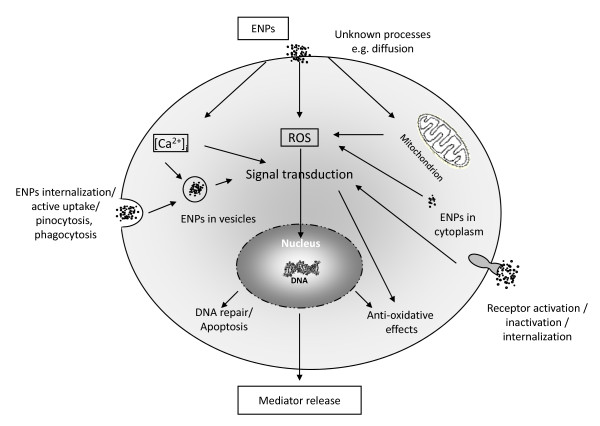
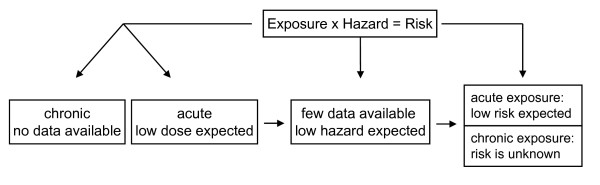
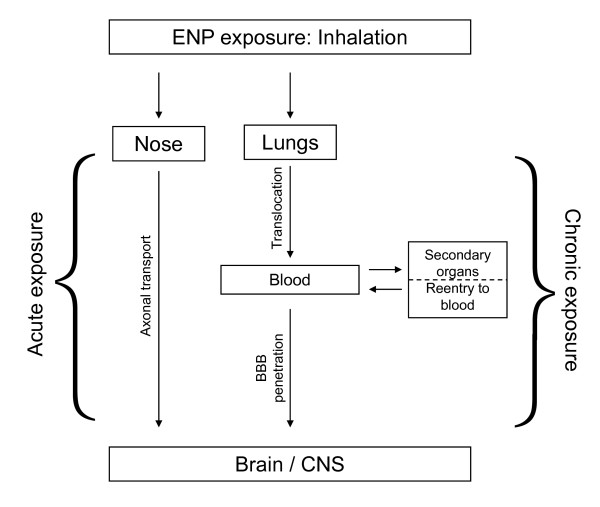
There are certain concerns regarding the safety for the environment and human health from the use of engineered nanoparticles (ENPs) which leads to unintended exposures, as opposed to the use of ENPs for medical purposes. This review focuses on the unintended human exposure of ENPs. In particular, possible effects in the brain are discussed and an attempt to assess risks is performed.Animal experiments have shown that investigated ENPs (metallic nanoparticles, quantum dots, carbon nanotubes) can translocate to the brain from different entry points (skin, blood, respiratory pathways). After inhalation or instillation into parts of the respiratory tract a very small fraction of the inhaled or instilled ENPs reaches the blood and subsequently secondary organs, including the CNS, at a low translocation rate. Experimental in vivo and in vitro studies have shown that several types of ENPs can have various biological effects in the nervous system. Some of these effects could also imply that ENPs can cause hazards, both acutely and in the long term. The relevance of these data for risk assessment is far from clear. There are at present very few data on exposure of the general public to either acute high dose exposure or on chronic exposure to low levels of air-borne ENPs. It is furthermore unlikely that acute high dose exposures would occur. The risk from such exposures for damaging CNS effects is thus probably very low, irrespective of any biological hazard associated with ENPs.The situation is more complicated regarding chronic exposures, at low doses. The long term accumulation of ENPs can not be excluded. However, we do not have exposure data for the general public regarding ENPs. Although translocation to the brain via respiratory organs and the circulation appears to be very low, there remains a possibility that chronic exposures, and/or biopersistent ENPs, can influence processes within the brain that are triggering or aggravating pathological processes.In general, the present state of knowledge is unsatisfactory for a proper risk assessment in this area. Crucial deficits include lack of exposure data, the absence of a proper dose concept, and that studies often fail in adequate description of the investigated ENPs.
人们对工程纳米粒子(ENPs)的使用对环境和人类健康的安全性存在某些担忧,这导致了意外暴露,而不是将 ENPs 用于医疗目的。本综述重点关注 ENPs 的意外人体暴露。特别是,讨论了可能对大脑产生的影响,并尝试对风险进行评估。动物实验表明,研究中的 ENPs(金属纳米粒子、量子点、碳纳米管)可以从不同的进入点(皮肤、血液、呼吸道途径)转移到大脑。吸入或滴入呼吸道的一部分后,吸入或滴入的 ENPs 中非常小的一部分以低转移率到达血液,随后到达次级器官,包括中枢神经系统。体内和体外实验研究表明,几种类型的 ENPs 可以在神经系统中具有各种生物学效应。其中一些影响也可能意味着 ENPs 会造成危害,无论是急性的还是长期的。这些数据对于风险评估的相关性远不清楚。目前,关于公众暴露于急性高剂量暴露或慢性暴露于空气中的低水平 ENPs 的数据非常少。此外,不太可能发生急性高剂量暴露。因此,无论与 ENPs 相关的任何生物危害如何,这种暴露对中枢神经系统损伤的风险可能非常低。对于低剂量的慢性暴露,情况更加复杂。不能排除 ENPs 的长期积累。但是,我们没有关于公众接触 ENPs 的暴露数据。尽管通过呼吸道和循环系统向大脑转移的可能性非常低,但仍然存在慢性暴露和/或生物持久性 ENPs 可能影响大脑内引发或加重病理过程的可能性。一般来说,目前在这一领域的知识状况不足以进行适当的风险评估。关键缺陷包括缺乏暴露数据、缺乏适当的剂量概念,以及研究往往未能充分描述所研究的 ENPs。