Department of Clinical Neuroscience, Division of Psychiatry, Karolinska Institutet, Stockholm, Sweden.
BMC Psychiatry. 2010 Dec 22;10:112. doi: 10.1186/1471-244X-10-112.
ADHD is a common and disabling disorder, with an increased risk for coexisting disorders, substance abuse and delinquency. In the present study, we aimed at exploring ADHD and criminality. We estimated the prevalence of ADHD among longer-term prison inmates, described symptoms and cognitive functioning, and compared findings with ADHD among psychiatric outpatients and healthy controls.
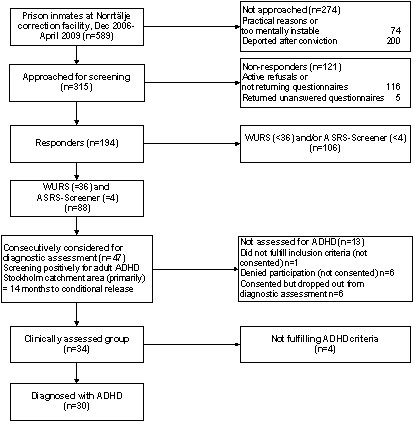
At Norrtälje Prison, we approached 315 male inmates for screening of childhood ADHD by the Wender Utah Rating Scale (WURS-25) and for present ADHD by the Adult ADHD Self-Report Screener (ASRS-Screener). The response rate was 62%. Further, we assessed 34 inmates for ADHD and coexisting disorders. Finally, we compared findings with 20 adult males with ADHD, assessed at a psychiatric outpatient clinic and 18 healthy controls.
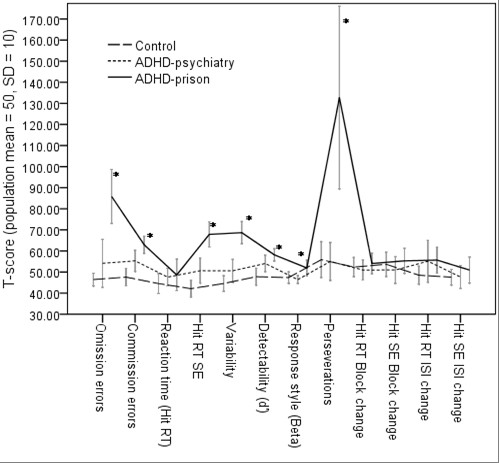
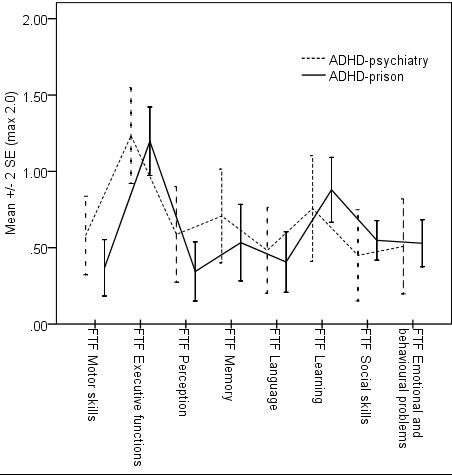
The estimated prevalence of adult ADHD among longer-term inmates was 40%. Only 2 out of 30 prison inmates confirmed with ADHD had received a diagnosis of ADHD during childhood, despite most needed health services and educational support. All subjects reported lifetime substance use disorder (SUD) where amphetamine was the most common drug. Mood and anxiety disorders were present among half of subjects; autism spectrum disorder (ASD) among one fourth and psychopathy among one tenth. Personality disorders were common; almost all inmates presented conduct disorder (CD) before antisocial personality disorder (APD). Prison inmates reported more ADHD symptoms during both childhood and adulthood, compared with ADHD psychiatric outpatients. Further, analysis of executive functions after controlling for IQ showed both ADHD groups performed poorer than controls on working memory tests. Besides, on a continuous performance test, the ADHD prison group displayed poorer results compared with both other groups.
This study suggested ADHD to be present among 40% of adult male longer-term prison inmates. Further, ADHD and coexisting disorders, such as SUD, ASD, personality disorders, mood- and anxiety disorders, severely affected prison inmates with ADHD. Besides, inmates showed poorer executive functions also when controlling for estimated IQ compared with ADHD among psychiatric outpatients and controls. Our findings imply the need for considering these severities when designing treatment programmes for prison inmates with ADHD.
ADHD 是一种常见且致残的疾病,存在共病风险,包括物质滥用和犯罪行为。本研究旨在探讨 ADHD 与犯罪行为之间的关系。我们估计了长期服刑男性囚犯中的 ADHD 患病率,描述了症状和认知功能,并将结果与精神科门诊患者和健康对照组中的 ADHD 进行了比较。
在诺尔泰利耶监狱,我们通过 Wender Utah 评定量表(WURS-25)对 315 名男性囚犯进行了儿童期 ADHD 筛查,并通过成人 ADHD 自评筛查量表(ASRS-Screener)进行了目前 ADHD 筛查。回应率为 62%。进一步,我们评估了 34 名囚犯的 ADHD 及共病情况。最后,我们将结果与 20 名在精神科门诊就诊的成年 ADHD 男性和 18 名健康对照组进行了比较。
长期服刑男性囚犯中的成人 ADHD 患病率估计为 40%。尽管大多数人需要医疗服务和教育支持,但仅有 2 名经确认患有 ADHD 的囚犯在儿童期被诊断出患有 ADHD。所有受试者均报告存在终生物质使用障碍(SUD),其中最常见的药物是安非他命。半数受试者存在心境和焦虑障碍;四分之一存在自闭症谱系障碍(ASD),十分之一存在精神病态。人格障碍较为常见;几乎所有囚犯在反社会人格障碍(APD)之前都存在品行障碍(CD)。与 ADHD 精神科门诊患者相比,囚犯报告的 ADHD 症状在儿童期和成年期都更多。进一步,在控制 IQ 后对执行功能进行分析,发现 ADHD 两组的工作记忆测试结果均不如对照组。此外,在连续表现测试中,ADHD 囚犯组的结果比其他两组都差。
本研究表明,40%的成年男性长期服刑囚犯患有 ADHD。此外,ADHD 及共病,如 SUD、ASD、人格障碍、心境和焦虑障碍,严重影响了 ADHD 囚犯。进一步,在控制估计 IQ 后,与 ADHD 精神科门诊患者和对照组相比,囚犯的执行功能也较差。我们的研究结果表明,在为 ADHD 囚犯设计治疗方案时,需要考虑这些严重程度。