Molecular Oncogenesis Laboratory, Department of Experimental Oncology, National Cancer Institute Regina Elena, Rome, Italy.
PLoS One. 2010 Dec 13;5(12):e15048. doi: 10.1371/journal.pone.0015048.
Hypoxia inducible factor-1α (HIF-1α) is responsible for the majority of HIF-1-induced gene expression changes under hypoxia and for the "angiogenic switch" during tumor progression. HIF-1α is often upregulated in tumors leading to more aggressive tumor growth and chemoresistance, therefore representing an important target for antitumor intervention. We previously reported that zinc downregulated HIF-1α levels. Here, we evaluated the molecular mechanisms of zinc-induced HIF-1α downregulation and whether zinc affected HIF-1α also in vivo.
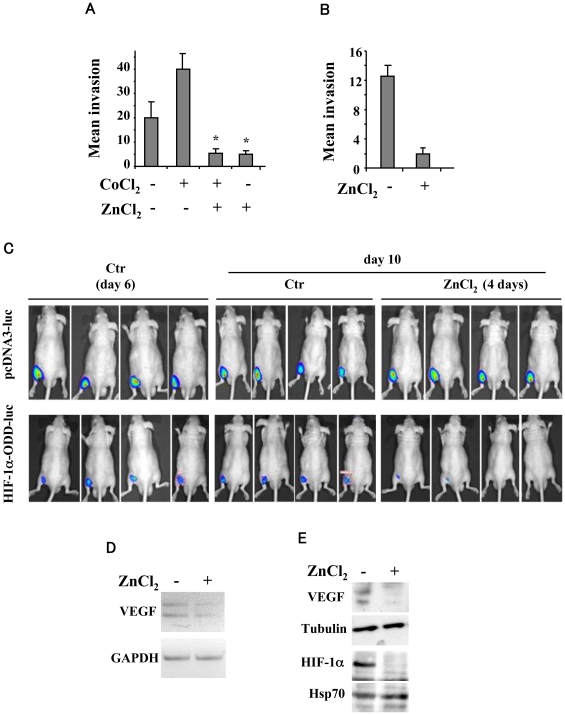
METHODOLOGY/PRINCIPAL FINDINGS: Here we report that zinc downregulated HIF-1α protein levels in human prostate cancer and glioblastoma cells under hypoxia, whether induced or constitutive. Investigations into the molecular mechanisms showed that zinc induced HIF-1α proteasomal degradation that was prevented by treatment with proteasomal inhibitor MG132. HIF-1α downregulation induced by zinc was ineffective in human RCC4 VHL-null renal carcinoma cell line; likewise, the HIF-1αP402/P564A mutant was resistant to zinc treatment. Similarly to HIF-1α, zinc downregulated also hypoxia-induced HIF-2α whereas the HIF-1β subunit remained unchanged. Zinc inhibited HIF-1α recruitment onto VEGF promoter and the zinc-induced suppression of HIF-1-dependent activation of VEGF correlated with reduction of glioblastoma and prostate cancer cell invasiveness in vitro. Finally, zinc administration downregulated HIF-1α levels in vivo, by bioluminescence imaging, and suppressed intratumoral VEGF expression.
CONCLUSIONS/SIGNIFICANCE: These findings, by demonstrating that zinc induces HIF-1α proteasomal degradation, indicate that zinc could be useful as an inhibitor of HIF-1α in human tumors to repress important pathways involved in tumor progression, such as those induced by VEGF, MDR1, and Bcl2 target genes, and hopefully potentiate the anticancer therapies.
缺氧诱导因子-1α(HIF-1α)负责大多数缺氧诱导的基因表达变化,并在肿瘤进展过程中引发“血管生成开关”。HIF-1α在肿瘤中常被上调,导致肿瘤生长更具侵袭性和化疗耐药性,因此成为抗肿瘤干预的重要靶点。我们之前报道过锌下调 HIF-1α 水平。在这里,我们评估了锌诱导 HIF-1α 下调的分子机制,以及锌是否也能在体内影响 HIF-1α。
方法/主要发现:在这里,我们报告锌在缺氧条件下下调人前列腺癌和神经胶质瘤细胞中的 HIF-1α 蛋白水平,无论是诱导还是组成性的。对分子机制的研究表明,锌诱导 HIF-1α 蛋白酶体降解,而蛋白酶体抑制剂 MG132 可阻止这一过程。锌诱导的 HIF-1α 下调在人 RCC4 VHL 缺失的肾癌细胞系中无效;同样,HIF-1αP402/P564A 突变体对锌处理有抗性。与 HIF-1α 相似,锌也下调缺氧诱导的 HIF-2α,而 HIF-1β 亚基保持不变。锌抑制 HIF-1α 募集到 VEGF 启动子上,锌诱导的 HIF-1 依赖性 VEGF 激活抑制与体外降低神经胶质瘤和前列腺癌细胞侵袭性相关。最后,通过生物发光成像,锌给药体内下调 HIF-1α 水平,并抑制肿瘤内 VEGF 表达。
结论/意义:这些发现表明,锌通过诱导 HIF-1α 蛋白酶体降解,表明锌可作为人肿瘤中 HIF-1α 的抑制剂,抑制肿瘤进展相关的重要途径,如 VEGF、MDR1 和 Bcl2 靶基因诱导的途径,并有望增强抗癌治疗效果。