Picard Emilie, Jonet Laurent, Sergeant Claire, Vesvres Marie-Hélène, Behar-Cohen Francine, Courtois Yves, Jeanny Jean-Claude
Inserm, Paris, France.
Mol Vis. 2010 Dec 8;16:2612-25.
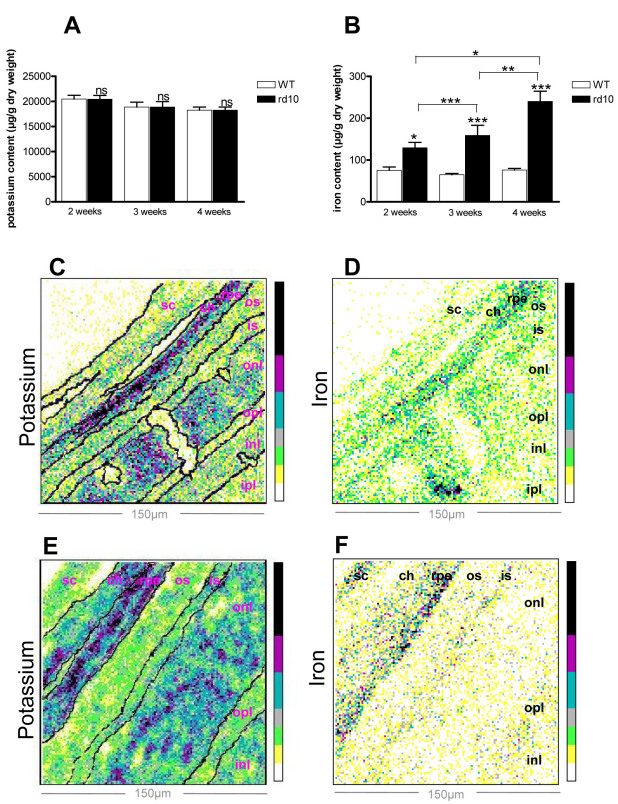
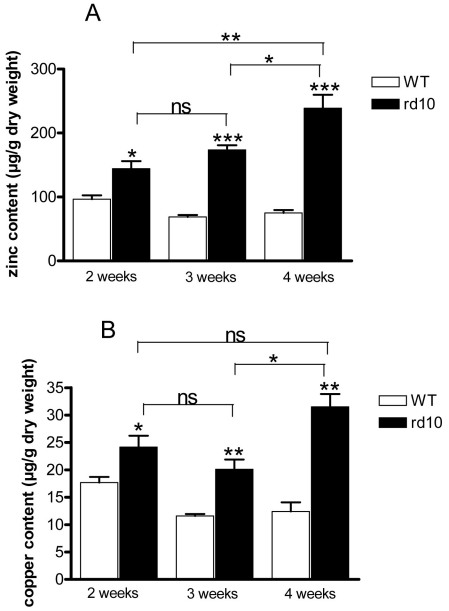
Retinal degeneration has been associated with iron accumulation in age-related macular degeneration (AMD), and in several rodent models that had one or several iron regulating protein impairments. We investigated the iron concentration and the protective role of human transferrin (hTf) in rd10 mice, a model of retinal degeneration.
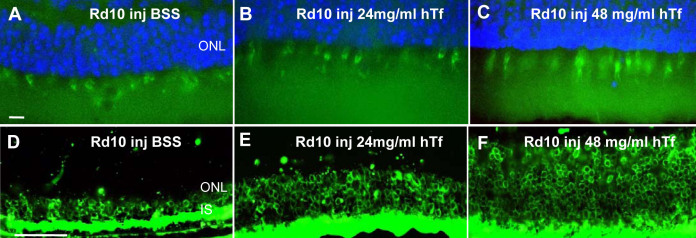
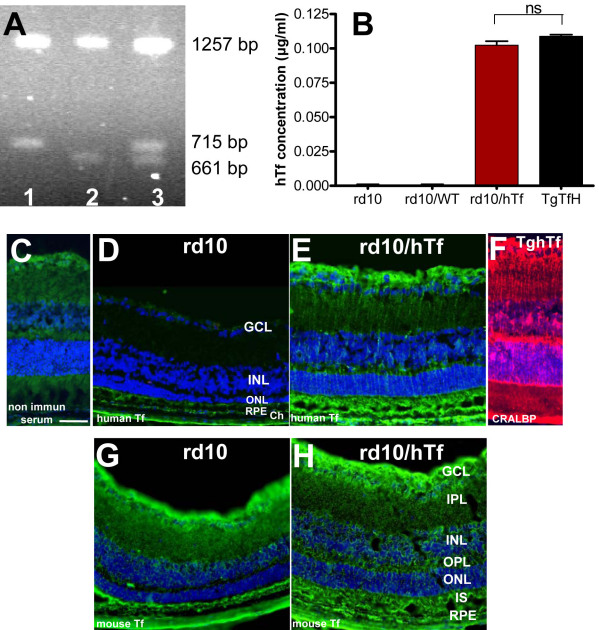
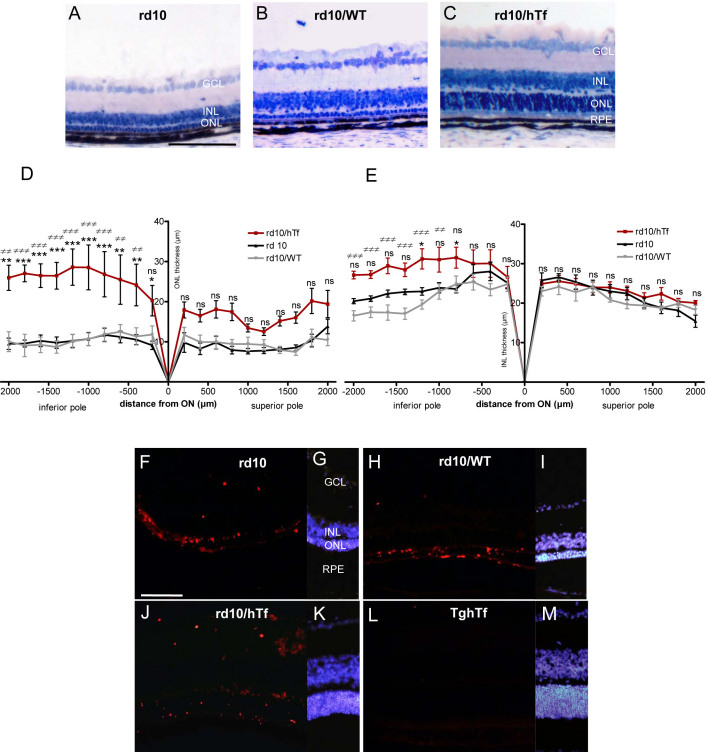
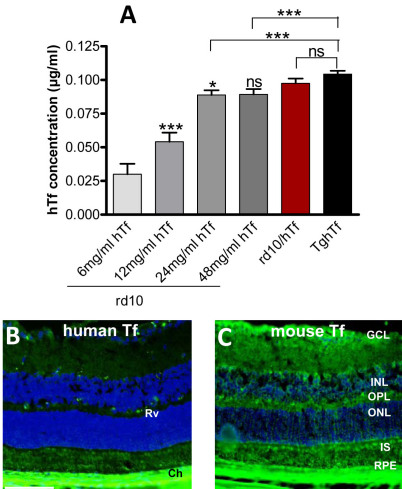
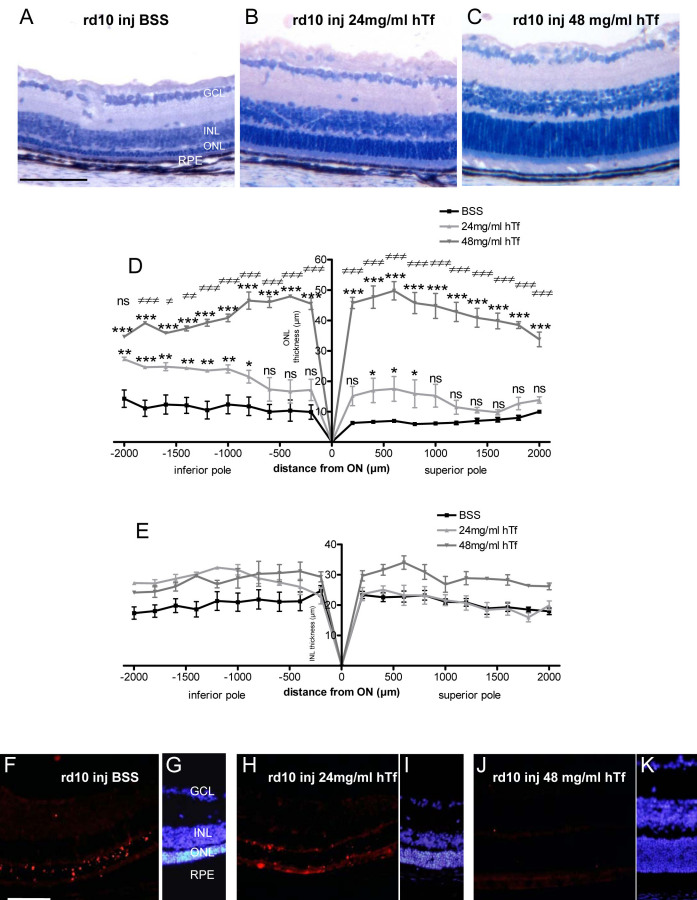
The proton-induced X-ray emission (PIXE) method was used to quantify iron in rd10 mice 2, 3, and 4 weeks after birth. We generated mice with the β-phosphodiesterase mutation and hTf expression by crossbreeding rd10 mice with TghTf mice (rd10/hTf mice). The photoreceptor loss and apoptosis were evaluated by terminal deoxynucleotidyl transferase dUTP nick end labeling in 3-week-old rd10/hTf mice and compared with 3-week-old rd10 mice. The neuroprotective effect of hTf was analyzed in 5-day-old rd10 mice treated by intraperitoneal administration with hTf for up to 25 days. The retinal hTf concentrations and the thickness of the outer nuclear layer were quantified in all treated mice at 25 days postnatally.
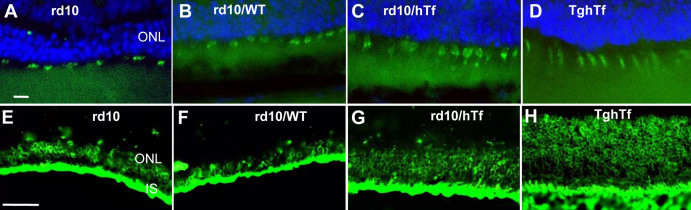
PIXE analysis demonstrated an age-dependent iron accumulation in the photoreceptors of rd10 mice. The rd10/hTf mice had the rd10 mutation, expressed high levels of hTf, and showed a significant decrease in photoreceptor death. In addition, rd10 mice intraperitoneally treated with hTf resulted in the retinal presence of hTf and a dose-dependent reduction in photoreceptor degeneration.
Our results suggest that iron accumulation in the retinas of rd10 mutant mice is associated with photoreceptor degeneration. For the first time, the enhanced survival of cones and rods in the retina of this model has been demonstrated through overexpression or systemic administration of hTf. This study highlights the therapeutic potential of Tf to inhibit iron-induced photoreceptor cell death observed in degenerative diseases such as retinitis pigmentosa and age-related macular degeneration.
视网膜变性与年龄相关性黄斑变性(AMD)以及几种存在一种或多种铁调节蛋白缺陷的啮齿动物模型中的铁蓄积有关。我们研究了人转铁蛋白(hTf)在视网膜变性模型rd10小鼠中的铁浓度及保护作用。
采用质子诱导X射线发射(PIXE)法对出生后2周、3周和4周的rd10小鼠体内的铁进行定量。通过将rd10小鼠与TghTf小鼠杂交(rd10/hTf小鼠),培育出具有β - 磷酸二酯酶突变且表达hTf的小鼠。通过末端脱氧核苷酸转移酶dUTP缺口末端标记法评估3周龄rd10/hTf小鼠的光感受器丢失和凋亡情况,并与3周龄rd10小鼠进行比较。对5日龄的rd10小鼠腹腔注射hTf持续25天,分析hTf的神经保护作用。在出生后25天对所有处理过的小鼠定量视网膜hTf浓度和外核层厚度。
PIXE分析表明rd10小鼠的光感受器中铁蓄积呈年龄依赖性。rd10/hTf小鼠具有rd10突变,表达高水平的hTf,且光感受器死亡显著减少。此外,腹腔注射hTf的rd10小鼠视网膜中出现hTf,且光感受器变性呈剂量依赖性降低。
我们的结果表明rd10突变小鼠视网膜中的铁蓄积与光感受器变性有关。首次通过hTf的过表达或全身给药证明了该模型视网膜中视锥细胞和视杆细胞的存活率提高。本研究突出了转铁蛋白在抑制视网膜色素变性和年龄相关性黄斑变性等退行性疾病中观察到的铁诱导光感受器细胞死亡方面的治疗潜力。