Department of Molecular Sciences, University of Tennessee Health Science Center, Memphis, Tennessee, United States of America.
PLoS One. 2010 Dec 13;5(12):e14313. doi: 10.1371/journal.pone.0014313.
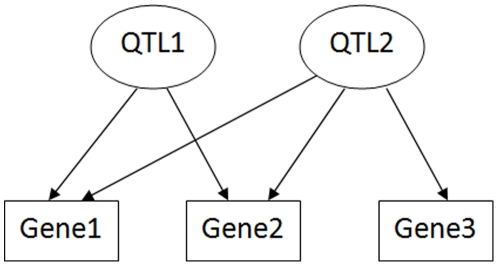
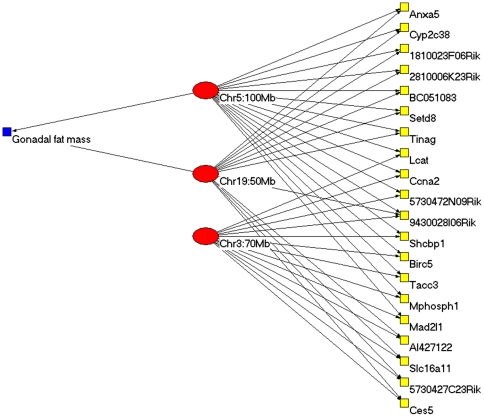
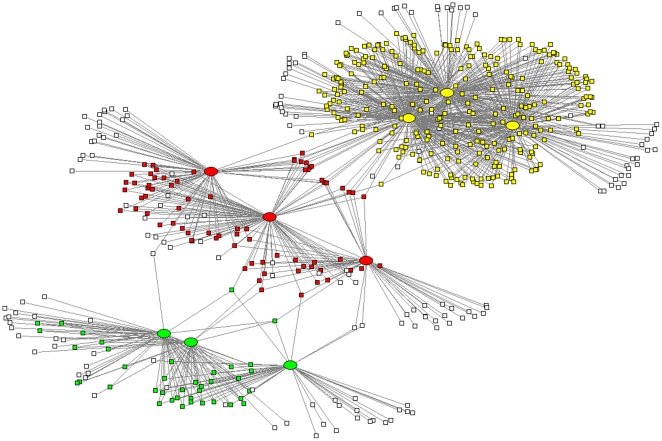
Systems genetics studies often involve the mapping of numerous regulatory relations between genetic loci and expression traits. These regulatory relations form a bipartite network consisting of genetic loci and expression phenotypes. Modular network organizations may arise from the pleiotropic and polygenic regulation of gene expression. Here we analyzed the expression QTL (eQTL) networks derived from expression genetic data of yeast and mouse liver and found 65 and 98 modules respectively. Computer simulation result showed that such modules rarely occurred in randomized networks with the same number of nodes and edges and same degree distribution. We also found significant within-module functional coherence. The analysis of genetic overlaps and the evidences from biomedical literature have linked some eQTL modules to physiological phenotypes. Functional coherence within the eQTL modules and genetic overlaps between the modules and physiological phenotypes suggests that eQTL modules may act as functional units underlying the higher-order phenotypes.
系统遗传学研究通常涉及到大量遗传基因座与表达性状之间的调控关系的映射。这些调控关系形成了一个由遗传基因座和表达表型组成的二分网络。基因表达的多效性和多基因调控可能导致模块化的网络组织。在这里,我们分析了来自酵母和小鼠肝脏表达遗传数据的表达 QTL(eQTL)网络,分别发现了 65 个和 98 个模块。计算机模拟结果表明,在具有相同节点和边数以及相同度分布的随机网络中,这种模块很少出现。我们还发现了模块内显著的功能一致性。遗传重叠的分析和来自生物医学文献的证据将一些 eQTL 模块与生理表型联系起来。eQTL 模块内的功能一致性以及模块与生理表型之间的遗传重叠表明,eQTL 模块可能作为高阶表型的功能单元发挥作用。