Ponsuksili Siriluck, Siengdee Puntita, Du Yang, Trakooljul Nares, Murani Eduard, Schwerin Manfred, Wimmers Klaus
Institute for 'Genome Biology', Leibniz Institute for Farm Animal Biology (FBN), Wilhelm-Stahl-Allee 2, D-18196 Dummerstorf, Germany.
PLoS One. 2015 Apr 14;10(4):e0123678. doi: 10.1371/journal.pone.0123678. eCollection 2015.
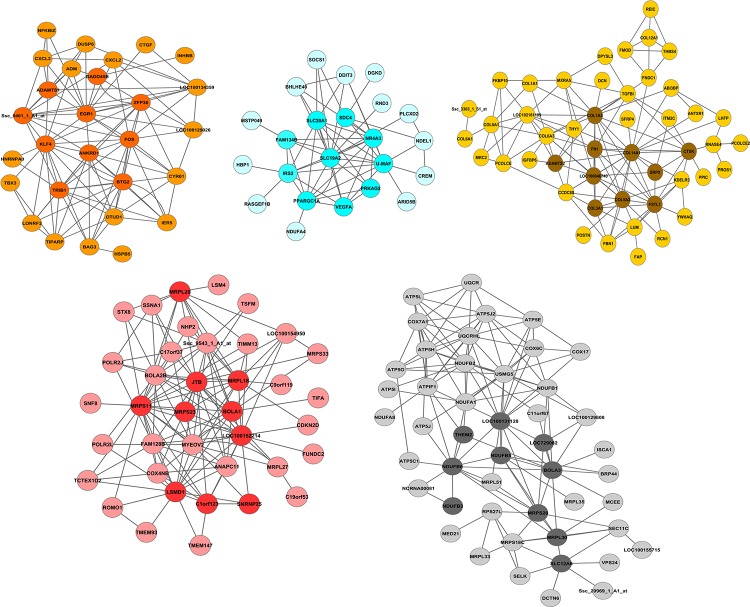
Understanding the genetic contributions behind skeletal muscle composition and metabolism is of great interest in medicine and agriculture. Attempts to dissect these complex traits combine genome-wide genotyping, expression data analyses and network analyses. Weighted gene co-expression network analysis (WGCNA) groups genes into modules based on patterns of co-expression, which can be linked to phenotypes by correlation analysis of trait values and the module eigengenes, i.e. the first principal component of a given module. Network hub genes and regulators of the genes in the modules are likely to play an important role in the emergence of respective traits. In order to detect common regulators of genes in modules showing association with meat quality traits, we identified eQTL for each of these genes, including the highly connected hub genes. Additionally, the module eigengene values were used for association analyses in order to derive a joint eQTL for the respective module. Thereby major sites of orchestrated regulation of genes within trait-associated modules were detected as hotspots of eQTL of many genes of a module and of its eigengene. These sites harbor likely common regulators of genes in the modules. We exemplarily showed the consistent impact of candidate common regulators on the expression of members of respective modules by RNAi knockdown experiments. In fact, Cxcr7 was identified and validated as a regulator of genes in a module, which is involved in the function of defense response in muscle cells. Zfp36l2 was confirmed as a regulator of genes of a module related to cell death or apoptosis pathways. The integration of eQTL in module networks enabled to interpret the differentially-regulated genes from a systems perspective. By integrating genome-wide genomic and transcriptomic data, employing co-expression and eQTL analyses, the study revealed likely regulators that are involved in the fine-tuning and synchronization of genes with trait-associated expression.
了解骨骼肌组成和代谢背后的遗传贡献在医学和农业领域备受关注。剖析这些复杂性状的尝试结合了全基因组基因分型、表达数据分析和网络分析。加权基因共表达网络分析(WGCNA)根据共表达模式将基因分组为模块,通过性状值与模块特征基因(即给定模块的第一主成分)的相关性分析,可将这些模块与表型联系起来。模块中的网络枢纽基因和基因调节因子可能在各自性状的出现中发挥重要作用。为了检测与肉质性状相关的模块中基因的共同调节因子,我们鉴定了这些基因(包括高度连接的枢纽基因)中的每个基因的表达数量性状基因座(eQTL)。此外,模块特征基因值用于关联分析,以得出各个模块的联合eQTL。由此,性状相关模块内基因协调调控的主要位点被检测为模块中许多基因及其特征基因的eQTL热点。这些位点可能包含模块中基因的共同调节因子。我们通过RNA干扰敲低实验示例性地展示了候选共同调节因子对各个模块成员表达的一致影响。事实上,Cxcr7被鉴定并验证为一个模块中基因的调节因子,该模块参与肌肉细胞中的防御反应功能。Zfp36l2被确认为与细胞死亡或凋亡途径相关模块中基因的调节因子。在模块网络中整合eQTL能够从系统角度解释差异调节的基因。通过整合全基因组范围的基因组和转录组数据,采用共表达和eQTL分析,该研究揭示了可能参与与性状相关表达的基因精细调节和同步的调节因子。