Virginia Bioinformatics Institute, Virginia Polytechnic Institute and State University, Blacksburg, Virginia, United States of America.
PLoS One. 2010 Dec 14;5(12):e15288. doi: 10.1371/journal.pone.0015288.
Resveratrol, a naturally occurring phytopolyphenol compound, has attracted extensive interest in recent years because of its diverse pharmacological characteristics. Although resveratrol possesses chemopreventive properties against several cancers, the molecular mechanisms by which it inhibits cell growth and induces apoptosis have not been clearly understood. The present study was carried out to examine whether PI3K/AKT/FOXO pathway mediates the biological effects of resveratrol.
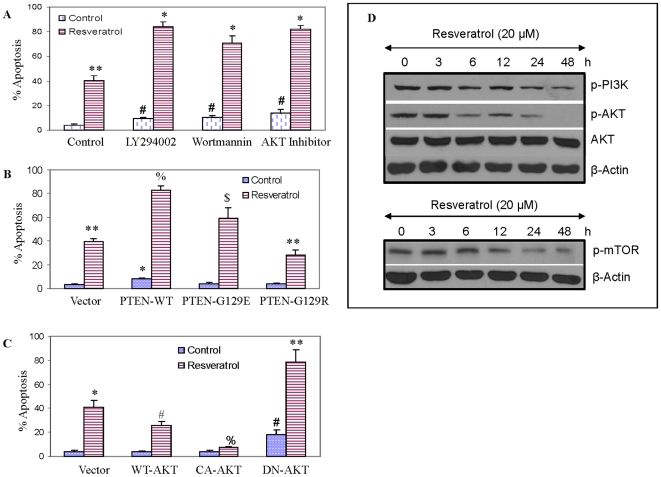
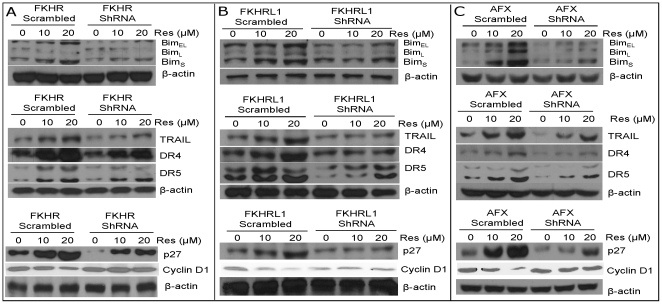
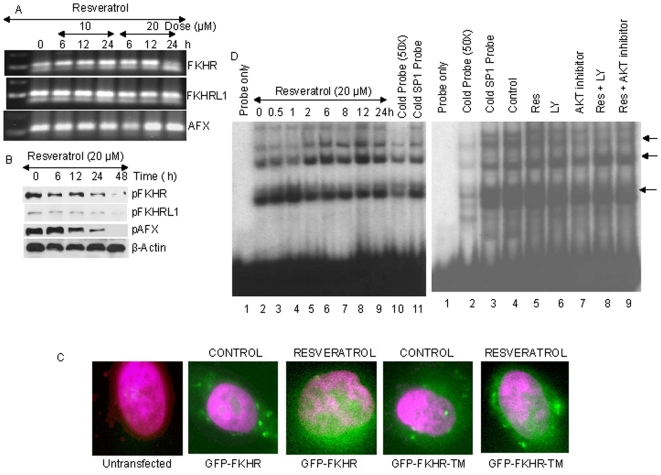
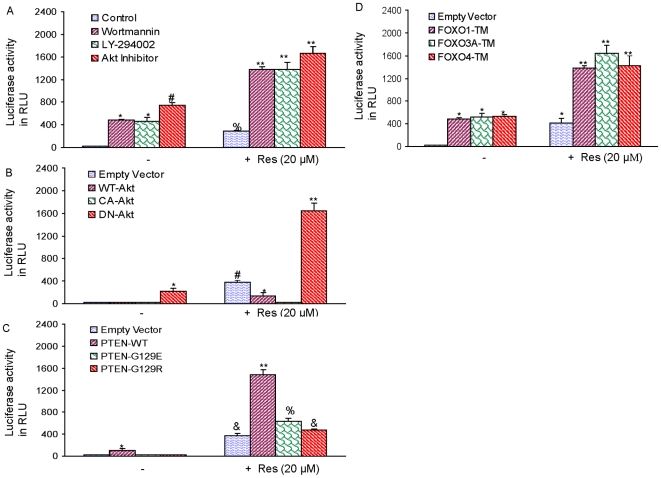
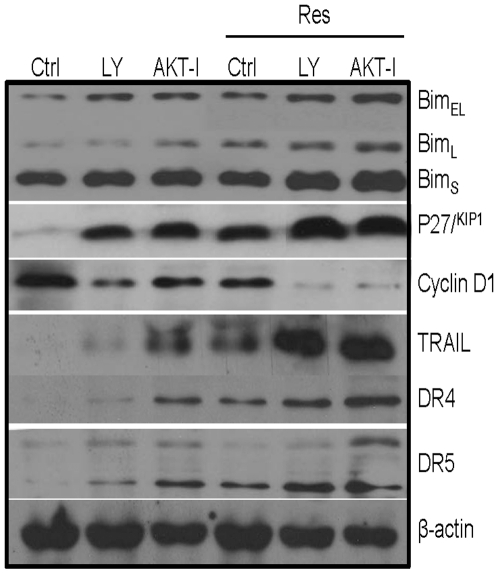
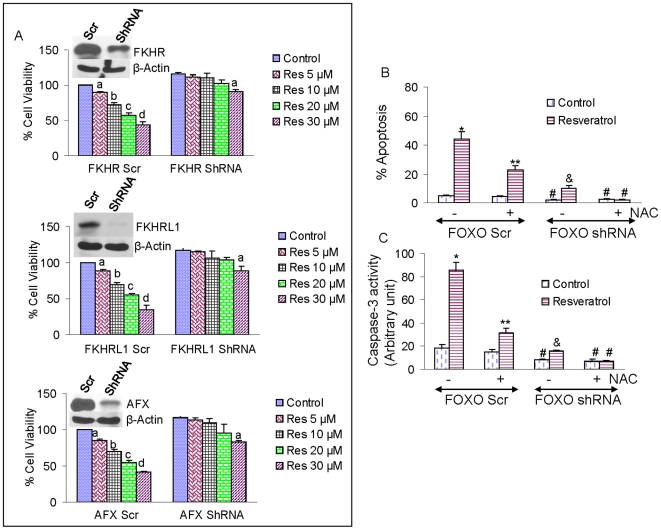
METHODOLOGY/PRINCIPAL FINDINGS: Resveratrol inhibited the phosphorylation of PI3K, AKT and mTOR. Resveratrol, PI3K inhibitors (LY294002 and Wortmannin) and AKT inhibitor alone slightly induced apoptosis in LNCaP cells. These inhibitors further enhanced the apoptosis-inducing potential of resveratrol. Overexpression of wild-type PTEN slightly induced apoptosis. Wild type PTEN and PTEN-G129E enhanced resveratrol-induced apoptosis, whereas PTEN-G129R had no effect on proapoptotic effects of resveratrol. Furthermore, apoptosis-inducing potential of resveratrol was enhanced by dominant negative AKT, and inhibited by wild-type AKT and constitutively active AKT. Resveratrol has no effect on the expression of FKHR, FKHRL1 and AFX genes. The inhibition of FOXO phosphorylation by resveratrol resulted in its nuclear translocation, DNA binding and transcriptional activity. The inhibition of PI3K/AKT pathway induced FOXO transcriptional activity resulting in induction of Bim, TRAIL, p27/KIP1, DR4 and DR5, and inhibition of cyclin D1. Similarly, resveratrol-induced FOXO transcriptional activity was further enhanced when activation of PI3K/AKT pathway was blocked. Over-expression of phosphorylation deficient mutants of FOXO proteins (FOXO1-TM, FOXO3A-TM and FOXO4-TM) induced FOXO transcriptional activity, which was further enhanced by resveratrol. Inhibition of FOXO transcription factors by shRNA blocked resveratrol-induced upregulation of Bim, TRAIL, DR4, DR5, p27/KIP1 and apoptosis, and inhibition of cyclin D1 by resveratrol.
CONCLUSION/SIGNIFICANCE: These data suggest that FOXO transcription factors mediate anti-proliferative and pro-apoptotic effects of resveratrol, in part due to activation of extrinsic apoptosis pathway.
白藜芦醇是一种天然存在的植物多酚化合物,由于其多种药理学特性,近年来引起了广泛关注。尽管白藜芦醇具有预防多种癌症的化学预防特性,但抑制细胞生长和诱导细胞凋亡的分子机制尚不清楚。本研究旨在探讨 PI3K/AKT/FOXO 通路是否介导白藜芦醇的生物学效应。
方法/主要发现:白藜芦醇抑制 PI3K、AKT 和 mTOR 的磷酸化。白藜芦醇、PI3K 抑制剂(LY294002 和 Wortmannin)和 AKT 抑制剂单独作用于 LNCaP 细胞时,可轻微诱导细胞凋亡。这些抑制剂进一步增强了白藜芦醇诱导细胞凋亡的潜力。野生型 PTEN 轻度诱导细胞凋亡。野生型 PTEN 和 PTEN-G129E 增强白藜芦醇诱导的细胞凋亡,而 PTEN-G129R 对白藜芦醇的促凋亡作用没有影响。此外,显性失活 AKT 增强了白藜芦醇诱导细胞凋亡的潜力,而野生型 AKT 和组成型激活 AKT 则抑制了白藜芦醇的促凋亡作用。白藜芦醇对 FKHR、FKHRL1 和 AFX 基因的表达没有影响。白藜芦醇抑制 FOXO 磷酸化导致其核转位、DNA 结合和转录活性。PI3K/AKT 通路的抑制诱导 FOXO 转录活性,导致 Bim、TRAIL、p27/KIP1、DR4 和 DR5 的诱导和 cyclin D1 的抑制。同样,当阻断 PI3K/AKT 通路的激活时,白藜芦醇诱导的 FOXO 转录活性进一步增强。磷酸化缺陷型 FOXO 蛋白(FOXO1-TM、FOXO3A-TM 和 FOXO4-TM)的过表达诱导 FOXO 转录活性,白藜芦醇进一步增强了该活性。用 shRNA 抑制 FOXO 转录因子阻断了白藜芦醇诱导的 Bim、TRAIL、DR4、DR5、p27/KIP1 的上调和细胞凋亡,并抑制了白藜芦醇诱导的 cyclin D1。
结论/意义:这些数据表明,FOXO 转录因子介导白藜芦醇的抗增殖和促凋亡作用,部分原因是通过激活外源性凋亡途径。