Université Paris-Sud, Laboratoire Ecologie, Systématique et Evolution, UMR 8079, Orsay, France.
PLoS Pathog. 2010 Dec 16;6(12):e1001229. doi: 10.1371/journal.ppat.1001229.
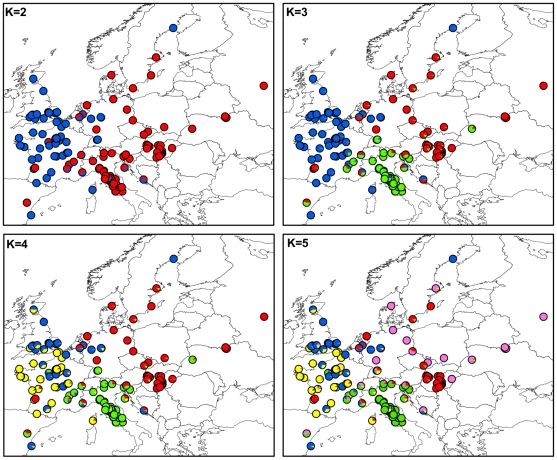
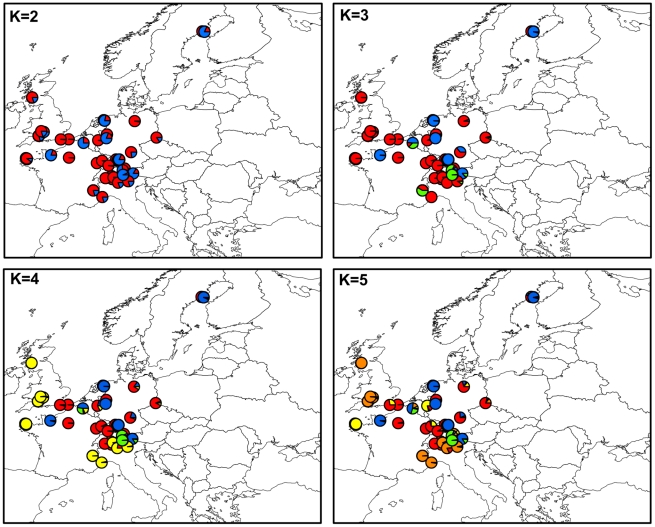
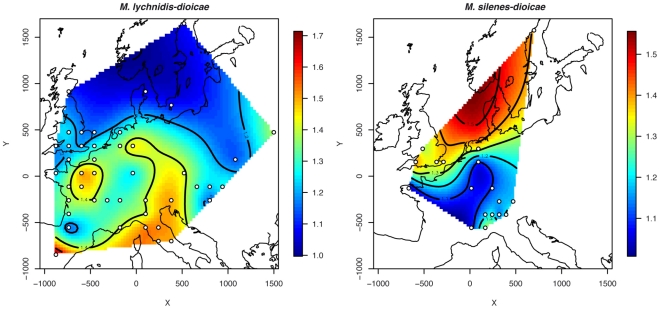
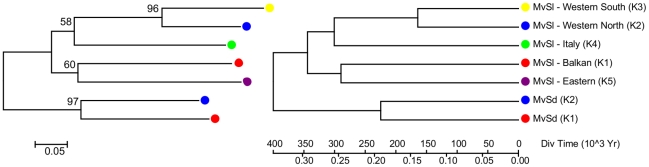
Climate warming is predicted to increase the frequency of invasions by pathogens and to cause the large-scale redistribution of native host species, with dramatic consequences on the health of domesticated and wild populations of plants and animals. The study of historic range shifts in response to climate change, such as during interglacial cycles, can help in the prediction of the routes and dynamics of infectious diseases during the impending ecosystem changes. Here we studied the population structure in Europe of two Microbotryum species causing anther smut disease on the plants Silene latifolia and Silene dioica. Clustering analyses revealed the existence of genetically distinct groups for the pathogen on S. latifolia, providing a clear-cut example of European phylogeography reflecting recolonization from southern refugia after glaciation. The pathogen genetic structure was congruent with the genetic structure of its host species S. latifolia, suggesting dependence of the migration pathway of the anther smut fungus on its host. The fungus, however, appeared to have persisted in more numerous and smaller refugia than its host and to have experienced fewer events of large-scale dispersal. The anther smut pathogen on S. dioica also showed a strong phylogeographic structure that might be related to more northern glacial refugia. Differences in host ecology probably played a role in these differences in the pathogen population structure. Very high selfing rates were inferred in both fungal species, explaining the low levels of admixture between the genetic clusters. The systems studied here indicate that migration patterns caused by climate change can be expected to include pathogen invasions that follow the redistribution of their host species at continental scales, but also that the recolonization by pathogens is not simply a mirror of their hosts, even for obligate biotrophs, and that the ecology of hosts and pathogen mating systems likely affects recolonization patterns.
气候变化预计会增加病原体的入侵频率,并导致本地宿主物种的大规模重新分布,这对家养和野生植物和动物种群的健康将产生巨大影响。对历史上因气候变化而发生的范围转移的研究,例如在间冰期循环期间,可以帮助预测在即将发生的生态系统变化期间传染病的传播途径和动态。在这里,我们研究了引起 Silene latifolia 和 Silene dioica 植物花药黑粉病的两种 Microbotryum 物种在欧洲的种群结构。聚类分析显示,病原体在 S. latifolia 上存在遗传上不同的群体,为反映冰河时代后从南部避难所重新殖民的欧洲系统地理学提供了一个明确的例子。病原体的遗传结构与宿主物种 S. latifolia 的遗传结构一致,这表明花药黑粉菌的迁移途径依赖于其宿主。然而,该真菌似乎比其宿主存在更多数量更小的避难所,并经历了较少的大规模扩散事件。S. dioica 上的花药黑粉菌病原体也表现出强烈的系统地理学结构,这可能与更北的冰河时代避难所有关。宿主生态学的差异可能在病原体种群结构的这些差异中起作用。在两种真菌物种中都推断出非常高的自交率,这解释了遗传群之间混合程度低的原因。所研究的系统表明,气候变化引起的迁移模式预计将包括病原体入侵,这些入侵将跟随其宿主物种在大陆范围内的重新分布,但病原体的重新殖民并不是其宿主的简单反映,即使对于专性生物寄生菌也是如此,并且宿主和病原体交配系统的生态学可能会影响重新殖民模式。