Specialist Centre for Spinal Surgery, Hospital Neustadt, Neustadt in Holstein, Germany.
J Pain Res. 2008 Nov 1;1:1-8. doi: 10.2147/jpr.s3996.
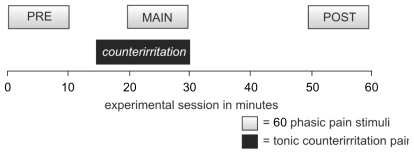
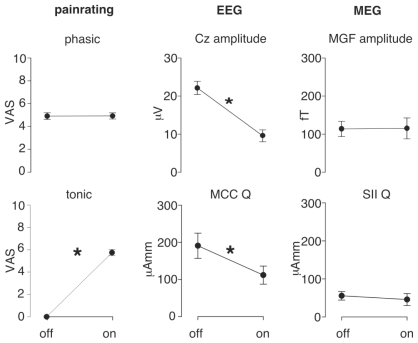
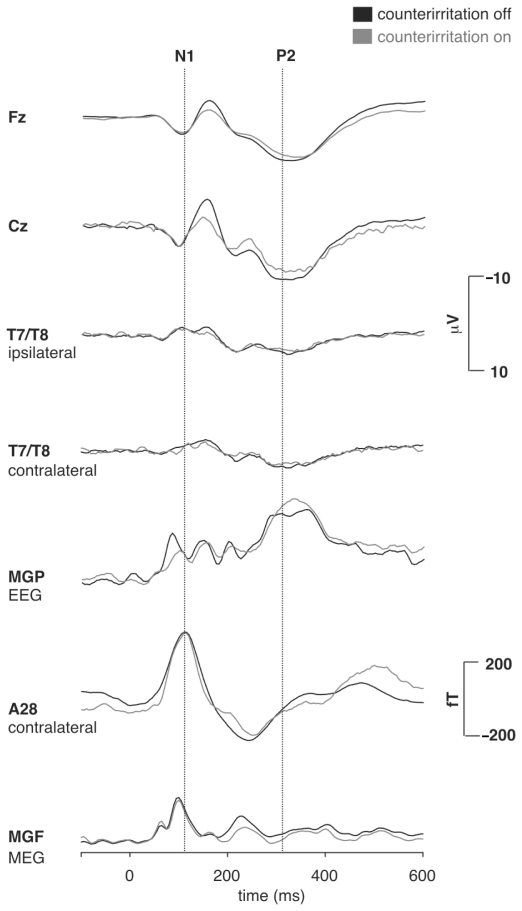
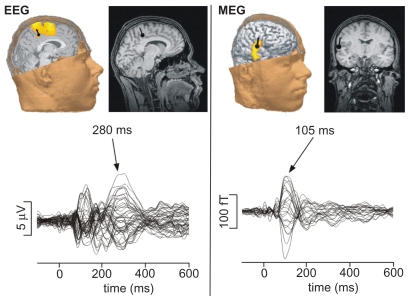
peripheral and central sensitization, which can result in neuroplastic changes. Previous psychophysical studies suggested a decrease of the so-called pain-inhibiting-pain effect (DNIC) in chronic pain patients. We aimed to study the DNIC effect on the neuronal level using magnetoencephalography and electroencephalography in 12 patients suffering from advanced unilateral knee osteoarthritis (OA). DNIC was induced in patients by provoking the typical OA pain by a slightly hyperextended joint position, while they received short electrical pain stimuli. Although the patients did not report a reduction of electrical pain perception, the cingulate gyrus showed a decrease of activation during provoked OA pain, while activity in the secondary somatosensory cortex did not change. Based on much stronger DNIC induction at comparable intensities of an acute counterirritant pain in healthy subjects this result suggests a deficit of DNIC in OA patients. We suggest that the strength of DNIC is subject to neuronal plasticity of descending inhibitory pain systems and diminishes during the development of a chronic pain condition.
外周和中枢敏化,这可能导致神经可塑性变化。先前的心理物理学研究表明,慢性疼痛患者的所谓疼痛抑制疼痛效应(DNIC)下降。我们旨在使用脑磁图和脑电图研究 12 名患有晚期单侧膝骨关节炎(OA)的患者的神经元水平上的 DNIC 效应。通过将关节稍微过度伸展来引发典型的 OA 疼痛,同时给予患者短暂的电刺激疼痛,从而在患者中引发 DNIC。尽管患者没有报告电刺激疼痛感知的减少,但扣带回在引发的 OA 疼痛期间显示出激活减少,而次级体感皮层的活动没有变化。基于在健康受试者中对类似强度的急性刺激性疼痛的更强 DNIC 诱导,这一结果表明 OA 患者的 DNIC 缺陷。我们认为,DNIC 的强度受下行抑制性疼痛系统的神经元可塑性的影响,并在慢性疼痛状态的发展过程中减弱。