Department of Pediatrics, University of Michigan Medical School, Ann Arbor, MI, USA.
Neurogastroenterol Motil. 2011 Apr;23(4):362-9. doi: 10.1111/j.1365-2982.2010.01656.x. Epub 2010 Dec 29.
Identification of neuronal progenitor/stem cells in the postnatal gut suggests the development of transplantation approaches to enteric nervous system (ENS) diseases. Many clinical applications would require engrafting large segments of postnatal gut in vivo. We investigated the ability of unselected gut cells vs selected enteric neural crest stem cells (eNCSCs) to engraft and differentiate in the postnatal gut in the Hirschsprung disease (HD, ednrb(sl/sl)) rat.
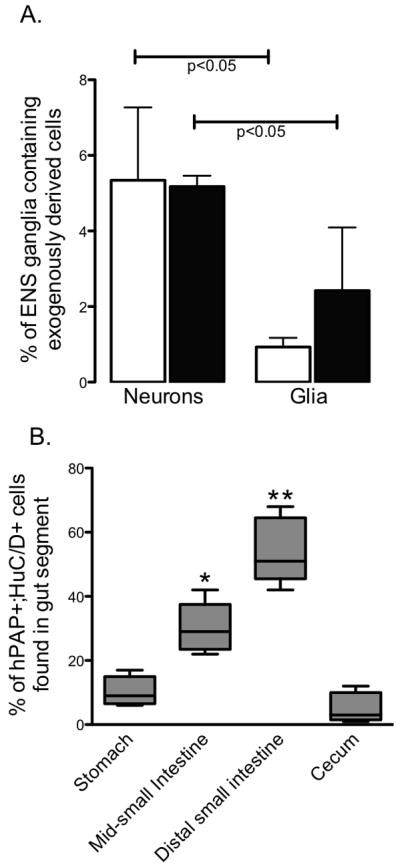
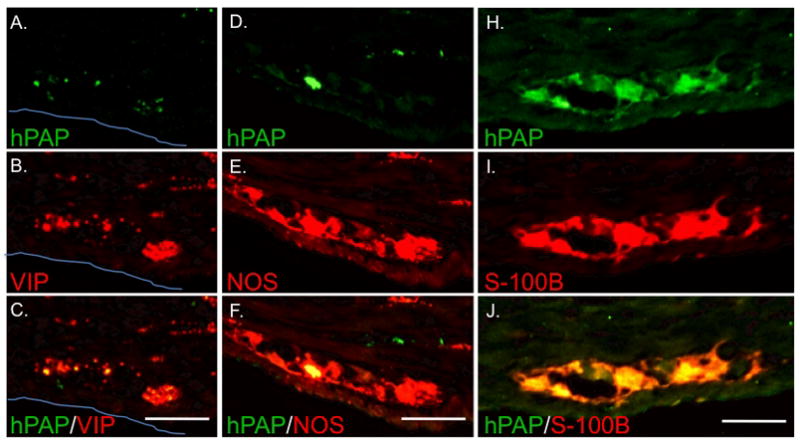
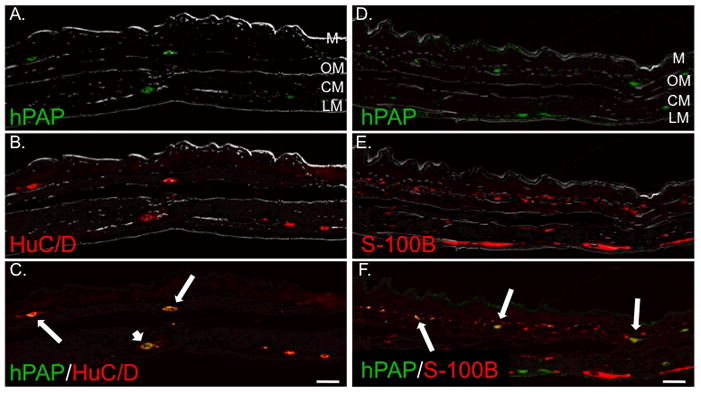
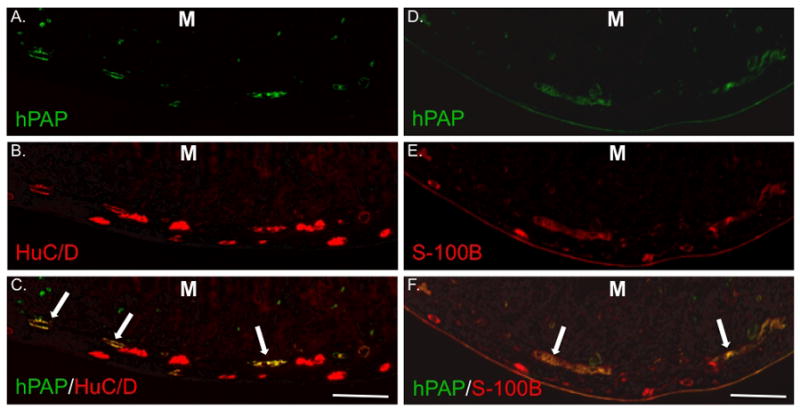
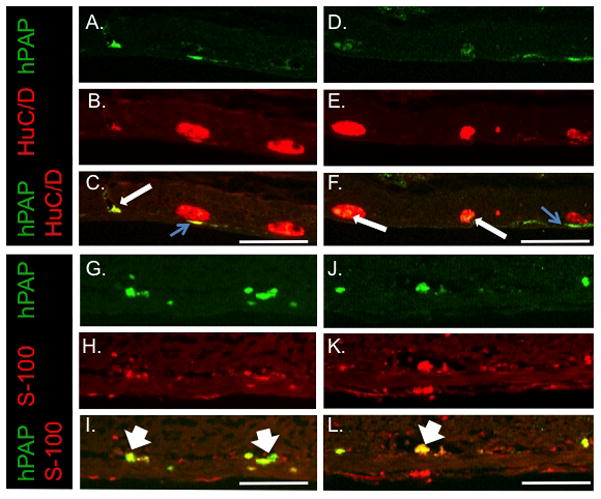
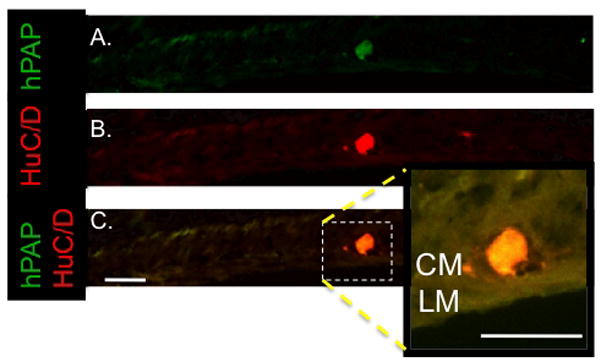
Total intestinal cells or eNCSCs (α(4) integrin(+), p75(++)) from embryonic day (E)14.5 rats carrying a marker transgene (human placental alkaline phosphatase, hPAP) were injected intraperitoneally (i.p.) into neonatal HD rats and their healthy littermates. The entire gut was systematically analyzed 3 weeks later for hPAP(+) cells between the serosal surface and the muscularis mucosae. Engrafted cells were examined for HuC/D, S-100B, neuropeptide Y (NPY), neuronal nitric oxide synthase (nNOS), and vasoactive intestinal peptide (VIP) expression.
No rats (0/33) injected with unselected cells had hPAP(+) cells in the ENS that expressed neuronal or glial markers. 5/11 healthy and 4/5 HD rats injected with eNCSCs showed widespread but low density engraftment in the ENS with cells expressing neuronal or glial markers. Neurons expressed nNOS and VIP. There was no engraftment in the colon of either HD or wildtype rats.
CONCLUSIONS & INFERENCES: Enteric neural crest stem cells will engraft diffusely throughout the postnatal gut of HD rats and differentiate into neurons and glia. Engraftment is not uniform, likely related to age-dependent changes in the gut mesenchyme. Intraperitoneal injection is easily performed in sick neonates and may be developed as a technique to supply exogenous ENS cells to the diseased postnatal gut.
在出生后的肠道中鉴定出神经元祖细胞/干细胞表明,开发移植方法治疗肠神经系统(ENS)疾病成为可能。许多临床应用需要在体内移植大量的出生后肠道。我们研究了未选择的肠道细胞与选择的肠神经嵴干细胞(eNCSCs)在先天性巨结肠病(HD,ednrb(sl/sl))大鼠的出生后肠道中的植入和分化能力。
来自携带标记基因(人胎盘碱性磷酸酶,hPAP)的胚胎第 14.5 天(E)大鼠的总肠细胞或 eNCSCs(α(4)整合素(+),p75(++))通过腹腔内(i.p.)注射到新生 HD 大鼠及其健康同窝仔鼠体内。3 周后,在脏层和黏膜肌层之间系统地分析整个肠道中 hPAP(+)细胞。植入细胞用 HuC/D、S-100B、神经肽 Y(NPY)、神经元型一氧化氮合酶(nNOS)和血管活性肠肽(VIP)表达进行检查。
未选择细胞注射的大鼠(0/33)没有在 ENS 中发现表达神经元或神经胶质标记物的 hPAP(+)细胞。注射 eNCSCs 的 5/11 只健康大鼠和 4/5 只 HD 大鼠显示 ENS 中有广泛但密度低的植入,植入细胞表达神经元或神经胶质标记物。神经元表达 nNOS 和 VIP。HD 或野生型大鼠的结肠均无植入。
肠神经嵴干细胞将在 HD 大鼠的出生后肠道中广泛植入并分化为神经元和神经胶质细胞。植入不是均匀的,可能与肠道间质的年龄依赖性变化有关。腹腔内注射在患病的新生儿中很容易进行,并且可以开发为将外源性 ENS 细胞供应给患病的出生后肠道的技术。