Laboratoire des Interactions Plantes Micro-organismes, UMR CNRS-INRA 2594/441, Castanet Tolosan, France.
PLoS One. 2010 Dec 22;5(12):e15773. doi: 10.1371/journal.pone.0015773.
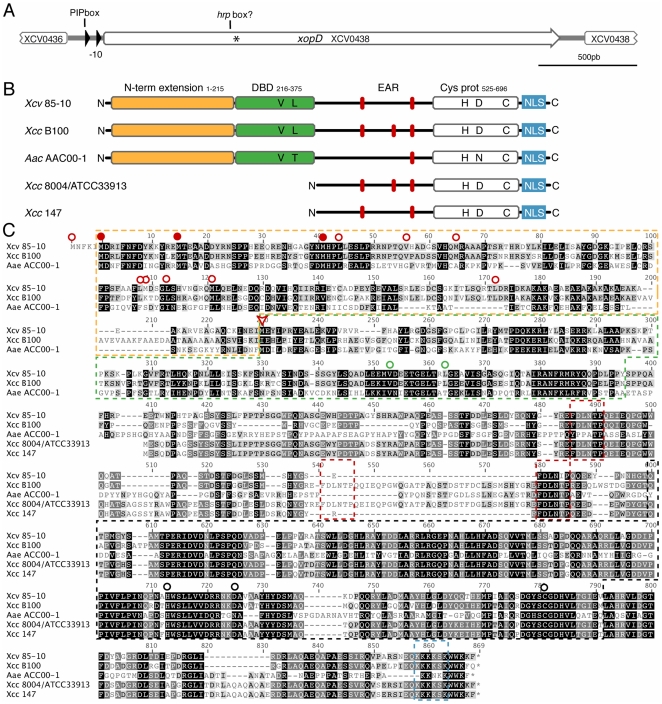
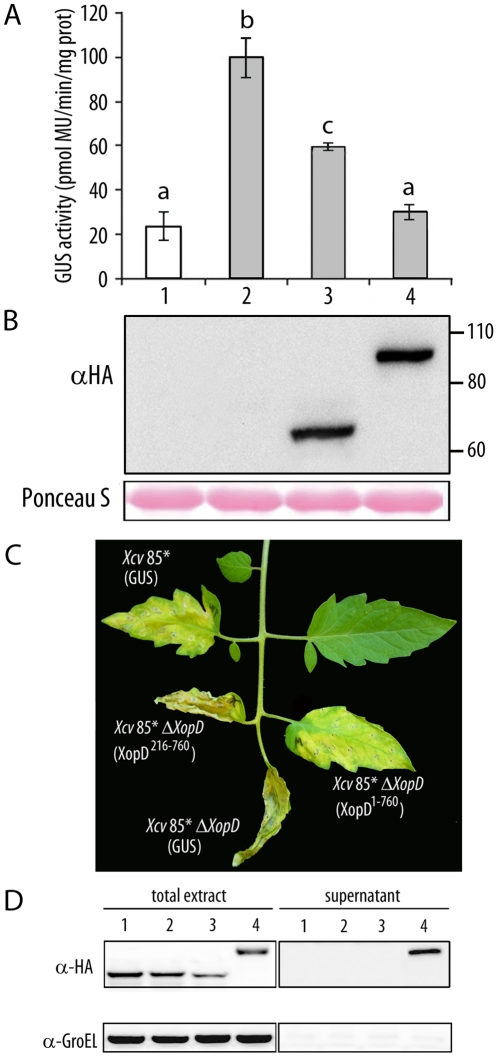
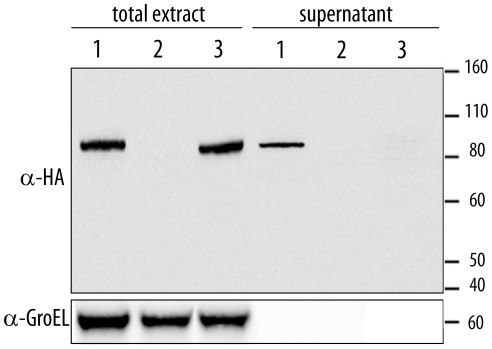
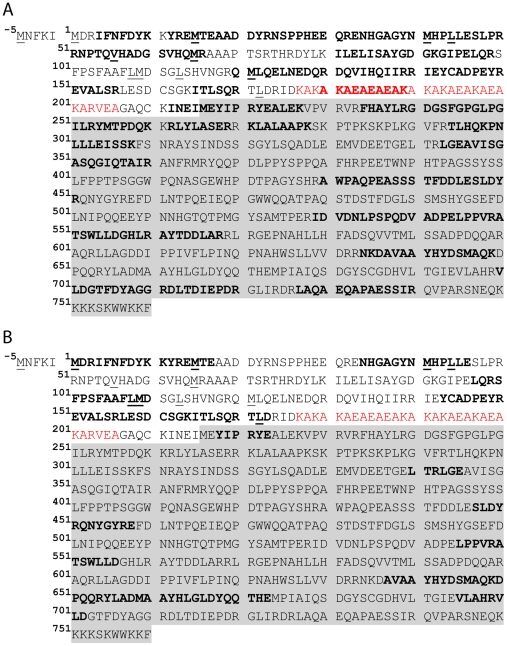
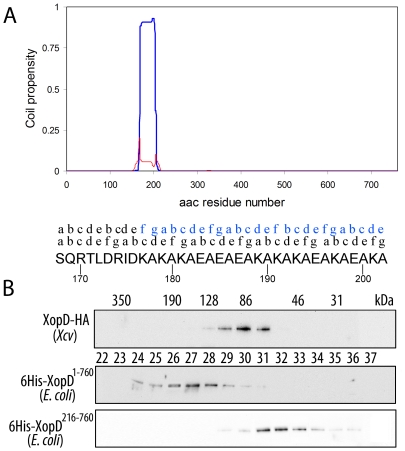
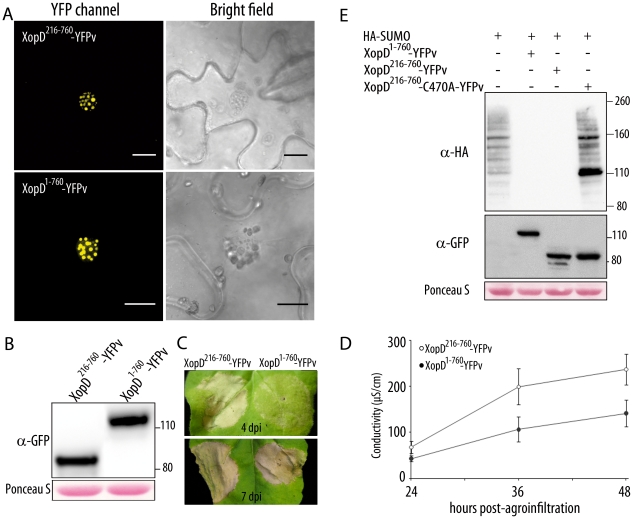
During evolution, pathogens have developed a variety of strategies to suppress plant-triggered immunity and promote successful infection. In Gram-negative phytopathogenic bacteria, the so-called type III protein secretion system works as a molecular syringe to inject type III effectors (T3Es) into plant cells. The XopD T3E from the strain 85-10 of Xanthomonas campestris pathovar vesicatoria (Xcv) delays the onset of symptom development and alters basal defence responses to promote pathogen growth in infected tomato leaves. XopD was previously described as a modular protein that contains (i) an N-terminal DNA-binding domain (DBD), (ii) two tandemly repeated EAR (ERF-associated amphiphillic repression) motifs involved in transcriptional repression, and (iii) a C-terminal cysteine protease domain, involved in release of SUMO (small ubiquitin-like modifier) from SUMO-modified proteins. Here, we show that the XopD protein that is produced and secreted by Xcv presents an additional N-terminal extension of 215 amino acids. Closer analysis of this newly identified N-terminal domain shows a low complexity region rich in lysine, alanine and glutamic acid residues (KAE-rich) with high propensity to form coiled-coil structures that confers to XopD the ability to form dimers when expressed in E. coli. The full length XopD protein identified in this study (XopD(1-760)) displays stronger repression of the XopD plant target promoter PR1, as compared to the XopD version annotated in the public databases (XopD(216-760)). Furthermore, the N-terminal extension of XopD, which is absent in XopD(216-760), is essential for XopD type III-dependent secretion and, therefore, for complementation of an Xcv mutant strain deleted from XopD in its ability to delay symptom development in tomato susceptible cultivars. The identification of the complete sequence of XopD opens new perspectives for future studies on the XopD protein and its virulence-associated functions in planta.
在进化过程中,病原体发展出了多种策略来抑制植物触发的免疫反应,并促进成功感染。在革兰氏阴性植物病原细菌中,所谓的 III 型蛋白分泌系统作为一种分子注射器,将 III 型效应物(T3E)注入植物细胞。来自野油菜黄单胞菌致病型维管束溃疡病菌(Xcv)85-10 菌株的 XopD T3E 延迟症状发展的开始,并改变基础防御反应,以促进感染番茄叶片中的病原体生长。XopD 以前被描述为一种模块化蛋白,包含 (i) 一个 N 端 DNA 结合域 (DBD),(ii) 两个串联重复的 EAR(ERF 相关的双嗜性抑制)基序,参与转录抑制,和 (iii) C 端半胱氨酸蛋白酶域,参与 SUMO(小泛素样修饰物)从 SUMO 修饰蛋白上的释放。在这里,我们表明,由 Xcv 产生和分泌的 XopD 蛋白呈现出 215 个氨基酸的额外 N 端延伸。对这个新鉴定的 N 端结构域的更详细分析表明,它富含赖氨酸、丙氨酸和谷氨酸残基的低复杂度区域(富含 KAE),具有形成卷曲螺旋结构的高倾向,这使 XopD 能够在大肠杆菌中表达时形成二聚体。本研究中鉴定的全长 XopD 蛋白(XopD(1-760))与公共数据库中注释的 XopD 版本(XopD(216-760))相比,对 XopD 植物靶启动子 PR1 的抑制作用更强。此外,XopD 的 N 端延伸在 XopD(216-760)中不存在,对于 XopD III 型依赖性分泌是必不可少的,因此对于补充从 Xcv 突变株中缺失 XopD 的能力是必不可少的,该突变株在番茄敏感品种中延迟症状发展的能力。XopD 的完整序列的鉴定为未来研究 XopD 蛋白及其在植物中的毒力相关功能开辟了新的前景。