INRA, Laboratoire des Interactions Plantes Micro-organismes (LIPM), UMR 441, Castanet-Tolosan, France.
mBio. 2013 Jun 4;4(3):e00538-12. doi: 10.1128/mBio.00538-12.
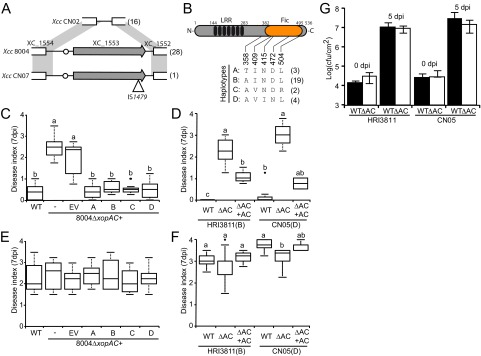
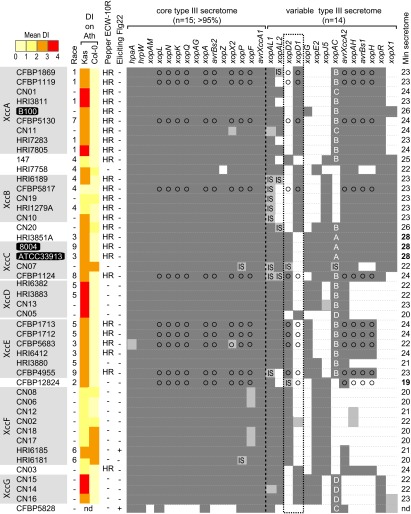
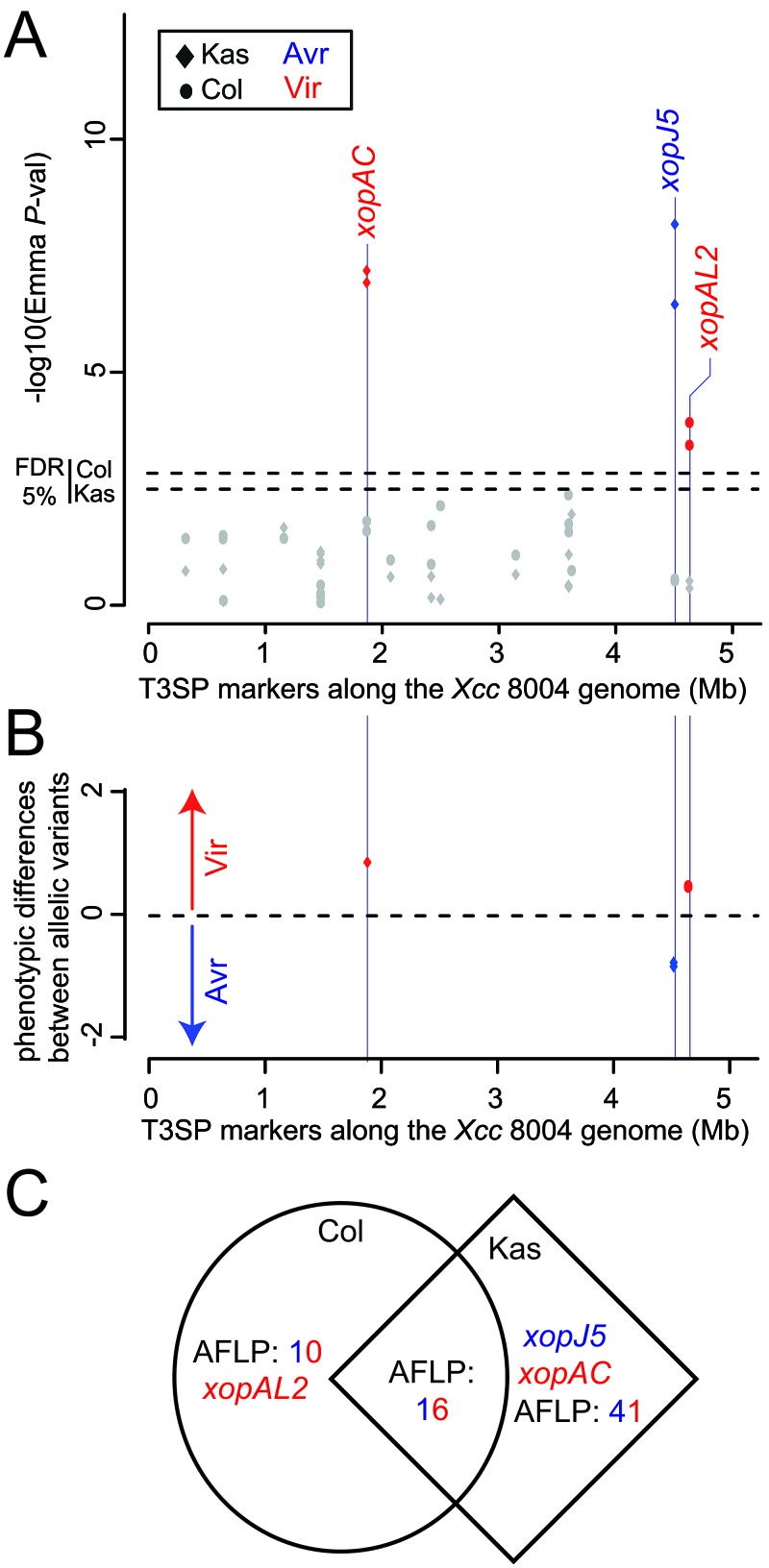
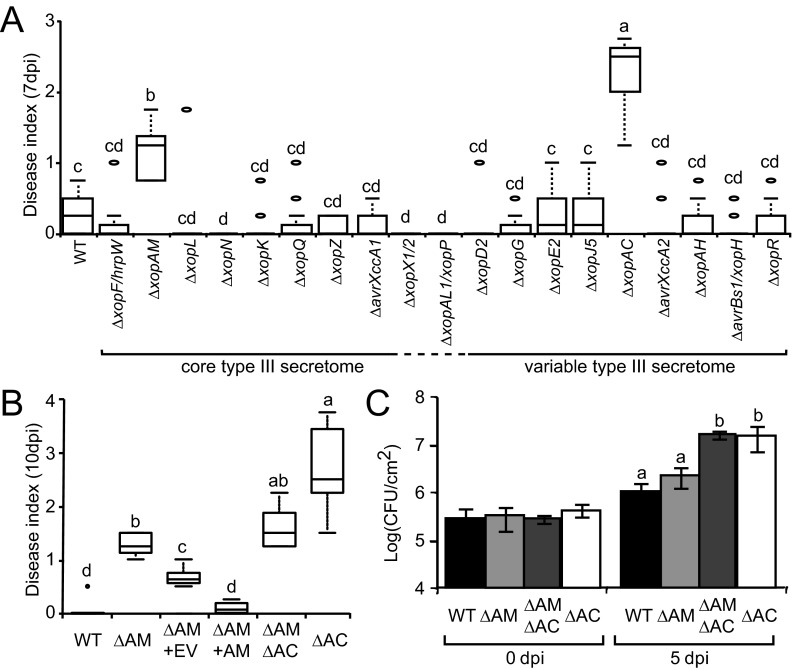
ABSTRACT The pathogenic bacterium Xanthomonas campestris pv. campestris, the causal agent of black rot of Brassicaceae, manipulates the physiology and the innate immunity of its hosts. Association genetic and reverse-genetic analyses of a world panel of 45 X. campestris pv. campestris strains were used to gain understanding of the genetic basis of the bacterium's pathogenicity to Arabidopsis thaliana. We found that the compositions of the minimal predicted type III secretome varied extensively, with 18 to 28 proteins per strain. There were clear differences in aggressiveness of those X. campestris pv. campestris strains on two Arabidopsis natural accessions. We identified 3 effector genes (xopAC, xopJ5, and xopAL2) and 67 amplified fragment length polymorphism (AFLP) markers that were associated with variations in disease symptoms. The nature and distribution of the AFLP markers remain to be determined, but we observed a low linkage disequilibrium level between predicted effectors and other significant markers, suggesting that additional genetic factors make a meaningful contribution to pathogenicity. Mutagenesis of type III effectors in X. campestris pv. campestris confirmed that xopAC functions as both a virulence and an avirulence gene in Arabidopsis and that xopAM functions as a second avirulence gene on plants of the Col-0 ecotype. However, we did not detect the effect of any other effector in the X. campestris pv. campestris 8004 strain, likely due to other genetic background effects. These results highlight the complex genetic basis of pathogenicity at the pathovar level and encourage us to challenge the agronomical relevance of some virulence determinants identified solely in model strains. IMPORTANCE The identification and understanding of the genetic determinants of bacterial virulence are essential to be able to design efficient protection strategies for infected plants. The recent availability of genomic resources for a limited number of pathogen isolates and host genotypes has strongly biased our research toward genotype-specific approaches. Indeed, these do not consider the natural variation in both pathogens and hosts, so their applied relevance should be challenged. In our study, we exploited the genetic diversity of Xanthomonas campestris pv. campestris, the causal agent of black rot on Brassicaceae (e.g., cabbage), to mine for pathogenicity determinants. This work evidenced the contribution of known and unknown loci to pathogenicity relevant at the pathovar level and identified these virulence determinants as prime targets for breeding resistance to X. campestris pv. campestris in Brassicaceae.
摘要 黑腐病菌黄单胞菌(Xanthomonas campestris pv. campestris)是十字花科植物黑腐病的致病菌,它可以操纵宿主的生理机能和先天免疫。我们对来自世界各地的 45 株黄单胞菌(X. campestris pv. campestris)的关联遗传和反向遗传分析,旨在了解该细菌对拟南芥致病性的遗传基础。我们发现,每种菌株的 III 型分泌系统的最小预测组成差异很大,每株菌有 18 到 28 种蛋白。两种拟南芥天然品系上的菌株侵袭力有明显差异。我们鉴定出 3 个效应基因(xopAC、xopJ5 和 xopAL2)和 67 个扩增片段长度多态性(AFLP)标记,与疾病症状的变化有关。AFLP 标记的性质和分布仍有待确定,但我们观察到预测效应物与其他重要标记之间的低连锁不平衡水平,表明其他遗传因素对致病性有重要贡献。黄单胞菌(X. campestris pv. campestris)中 III 型效应物的诱变证实,xopAC 在拟南芥中既是毒力基因也是无毒基因,xopAM 在 Col-0 生态型植物中是第二个无毒基因。然而,我们在 8004 株黄单胞菌(X. campestris pv. campestris)中没有检测到任何其他效应物的作用,可能是由于其他遗传背景的影响。这些结果突出了在病原种水平上致病性的复杂遗传基础,并鼓励我们挑战仅在模式菌株中鉴定的一些毒力决定因素的农艺相关性。 重要性 鉴定和理解细菌毒力的遗传决定因素对于为受感染的植物设计有效的保护策略至关重要。由于基因组资源的可用性有限,且仅针对少数几种病原体分离株和宿主基因型,我们的研究强烈偏向于基于基因型的方法。事实上,这些方法不考虑病原体和宿主的自然变异,因此其应用相关性应该受到质疑。在我们的研究中,我们利用黑腐病菌(Xanthomonas campestris pv. campestris)的遗传多样性,这种病菌是十字花科植物(如卷心菜)黑腐病的致病菌,来挖掘致病性决定因素。这项工作证明了已知和未知基因座对种水平上致病性的贡献,并将这些毒力决定因素确定为在十字花科植物中培育对黄单胞菌(X. campestris pv. campestris)抗性的主要靶标。