Division of Clinical Psychology and Psychotherapy, Department of Psychology, University of Basel, Basel, Switzerland.
PLoS One. 2010 Dec 31;5(12):e14478. doi: 10.1371/journal.pone.0014478.
To study in a large-scale cohort with prospective data the associations between psychosocial stress during pregnancy and placenta weight at birth. Animal data suggest that the placenta is involved in stress-related fetal programming.
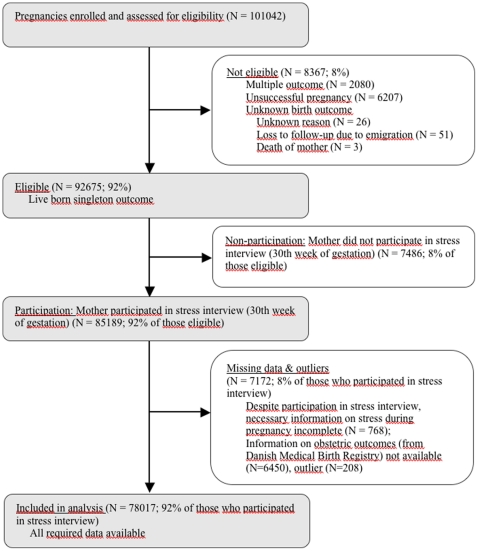
METHODOLOGY/PRINCIPAL FINDINGS: We defined a priori two types of psychosocial stress during pregnancy, life stress (perceived burdens in major areas of life) and emotional symptoms (e.g. anxiety). We estimated the associations of maternal stress during pregnancy with placenta weight at birth, controlled for length of gestation, by predicting gestational age- and sex-specific z-scores of placenta weight through multiple regression analysis, adjusted for potential confounders (N = 78,017 singleton pregnancies). Life stress (per increase in stress score by 1, range: 0-18) during pregnancy was associated with increased placenta weight at birth (z-score, reported in 10(-3); B, 14.33; CI, 10.12-18.54). In contrast, emotional symptoms during pregnancy were not associated with placenta weight at birth.
CONCLUSIONS/SIGNIFICANCE: Maternal life stress but not emotional symptoms during pregnancy was associated with increased placenta weight at birth; yet, the association-estimate was rather small. Our results may contribute to a better understanding of the role of the placenta in the regulation of intrauterine processes in response to maternal stress.
本研究旨在通过前瞻性大样本队列研究,探究孕期心理社会压力与胎盘出生体重之间的相关性。动物研究表明,胎盘参与了与应激相关的胎儿编程。
方法/主要发现:我们首先定义了孕期两种类型的心理社会压力,分别为生活压力(生活主要领域感知到的负担)和情绪症状(如焦虑)。我们通过多元回归分析预测了胎盘重量的胎龄和性别特异性 z 评分,从而控制了妊娠期的长短,以此来评估孕期母体压力与胎盘出生体重的相关性,同时调整了潜在的混杂因素(n=78017 例单胎妊娠)。孕期生活压力(压力评分每增加 1,范围:0-18)与胎盘出生体重增加相关(z 评分,以 10(-3)表示;B=14.33;CI,10.12-18.54)。相比之下,孕期的情绪症状与胎盘出生体重无关。
结论/意义:孕期母体生活压力与胎盘出生体重增加相关,但关联程度较小。我们的研究结果可能有助于更好地理解胎盘在调节宫内过程以应对母体压力方面的作用。