Masumi Atsuko
Department of Safety Research on Blood and Biological Products, National Institute of Infectious Diseases, Gakuen, 4-7-1 Musashimurayama-shi, Tokyo 208-0011, Japan.
J Biomed Biotechnol. 2011;2011:640610. doi: 10.1155/2011/640610. Epub 2010 Dec 29.
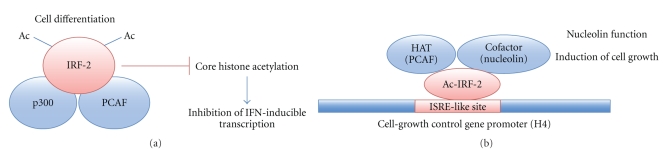
When studying transcription factors, it is necessary to investigate posttranslational modifications. Histone acetyltransferases (HATs) are typical of the modification enzymes involved in chromatin regulation. HATs acetylate the transcription factors (nonhistone proteins) as well as histones. Interferon regulatory factors (IRFs) are transcription factors that bind to the interferon regulatory element (IRF-E) and are involved in regulating cell growth, differentiation, and the immune and hematopoietic systems. During the process of binding to a specific DNA element, IRFs also bind to coactivators such as HATs and become modified. This review looks at how IRFs associate with HATs, p300, and PCAF, and thereby contribute to transcriptional activation.
在研究转录因子时,有必要研究翻译后修饰。组蛋白乙酰转移酶(HATs)是参与染色质调控的典型修饰酶。HATs使转录因子(非组蛋白)以及组蛋白发生乙酰化。干扰素调节因子(IRFs)是与干扰素调节元件(IRF-E)结合的转录因子,参与调节细胞生长、分化以及免疫和造血系统。在与特定DNA元件结合的过程中,IRFs还与诸如HATs等共激活因子结合并发生修饰。本综述探讨了IRFs如何与HATs、p300和PCAF相互作用,从而促进转录激活。