Johnston Andrew, Xing Xianying, Guzman Andrew M, Riblett MaryBeth, Loyd Candace M, Ward Nicole L, Wohn Christian, Prens Errol P, Wang Frank, Maier Lisa E, Kang Sewon, Voorhees John J, Elder James T, Gudjonsson Johann E
Department of Dermatology, University of Michigan, Ann Arbor, MI 48109, USA.
J Immunol. 2011 Feb 15;186(4):2613-22. doi: 10.4049/jimmunol.1003162. Epub 2011 Jan 17.
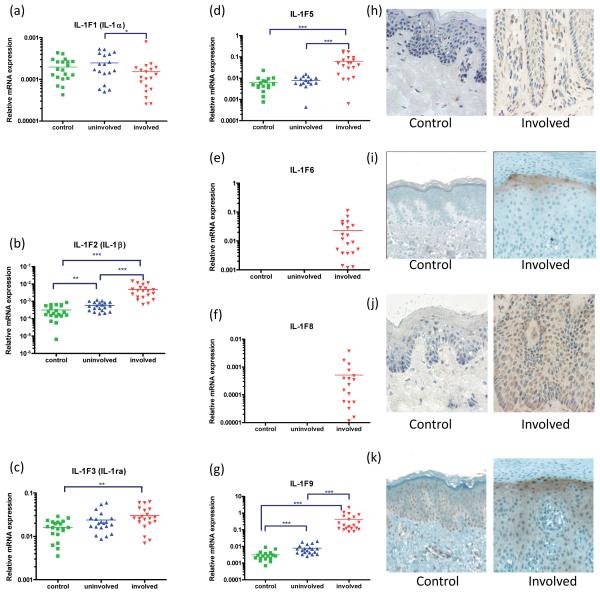
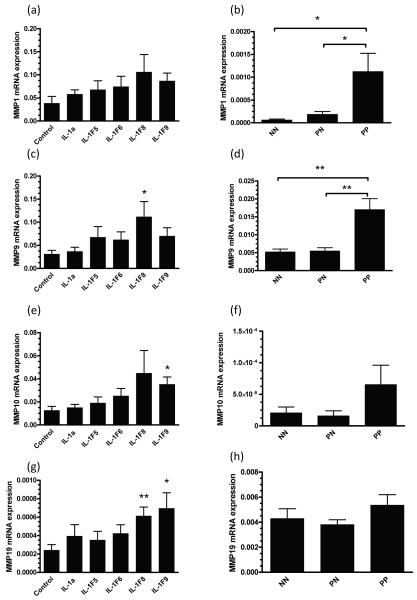
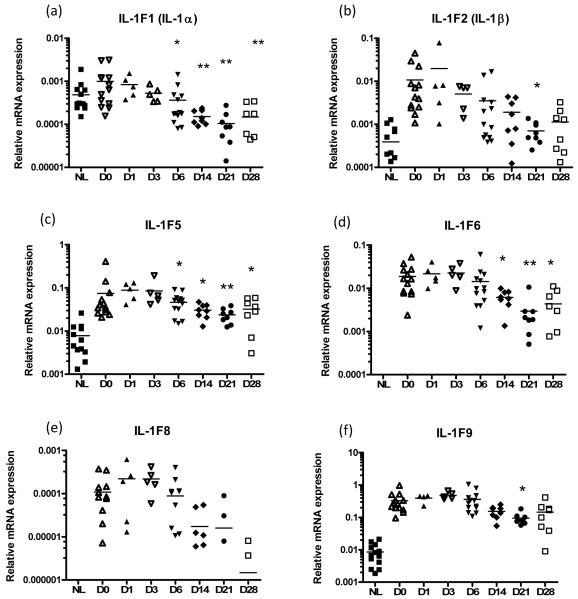
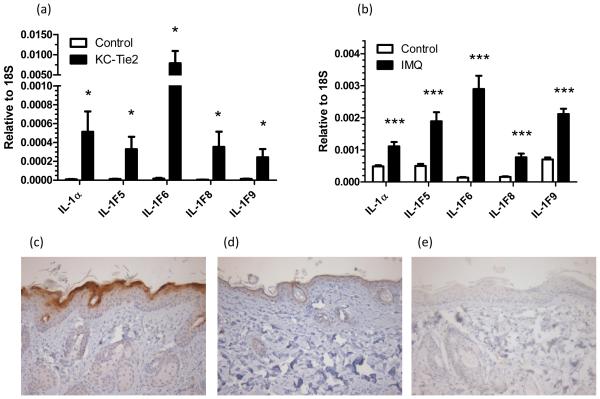
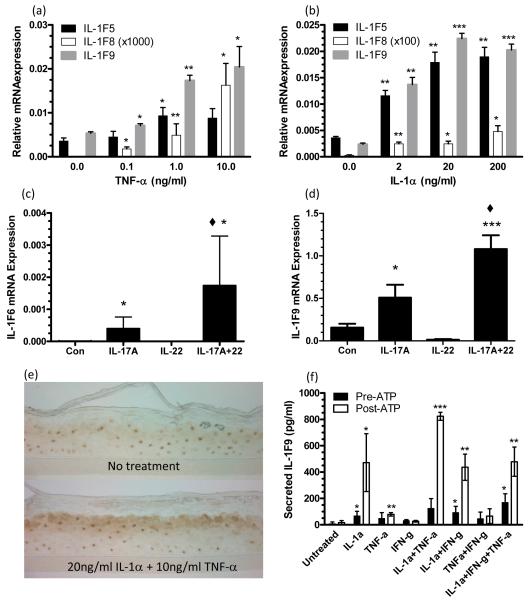
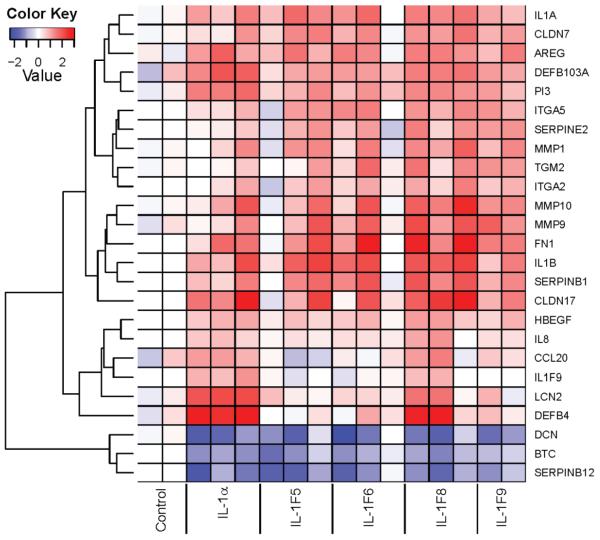
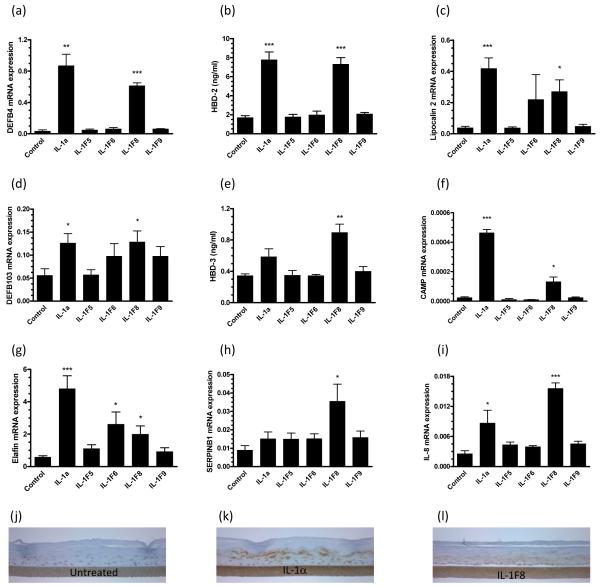
IL-1F6, IL-1F8, and IL-1F9 and the IL-1R6(RP2) receptor antagonist IL-1F5 constitute a novel IL-1 signaling system that is poorly characterized in skin. To further characterize these cytokines in healthy and inflamed skin, we studied their expression in healthy control, uninvolved psoriasis, and psoriasis plaque skin using quantitative RT-PCR and immunohistochemistry. Expression of IL-1F5, -1F6, -1F8, and -1F9 were increased 2 to 3 orders of magnitude in psoriasis plaque versus uninvolved psoriasis skin, which was supported immunohistologically. Moreover, treatment of psoriasis with etanercept led to significantly decreased IL-1F5, -1F6, -1F8, and -1F9 mRNAs, concomitant with clinical improvement. Similarly increased expression of IL-1F5, -1F6, -1F8, and -1F9 was seen in the involved skin of two mouse models of psoriasis. Suggestive of their importance in inflamed epithelia, IL-1α and TNF-α induced IL-1F5, -1F6, -1F8, and -1F9 transcript expression by normal human keratinocytes. Microarray analysis revealed that these cytokines induce the expression of antimicrobial peptides and matrix metalloproteinases by reconstituted human epidermis. In particular, IL-1F8 increased mRNA expression of human β-defensin (HBD)-2, HBD-3, and CAMP and protein secretion of HBD-2 and HBD-3. Collectively, our data suggest important roles for these novel cytokines in inflammatory skin diseases and identify these peptides as potential targets for antipsoriatic therapies.
白细胞介素1F6(IL-1F6)、白细胞介素1F8(IL-1F8)、白细胞介素1F9(IL-1F9)以及白细胞介素1受体6(IL-1R6,即RP2)拮抗剂白细胞介素1F5构成了一个新的白细胞介素1信号系统,目前在皮肤方面对其了解甚少。为了进一步明确这些细胞因子在健康皮肤和炎症皮肤中的特性,我们运用定量逆转录聚合酶链反应(RT-PCR)和免疫组织化学方法,研究了它们在健康对照皮肤、未受累的银屑病皮肤以及银屑病斑块皮肤中的表达情况。与未受累的银屑病皮肤相比,银屑病斑块中白细胞介素1F5、-1F6、-1F8和-1F9的表达增加了2至3个数量级,免疫组织学结果也证实了这一点。此外,用依那西普治疗银屑病可使白细胞介素1F5、-1F6、-1F8和-1F9的信使核糖核酸(mRNA)显著降低,同时临床症状有所改善。在两种银屑病小鼠模型的受累皮肤中,也观察到白细胞介素1F5、-1F6、-1F8和-1F9有类似的表达增加。白细胞介素1α(IL-1α)和肿瘤坏死因子-α(TNF-α)可诱导正常人角质形成细胞表达白细胞介素1F5、-1F6、-1F8和-1F9转录本,这提示它们在炎症上皮细胞中具有重要作用。微阵列分析显示,这些细胞因子可诱导重组人表皮表达抗菌肽和基质金属蛋白酶。特别是,白细胞介素1F8可增加人β-防御素(HBD)-2、HBD-3和CAMP的mRNA表达以及HBD-2和HBD-3的蛋白分泌。总的来说,我们的数据表明这些新型细胞因子在炎症性皮肤病中发挥重要作用,并确定这些肽类为银屑病治疗的潜在靶点。