Neuroscience Research Center, Mashhad University of Medical Sciences, Mashhad, Iran.
Clinics (Sao Paulo). 2010;65(11):1175-81. doi: 10.1590/s1807-59322010001100021.
Severe cognitive impairment follows thyroid hormone deficiency during the neonatal period. The role of nitric oxide (NO) in learning and memory has been widely investigated.
This study aimed to investigate the effect of hypothyroidism during neonatal and juvenile periods on NO metabolites in the hippocampi of rats and on learning and memory. Animals were divided into two groups and treated for 60 days from the first day of lactation. The control group received regular water, whereas animals in a separate group were given water supplemented with 0.03% methimazole to induce hypothyroidism. Male offspring were selected and tested in the Morris water maze. Samples of blood were collected to measure the metabolites of NO, NO2, NO3 and thyroxine. The animals were then sacrificed, and their hippocampi were removed to measure the tissue concentrations of NO2 and NO3.
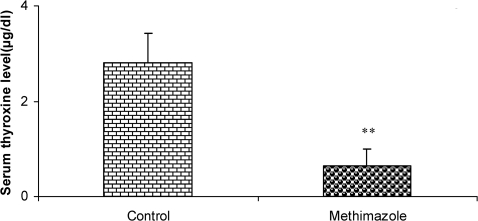
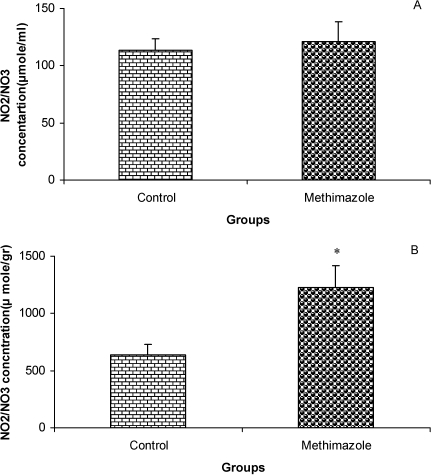
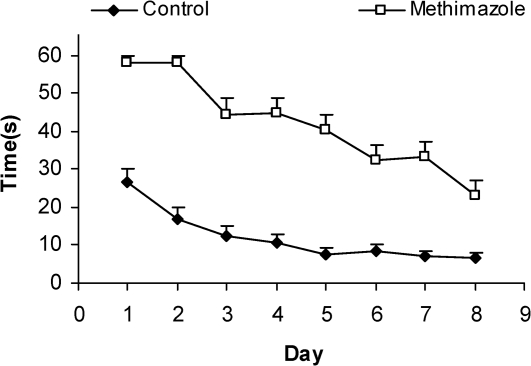
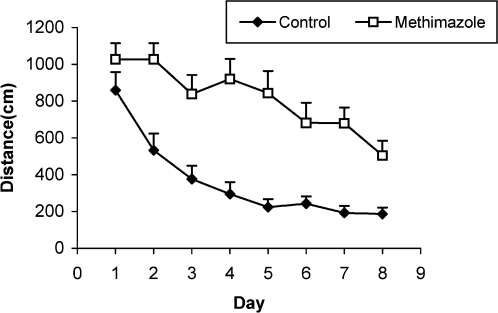
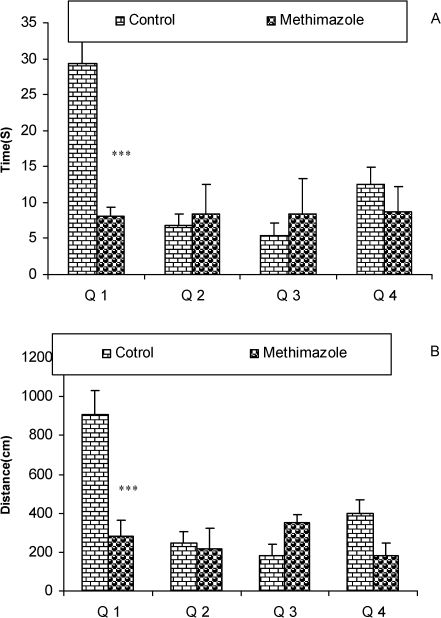
Compared to the control group's offspring, serum thyroxine levels in the methimazole group's offspring were significantly lower (P<0.01). In addition, the swim distance and time latency were significantly higher in the methimazole group (P<0.001), and the time spent by this group in the target quadrant (Q1) during the probe trial was significantly lower (P<0.001). There was no significant difference in the plasma levels of NO metabolites between the two groups; however, significantly higher NO metabolite levels in the hippocampi of the methimazole group were observed compared to controls (P<0.05).
These results suggest that the increased NO level in the hippocampus may play a role in the learning and memory deficits observed in childhood hypothyroidism; however, the precise underlying mechanism(s) remains to be elucidated.
新生儿期甲状腺激素缺乏会导致严重的认知障碍。一氧化氮(NO)在学习和记忆中的作用已得到广泛研究。
本研究旨在探讨新生儿期和幼年期甲状腺功能减退对大鼠海马区 NO 代谢物以及学习和记忆的影响。动物分为两组,从哺乳期第一天开始接受 60 天的治疗。对照组给予常规水,而另一组给予补充 0.03%甲巯咪唑的水以诱导甲状腺功能减退。选择雄性后代进行 Morris 水迷宫测试。采集血液样本以测量 NO、NO2、NO3 和甲状腺素的代谢物。然后处死动物,取出海马测量 NO2 和 NO3 的组织浓度。
与对照组后代相比,甲巯咪唑组后代的血清甲状腺素水平明显降低(P<0.01)。此外,甲巯咪唑组的游泳距离和潜伏期明显较高(P<0.001),在探针试验中该组在目标象限(Q1)的停留时间明显较低(P<0.001)。两组间血浆 NO 代谢物水平无显著差异;然而,与对照组相比,甲巯咪唑组海马中的 NO 代谢物水平明显升高(P<0.05)。
这些结果表明,海马中 NO 水平的升高可能在儿童期甲状腺功能减退症中观察到的学习和记忆缺陷中发挥作用;然而,确切的潜在机制仍有待阐明。