Institute for Genomic Diversity, Cornell University, Ithaca, NY, USA.
BMC Med Genet. 2011 Jan 18;12:10. doi: 10.1186/1471-2350-12-10.
the thrifty gene hypothesis posits that, in populations that experienced periods of feast and famine, natural selection favoured individuals carrying thrifty alleles that promote the storage of fat and energy. Polynesians likely experienced long periods of cold stress and starvation during their settlement of the Pacific and today have high rates of obesity and type 2 diabetes (T2DM), possibly due to past positive selection for thrifty alleles. Alternatively, T2DM risk alleles may simply have drifted to high frequency in Polynesians. To identify thrifty alleles in Polynesians, we previously examined evidence of positive selection on T2DM-associated SNPs and identified a T2DM risk allele at unusually high frequency in Polynesians. We suggested that the risk allele of the Gly482Ser variant in the PPARGC1A gene was driven to high frequency in Polynesians by positive selection and therefore possibly represented a thrifty allele in the Pacific.
here we examine whether PPARGC1A is a thrifty gene in Pacific populations by testing for an association between Gly482Ser genotypes and BMI in two Pacific populations (Maori and Tongans) and by evaluating the frequency of the risk allele of the Gly482Ser variant in a sample of worldwide populations.
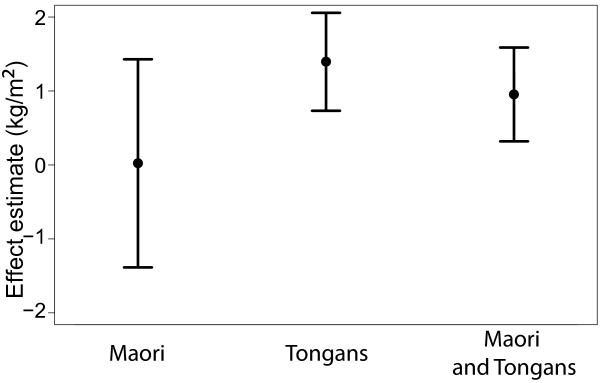
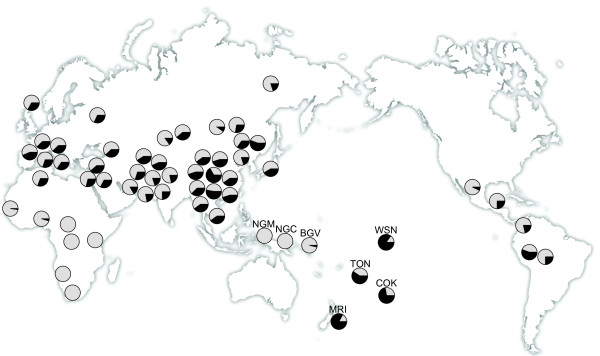
we find that the Gly482Ser variant is associated with BMI in Tongans but not in Maori. In a sample of 58 populations worldwide, we also show that the 482Ser risk allele reaches its highest frequency in the Pacific.
the association between Gly482Ser genotypes and BMI in Tongans together with the worldwide frequency distribution of the Gly482Ser risk allele suggests that PPARGC1A remains a candidate thrifty gene in Pacific populations.
节俭基因假说认为,在经历过饱食和饥饿交替的人群中,自然选择有利于携带节俭等位基因的个体,这些等位基因促进脂肪和能量的储存。波利尼西亚人在定居太平洋的过程中可能经历了长期的寒冷压力和饥饿,如今他们肥胖和 2 型糖尿病(T2DM)的发病率很高,这可能是由于过去对节俭等位基因的正向选择。或者,T2DM 风险等位基因可能只是在波利尼西亚人中简单地漂移到了高频率。为了在波利尼西亚人中鉴定节俭等位基因,我们之前研究了与 T2DM 相关的 SNP 上正选择的证据,并在波利尼西亚人中发现了一个 T2DM 风险等位基因的异常高频率。我们认为,PPARGC1A 基因中的 Gly482Ser 变体的风险等位基因在波利尼西亚人中被正选择推向高频,因此可能代表了太平洋地区的节俭等位基因。
在这里,我们通过检测两个太平洋人群(毛利人和汤加人)中 Gly482Ser 基因型与 BMI 之间的关联,以及评估 Gly482Ser 变体的风险等位基因在全球人群样本中的频率,来检验 PPARGC1A 是否是太平洋人群中的节俭基因。
我们发现 Gly482Ser 变体与汤加人的 BMI 相关,但与毛利人无关。在全球 58 个人群的样本中,我们还表明,482Ser 风险等位基因在太平洋地区达到了最高频率。
Gly482Ser 基因型与 Tongans 人群 BMI 之间的关联以及 Gly482Ser 风险等位基因在全球范围内的分布频率表明,PPARGC1A 仍然是太平洋人群中的一个候选节俭基因。