MRC Laboratory of Molecular Biology, Hills Road, Cambridge CB2 0QH, UK.
J Mol Biol. 2011 Mar 18;407(1):149-70. doi: 10.1016/j.jmb.2011.01.034. Epub 2011 Jan 22.
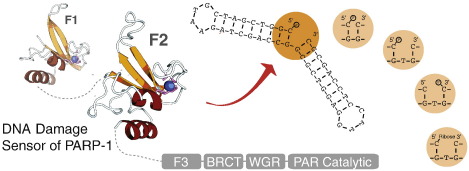
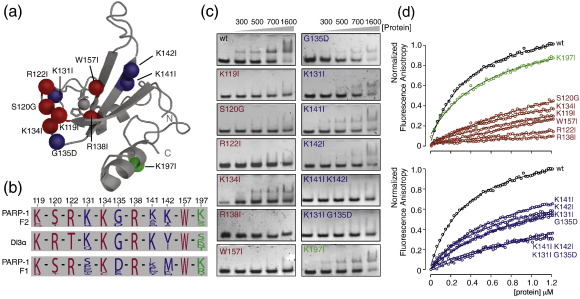
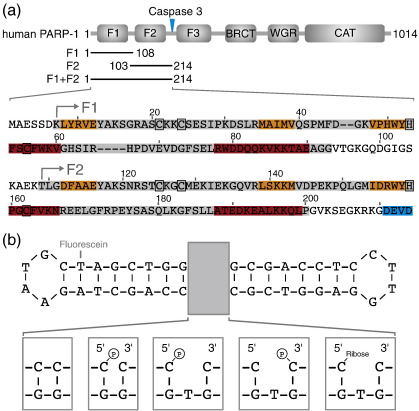
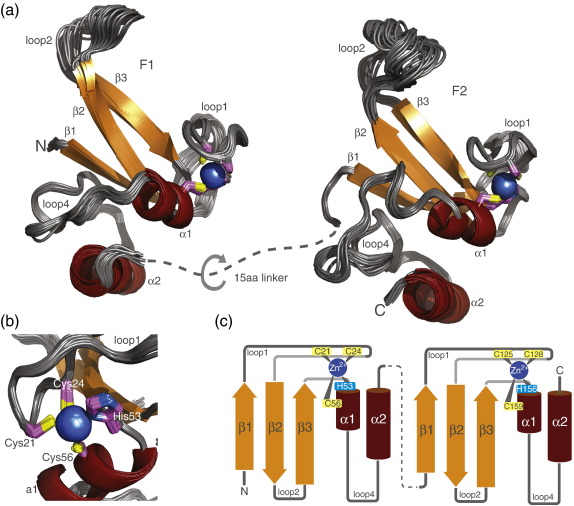
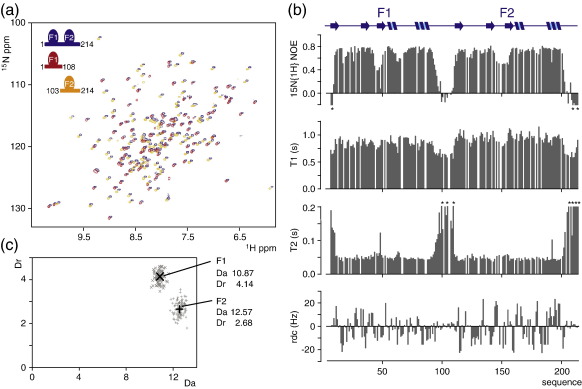
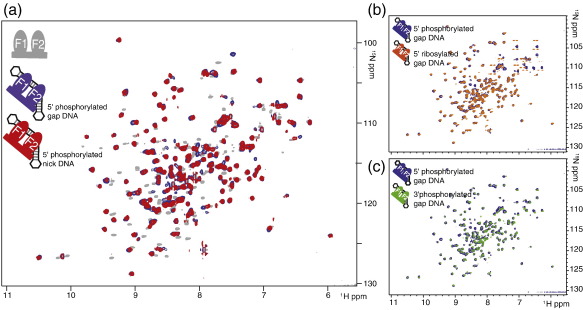
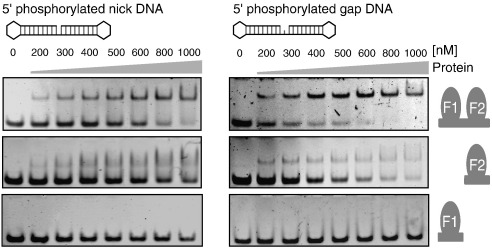
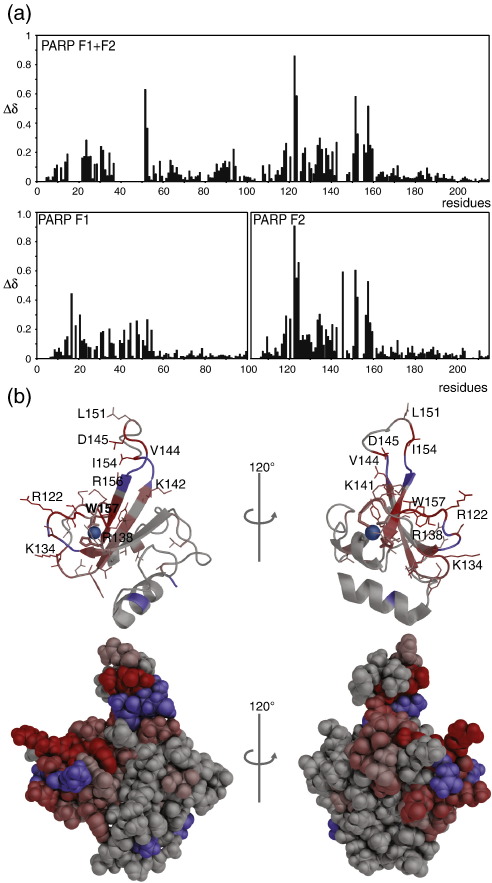
Poly(ADP-ribose)polymerase-1 (PARP-1) is a highly abundant chromatin-associated enzyme present in all higher eukaryotic cell nuclei, where it plays key roles in the maintenance of genomic integrity, chromatin remodeling and transcriptional control. It binds to DNA single- and double-strand breaks through an N-terminal region containing two zinc fingers, F1 and F2, following which its C-terminal catalytic domain becomes activated via an unknown mechanism, causing formation and addition of polyadenosine-ribose (PAR) to acceptor proteins including PARP-1 itself. Here, we report a biophysical and structural characterization of the F1 and F2 fingers of human PARP-1, both as independent fragments and in the context of the 24-kDa DNA-binding domain (F1+F2). We show that the fingers are structurally independent in the absence of DNA and share a highly similar structural fold and dynamics. The F1+F2 fragment recognizes DNA single-strand breaks as a monomer and in a single orientation. Using a combination of NMR spectroscopy and other biophysical techniques, we show that recognition is primarily achieved by F2, which binds the DNA in an essentially identical manner whether present in isolation or in the two-finger fragment. F2 interacts much more strongly with nicked or gapped DNA ligands than does F1, and we present a mutational study that suggests origins of this difference. Our data suggest that different DNA lesions are recognized by the DNA-binding domain of PARP-1 in a highly similar conformation, helping to rationalize how the full-length protein participates in multiple steps of DNA single-strand breakage and base excision repair.
聚(ADP-核糖)聚合酶 1(PARP-1)是一种高度丰富的染色质相关酶,存在于所有高等真核细胞核中,在维持基因组完整性、染色质重塑和转录调控中发挥关键作用。它通过包含两个锌指 F1 和 F2 的 N 端区域结合到 DNA 单链和双链断裂,之后其 C 端催化结构域通过未知机制被激活,导致聚腺苷酸-核糖(PAR)的形成和添加到包括 PARP-1 自身在内的受体蛋白上。在这里,我们报告了人 PARP-1 的 F1 和 F2 指的生物物理和结构特征,包括作为独立片段和在 24kDa DNA 结合域(F1+F2)的背景下。我们表明,在没有 DNA 的情况下,这些指是结构上独立的,具有高度相似的结构折叠和动力学。F1+F2 片段以单体形式并以单一取向识别 DNA 单链断裂。我们使用 NMR 光谱学和其他生物物理技术的组合表明,识别主要由 F2 完成,无论其是否单独存在或存在于双指片段中,F2 都以基本相同的方式结合 DNA。F2 与缺口或缺口 DNA 配体的相互作用比 F1 强得多,我们进行了一项突变研究,提出了这种差异的起源。我们的数据表明,不同的 DNA 损伤通过 PARP-1 的 DNA 结合域以高度相似的构象识别,有助于解释全长蛋白如何参与 DNA 单链断裂和碱基切除修复的多个步骤。