Dutto Ilaria, Sukhanova Maria, Tillhon Micol, Cazzalini Ornella, Stivala Lucia A, Scovassi A Ivana, Lavrik Olga, Prosperi Ennio
Istituto di Genetica Molecolare del CNR, Via Abbiategrasso, 207, Pavia, Italy.
Institute of Chemical Biology and Fundamental Medicine, Russian Academy of Sciences, Prospekt Lavrentiev 8, Novosibirsk, Russian Federation.
PLoS One. 2016 Jan 5;11(1):e0146031. doi: 10.1371/journal.pone.0146031. eCollection 2016.
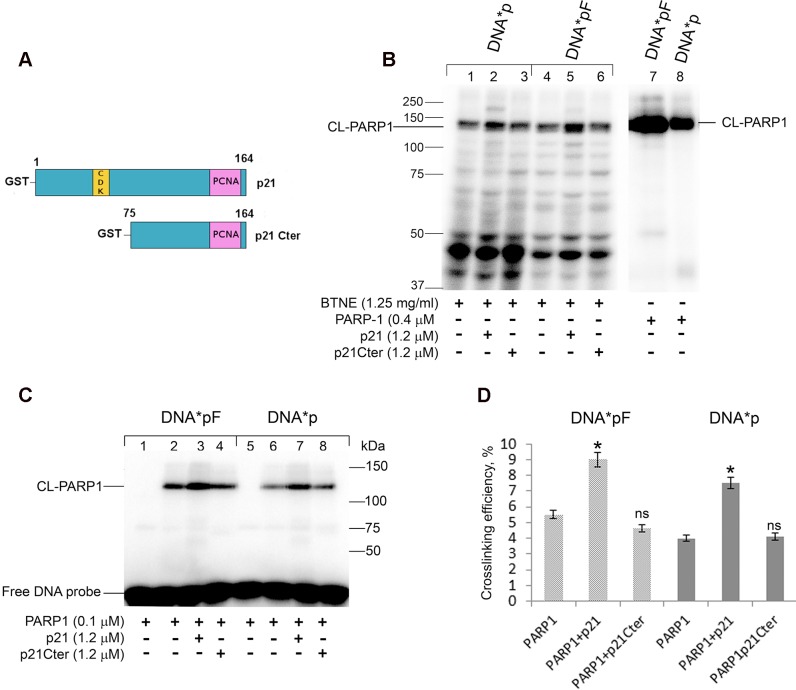
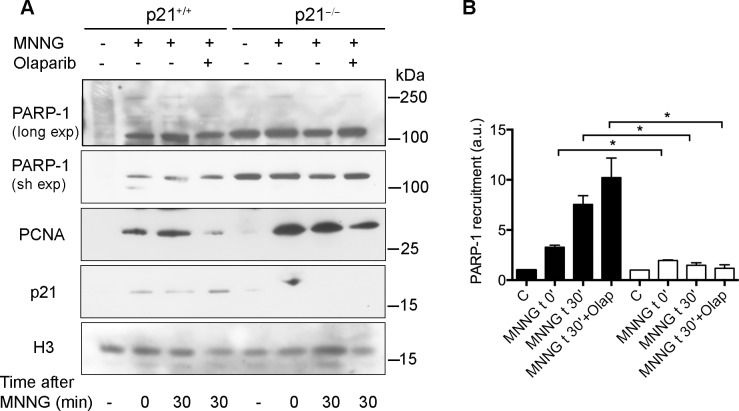
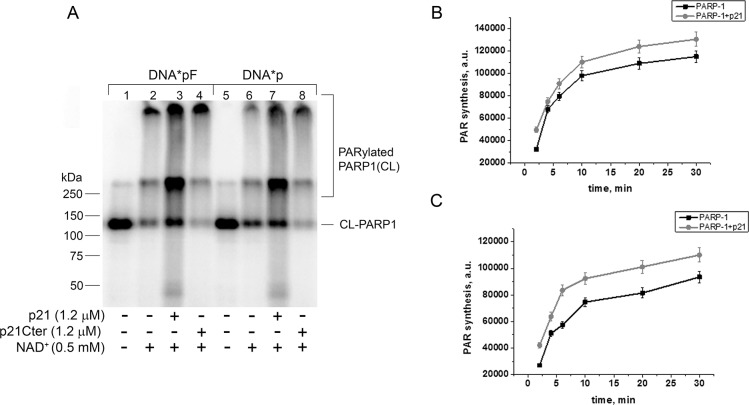
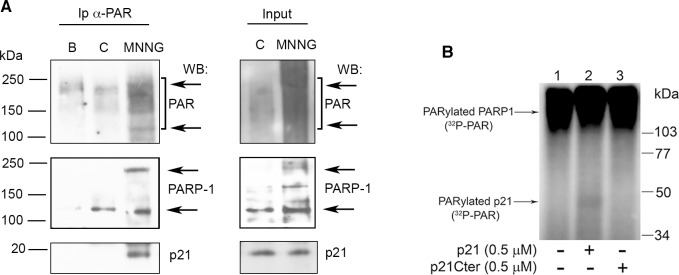
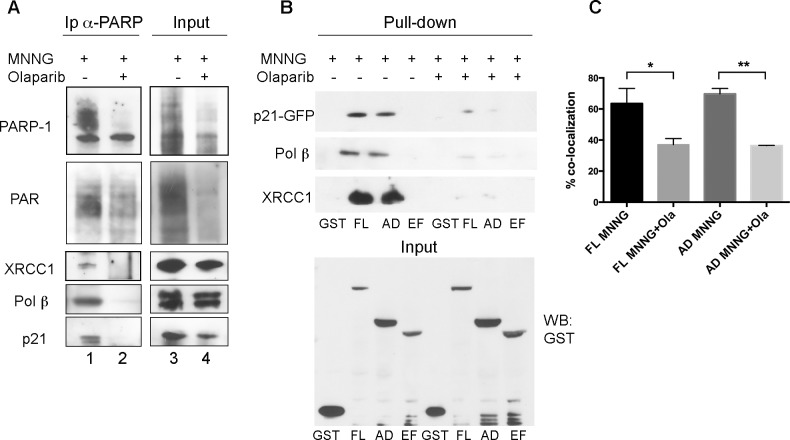
The cell cycle inhibitor p21CDKN1A was previously found to interact directly with DNA nick-sensor poly(ADP-ribose) polymerase-1 (PARP-1) and to promote base excision repair (BER). However, the molecular mechanism responsible for this BER-related association of p21 with PARP-1 remains to be clarified. In this study we investigate the capability of p21 to influence PARP-1 binding to DNA repair intermediates in a reconstituted BER system in vitro. Using model photoreactive BER substrates containing single-strand breaks, we found that full-length recombinant GST-tagged p21 but not a C-terminal domain truncated form of p21 was able to stimulate the PARP-1 binding to BER intermediates with no significant influence on the catalytic activity of PARP-1. In addition, we investigate whether the activation of PARP-1 through poly(ADP-ribose) (PAR) synthesis, is required for its interaction with p21. We have found that in human fibroblasts and in HeLa cells treated with the DNA alkylating agent N-methyl-N'-nitro-N-nitrosoguanidine (MNNG), the interaction of p21 with PARP-1 was greatly dependent on PAR synthesis. In fact, an anti-PAR antibody was able to co-immunoprecipitate p21 and PARP-1 from extracts of MNNG-treated cells, while blocking PAR synthesis with the PARP-1 inhibitor Olaparib, drastically reduced the amount of p21 co-immunoprecipitated by a PARP-1 antibody. Our results provide the first evidence that p21 can stimulate the binding of PARP-1 to DNA repair intermediates, and that this cooperation requires PAR synthesis.
细胞周期抑制剂p21CDKN1A先前被发现可直接与DNA缺口传感器聚(ADP-核糖)聚合酶-1(PARP-1)相互作用,并促进碱基切除修复(BER)。然而,p21与PARP-1这种与BER相关关联的分子机制仍有待阐明。在本研究中,我们在体外重组的BER系统中研究了p21影响PARP-1与DNA修复中间体结合的能力。使用含有单链断裂的模型光反应性BER底物,我们发现全长重组GST标签的p21而非p21的C末端结构域截短形式能够刺激PARP-1与BER中间体的结合,而对PARP-1的催化活性没有显著影响。此外,我们研究了通过聚(ADP-核糖)(PAR)合成激活PARP-1是否是其与p21相互作用所必需的。我们发现,在用DNA烷化剂N-甲基-N'-硝基-N-亚硝基胍(MNNG)处理的人成纤维细胞和HeLa细胞中,p21与PARP-1的相互作用极大地依赖于PAR合成。事实上,一种抗PAR抗体能够从MNNG处理的细胞提取物中共免疫沉淀p21和PARP-1,而用PARP-1抑制剂奥拉帕利阻断PAR合成则会大幅减少PARP-1抗体共免疫沉淀的p21量。我们的结果提供了首个证据,即p21可以刺激PARP-1与DNA修复中间体的结合,并且这种合作需要PAR合成。