Department of Safety Research on Blood and Biological Products, National Institute of Infectious Diseases, Tokyo, Japan.
PLoS One. 2010 Nov 30;5(11):e15091. doi: 10.1371/journal.pone.0015091.
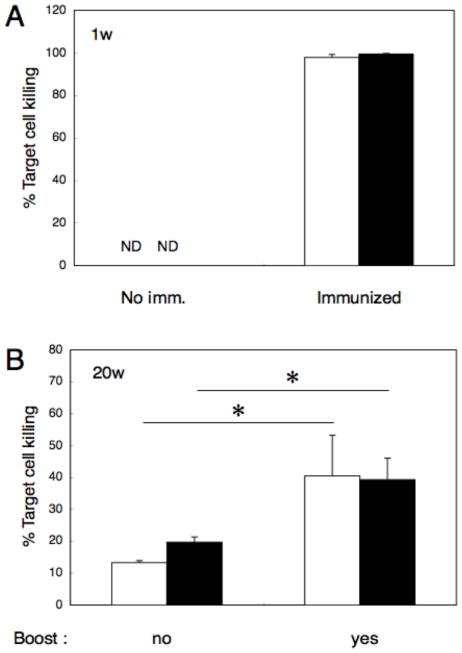
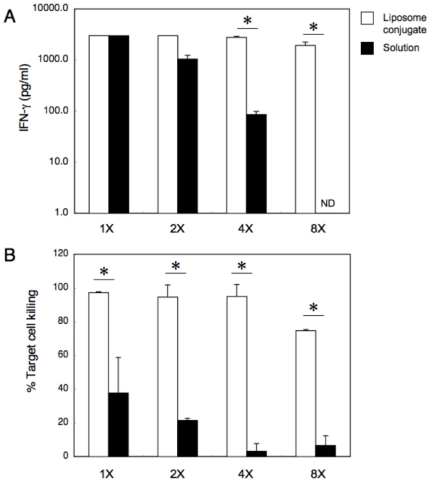
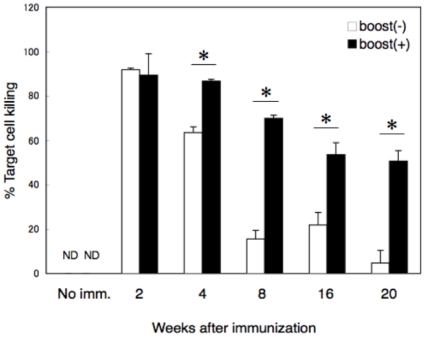
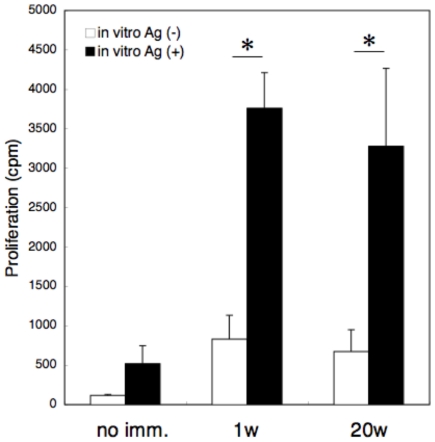
CD8(+) T cells provide broad immunity to viruses, because they are able to recognize all types of viral proteins. Therefore, the development of vaccines capable of inducing long-lived memory CD8(+) T cells is desired to prevent diseases, especially those for which no vaccines currently exist. However, in designing CD8(+) T cell vaccines, the role of CD4(+) T cells in the induction and maintenance of memory CD8(+) T cells remains uncertain. In the present study, the necessity or not of CD4(+) T cells in the induction and maintenance of memory CD8(+) T cells was investigated in mice immunized with liposome-coupled CTL epitope peptides. When OVA-derived CTL epitope peptides were chemically coupled to the surfaces of liposomes and inoculated into mice, both primary and secondary CTL responses were successfully induced. The results were further confirmed in CD4(+) T cell-eliminated mice, suggesting that CD4(+) T cells were not required for the generation of memory CD8(+) T cells in the case of immunization with liposome-coupled peptides. Thus, surface-linked liposomal antigens, capable of inducing long-lived memory CD8(+) T cells without the contribution of CD4(+) T cells, might be applicable for the development of vaccines to prevent viral infection, especially for those viruses that evade humoral immunity by varying their surface proteins, such as influenza viruses, HIV, HCV, SARS coronaviruses, and Ebola viruses.
CD8(+) T 细胞能够识别所有类型的病毒蛋白,从而提供广泛的病毒免疫力。因此,人们希望开发能够诱导产生长寿记忆 CD8(+) T 细胞的疫苗,以预防疾病,特别是那些目前尚无疫苗的疾病。然而,在设计 CD8(+) T 细胞疫苗时,CD4(+) T 细胞在诱导和维持记忆 CD8(+) T 细胞中的作用仍不确定。在本研究中,通过用脂质体偶联 CTL 表位肽免疫小鼠,研究了 CD4(+) T 细胞在诱导和维持记忆 CD8(+) T 细胞中的必要性。当 OVA 衍生的 CTL 表位肽被化学偶联到脂质体表面并接种到小鼠中时,成功地诱导了初次和次级 CTL 反应。在消除 CD4(+) T 细胞的小鼠中进一步证实了这一结果,表明在脂质体偶联肽免疫的情况下,CD4(+) T 细胞不是产生记忆 CD8(+) T 细胞所必需的。因此,表面连接的脂质体抗原,能够在不依赖 CD4(+) T 细胞的情况下诱导产生长寿的记忆 CD8(+) T 细胞,可能适用于开发预防病毒感染的疫苗,特别是对于那些通过改变表面蛋白逃避体液免疫的病毒,如流感病毒、HIV、HCV、SARS 冠状病毒和埃博拉病毒。