Department of Radiology, University of California San Diego, 9500 Gilman Dr., 0841, La Jolla, CA 92093-0841, USA.
Cogn Affect Behav Neurosci. 2011 Mar;11(1):113-30. doi: 10.3758/s13415-010-0017-7.
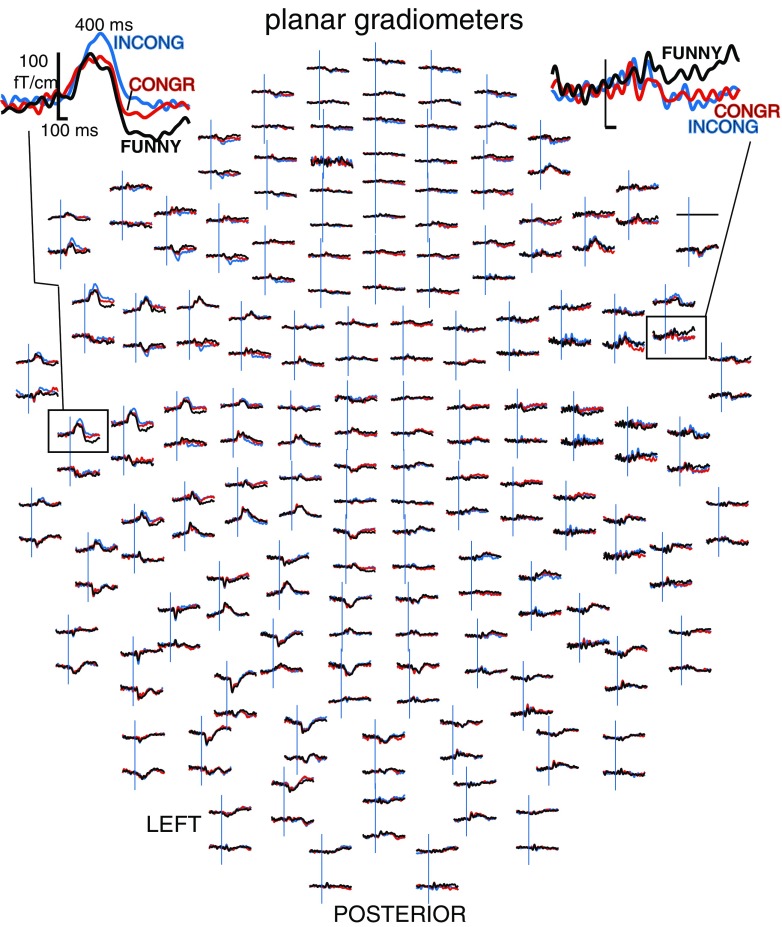
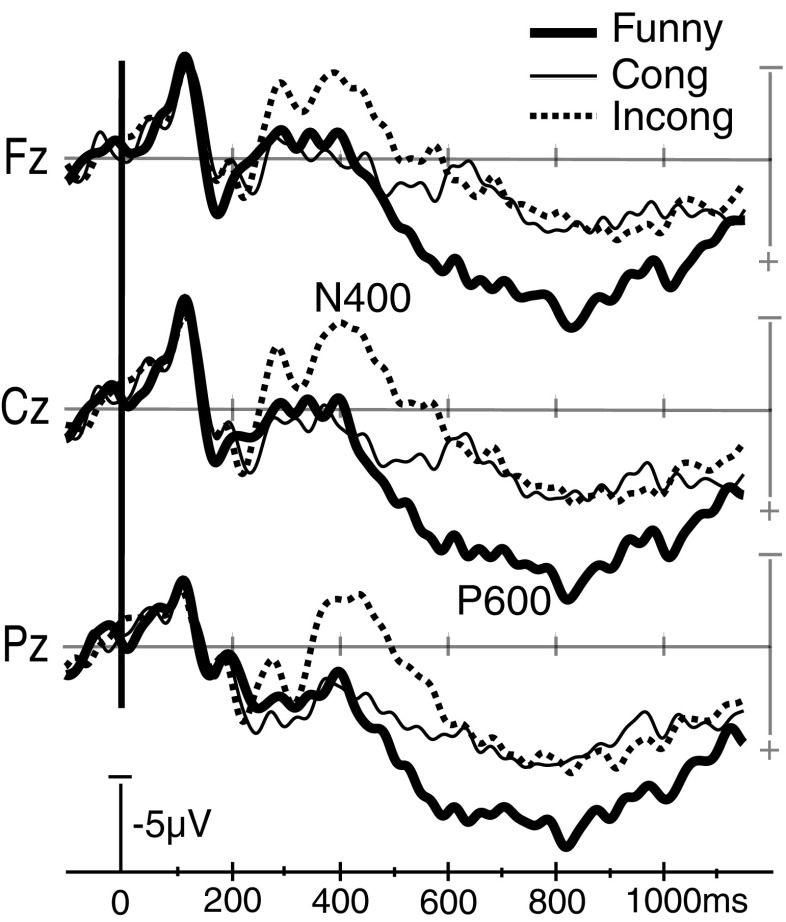
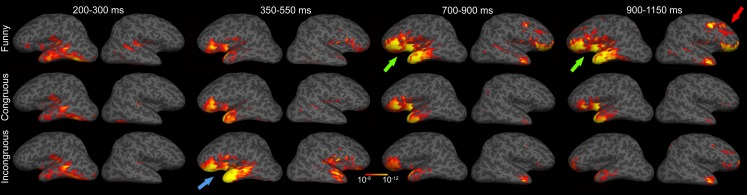
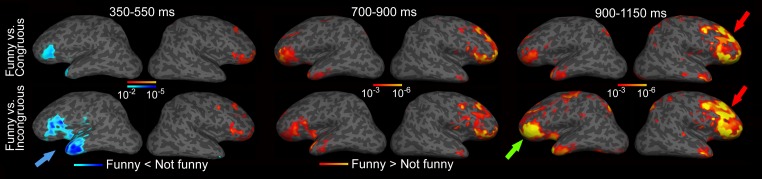
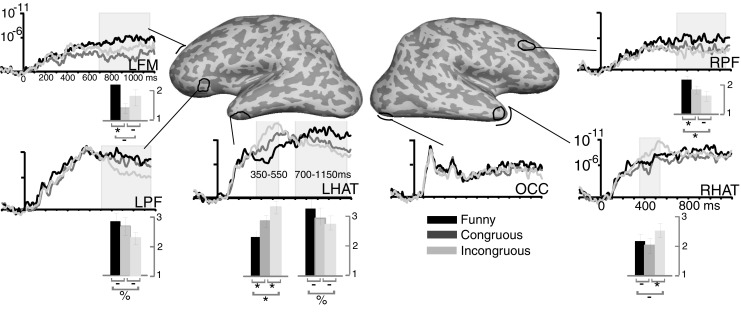
Understanding a joke relies on semantic, mnemonic, inferential, and emotional contributions from multiple brain areas. Anatomically constrained magnetoencephalography (aMEG) combining high-density whole-head MEG with anatomical magnetic resonance imaging allowed us to estimate where the humor-specific brain activations occur and to understand their temporal sequence. Punch lines provided either funny, not funny (semantically congruent), or nonsensical (incongruent) replies to joke questions. Healthy subjects rated them as being funny or not funny. As expected, incongruous endings evoke the largest N400m in left-dominant temporo-prefrontal areas, due to integration difficulty. In contrast, funny punch lines evoke the smallest N400m during this initial lexical-semantic stage, consistent with their primed "surface congruity" with the setup question. In line with its sensitivity to ambiguity, the anteromedial prefrontal cortex may contribute to the subsequent "second take" processing, which, for jokes, presumably reflects detection of a clever "twist" contained in the funny punch lines. Joke-selective activity simultaneously emerges in the right prefrontal cortex, which may lead an extended bilateral temporo-frontal network in establishing the distant unexpected creative coherence between the punch line and the setup. This progression from an initially promising but misleading integration from left frontotemporal associations, to medial prefrontal ambiguity evaluation and right prefrontal reprocessing, may reflect the essential tension and resolution underlying humor.
理解笑话依赖于多个大脑区域的语义、记忆、推理和情感贡献。结合高密度全头 MEG 和解剖磁共振成像的解剖约束性脑磁图(aMEG)使我们能够估计幽默特异性脑激活发生的位置,并了解它们的时间顺序。妙语提供了有趣、不有趣(语义一致)或无意义(不一致)的笑话问题回答。健康受试者对它们进行了有趣或不有趣的评价。不出所料,由于整合困难,不一致的结尾会在以左半球为主的颞-前额区域引发最大的 N400m。相比之下,有趣的妙语在这个初始词汇语义阶段引发的 N400m 最小,与它们与设置问题的“表面一致性”一致。与它对歧义的敏感性一致,前内侧前额叶皮层可能有助于随后的“第二次思考”处理,对于笑话来说,这可能反映了对妙语中包含的巧妙“转折”的检测。笑话选择性活动同时出现在右前额叶皮层中,这可能会导致一个扩展的双侧颞-额网络在妙语和设置之间建立遥远的意外创造性连贯。这种从左额颞联合最初有希望但误导性的整合,到内侧前额叶的歧义评估和右前额叶的重新处理的进展,可能反映了幽默的基本张力和解决。