Tian Fang, Hou Yuling, Zhu Wenfeng, Dietrich Arne, Zhang Qinglin, Yang Wenjing, Chen Qunlin, Sun Jiangzhou, Jiang Qiu, Cao Guikang
Key Laboratory of Cognition and Personality (SWU), Ministry of Education, Chongqing, China.
Faculty of Psychology, Southwest University, Chongqing, China.
Front Psychol. 2017 Oct 18;8:1835. doi: 10.3389/fpsyg.2017.01835. eCollection 2017.
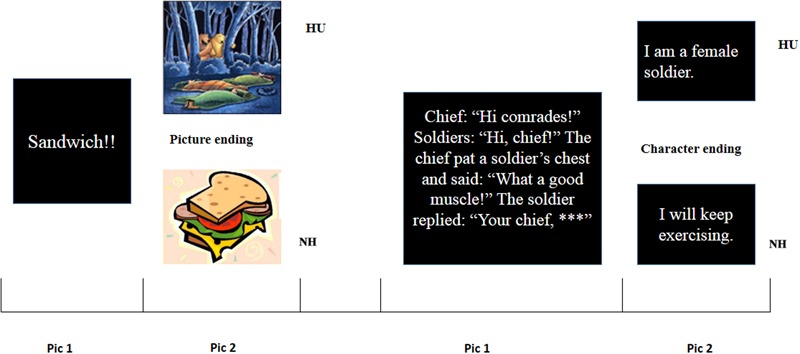
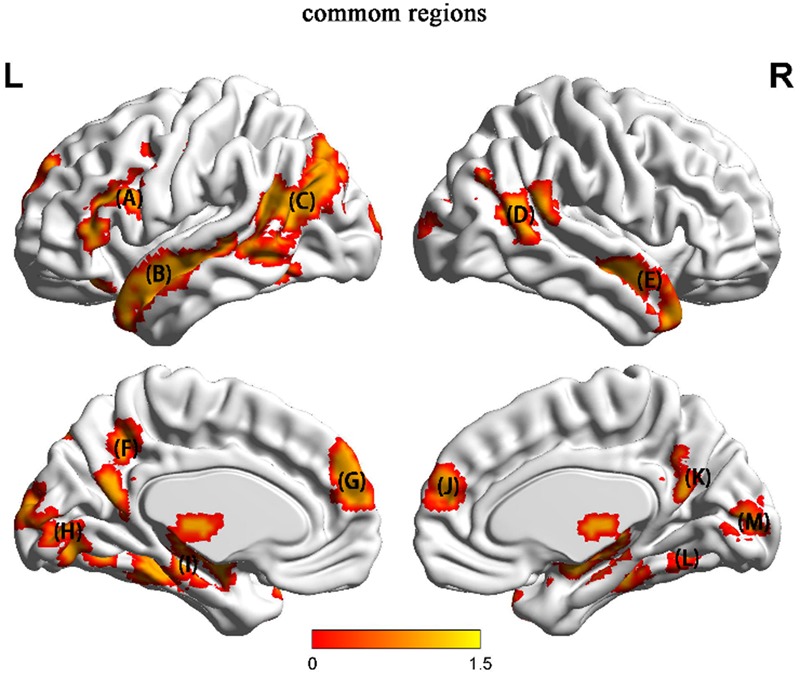
As a high-level cognitive activity, humor comprehension requires incongruity detection and incongruity resolution, which then elicits an insight moment. The purpose of the study was to explore the neural basis of humor comprehension, particularly the moment of insight, by using both characters and language-free cartoons in a functional magnetic resonance imaging study. The results showed that insight involving jokes elicited greater activation in language and semantic-related brain regions as well as a variety of additional regions, such as the superior frontal gyrus (SFG), the inferior frontal gyrus (IFG), the middle temporal gyrus (MTG), the superior temporal gyrus (STG), the temporoparietal junctions (TPJ), the hippocampus and visual areas. These findings indicate that the MTG might play a role in incongruity detection, while the SFG, IFG and the TPJ might be involved in incongruity detection. The passive insight event elicited by jokes appears to be mediated by a limited number of brain areas. Our study showed that the brain regions associated with humor comprehension were not affected by the type of stimuli and that humor and insight shared common brain areas. These results indicate that one experiences a feeling of insight during humor comprehension, which contributes to the understanding of humor comprehension.
作为一种高级认知活动,幽默理解需要不协调检测和不协调解决,进而引发顿悟时刻。本研究的目的是通过在功能磁共振成像研究中使用文字和无文字漫画,探索幽默理解的神经基础,特别是顿悟时刻。结果表明,涉及笑话的顿悟在语言和语义相关的脑区以及其他多个区域引发了更强的激活,如额上回(SFG)、额下回(IFG)、颞中回(MTG)、颞上回(STG)、颞顶联合区(TPJ)、海马体和视觉区域。这些发现表明,MTG可能在不协调检测中发挥作用,而SFG、IFG和TPJ可能参与不协调检测。笑话引发的被动顿悟事件似乎由有限数量的脑区介导。我们的研究表明,与幽默理解相关的脑区不受刺激类型的影响,并且幽默和顿悟共享共同的脑区。这些结果表明,人们在幽默理解过程中会体验到顿悟感,这有助于理解幽默理解。