Menzies Research Institute, University of Tasmania, Hobart, TAS, Australia.
BMJ. 2011 Jan 25;342:c7254. doi: 10.1136/bmj.c7254.
To determine the effectiveness of vitamin D supplementation for improving bone mineral density in children and adolescents and if effects vary with factors such as vitamin D dose and vitamin D status.
Systematic review and meta-analysis.
Cochrane Central Register of Controlled Trials, Medline (1966 to present), Embase (1980 to present), CINAHL (1982 to present), AMED (1985 to present), and ISI Web of Science (1945 to present), last updated on 9 August 2009, and hand searching of conference abstracts from key journals. Study selection Placebo controlled randomised controlled trials of vitamin D supplementation for at least three months in healthy children and adolescents (aged 1 month to <20 years) with bone density outcomes. Two authors independently assessed references for inclusion and study quality and extracted data.
Standardised mean differences of the percentage change from baseline in bone mineral density of the forearm, hip, and lumbar spine and total body bone mineral content in treatment and control groups. Subgroup analyses were carried out by sex, pubertal stage, dose of vitamin D, and baseline serum vitamin D concentration. Compliance and allocation concealment were also considered as possible sources of heterogeneity.
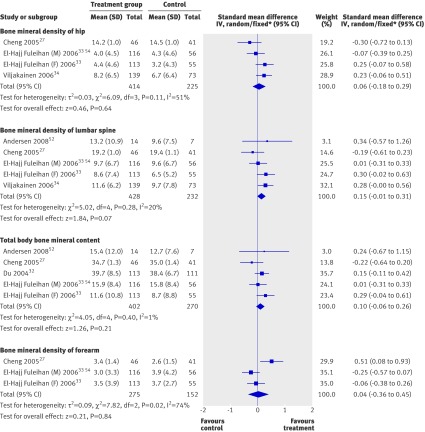
From 1653 potential references, six studies, totalling 343 participants receiving placebo and 541 receiving vitamin D, contributed data to meta-analyses. Vitamin D supplementation had no statistically significant effects on total body bone mineral content or on bone mineral density of the hip or forearm. There was a trend to a small effect on lumbar spine bone mineral density (standardised mean difference 0.15, 95% confidence interval -0.01 to 0.31; P=0.07). Effects were similar in studies of participants with high compared with low serum vitamin D levels, although there was a trend towards a larger effect with low vitamin D for total body bone mineral content (P=0.09 for difference). In studies with low serum vitamin D, significant effects on total body bone mineral content and lumbar spine bone mineral density were roughly equivalent to a 2.6% and 1.7% percentage point greater change from baseline in the supplemented group.
It is unlikely that vitamin D supplements are beneficial in children and adolescents with normal vitamin D levels. The planned subgroup analyses by baseline serum vitamin D level suggest that vitamin D supplementation of deficient children and adolescents could result in clinically useful improvements, particularly in lumbar spine bone mineral density and total body bone mineral content, but this requires confirmation.
确定维生素 D 补充剂对改善儿童和青少年骨密度的有效性,以及维生素 D 剂量和维生素 D 状态等因素对其效果的影响。
系统评价和荟萃分析。
Cochrane 对照试验中心注册库、Medline(1966 年至今)、Embase(1980 年至今)、CINAHL(1982 年至今)、AMED(1985 年至今)和 ISI Web of Science(1945 年至今),最近更新日期为 2009 年 8 月 9 日,以及对主要期刊会议摘要的手工检索。
在健康儿童和青少年(1 个月至<20 岁)中,至少进行了 3 个月的维生素 D 补充剂安慰剂对照随机对照试验,以评估骨密度结局。两位作者独立评估纳入标准和研究质量,并提取数据。
治疗组和对照组前臂、髋部和腰椎骨矿物质密度以及全身骨矿物质含量的基线百分比变化的标准化均数差值。根据性别、青春期阶段、维生素 D 剂量和基线血清维生素 D 浓度进行亚组分析。还考虑了依从性和分配隐藏作为异质性的可能来源。
从 1653 个潜在的参考文献中,6 项研究(共 343 名接受安慰剂的参与者和 541 名接受维生素 D 的参与者)提供了荟萃分析的数据。维生素 D 补充剂对全身骨矿物质含量或髋部或前臂骨矿物质密度没有统计学上显著的影响。腰椎骨矿物质密度有较小但有统计学意义的趋势(标准化均数差值 0.15,95%置信区间-0.01 至 0.31;P=0.07)。在血清维生素 D 水平高的参与者和低的参与者的研究中,结果相似,尽管低维生素 D 组全身骨矿物质含量的效果有增大的趋势(低维生素 D 组与高维生素 D 组之间差异的 P 值为 0.09)。在血清维生素 D 水平低的研究中,全身骨矿物质含量和腰椎骨矿物质密度的显著变化大致相当于补充组的基线百分比变化增加 2.6%和 1.7%。
维生素 D 补充剂对维生素 D 水平正常的儿童和青少年可能没有益处。按基线血清维生素 D 水平进行的计划亚组分析表明,补充缺乏维生素 D 的儿童和青少年可能会导致有临床意义的改善,特别是在腰椎骨矿物质密度和全身骨矿物质含量方面,但这需要进一步证实。