Institut National de la Santé et de la Recherche Médicale, Unité Mixte de Recherche en Santé 839, Paris, France.
PLoS One. 2011 Jan 18;6(1):e14533. doi: 10.1371/journal.pone.0014533.
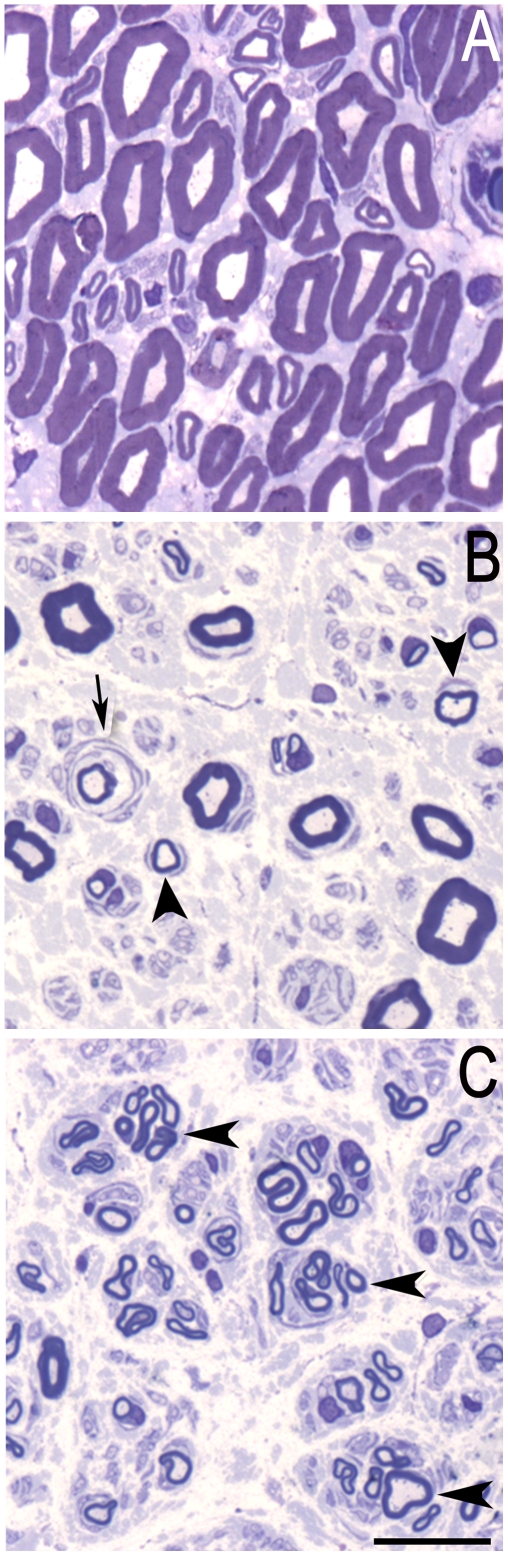
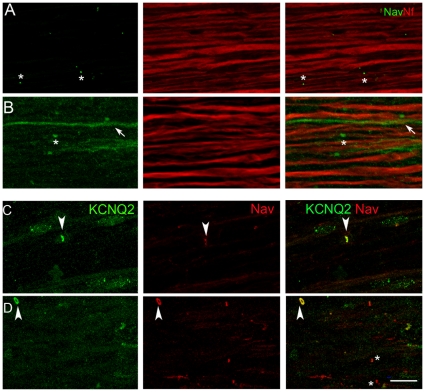
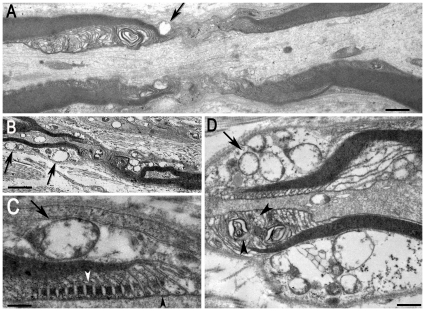
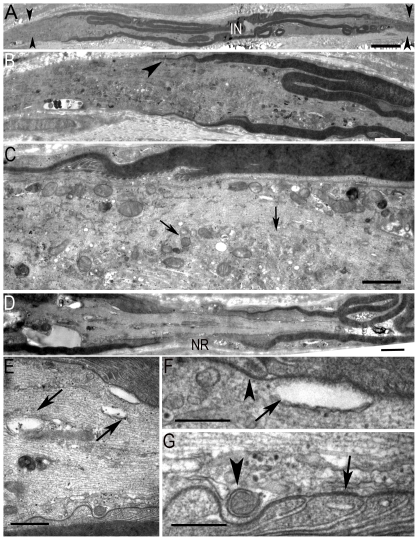
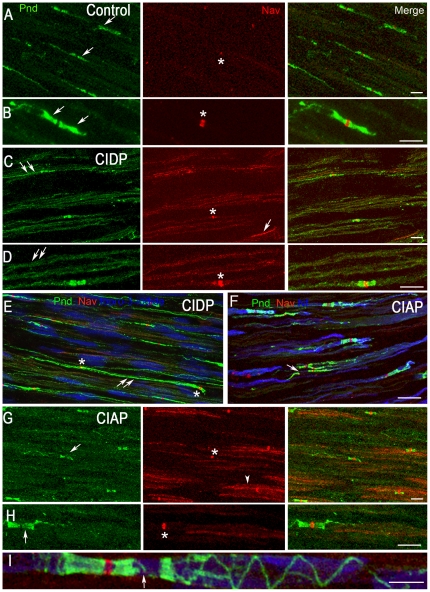
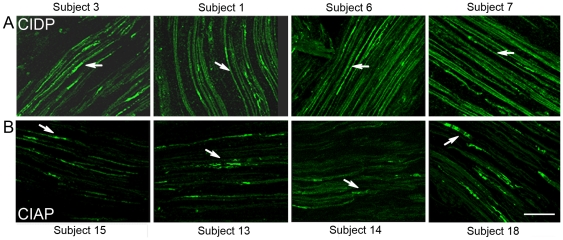
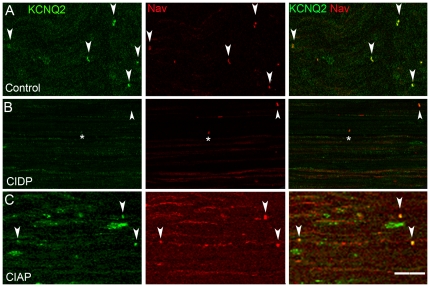
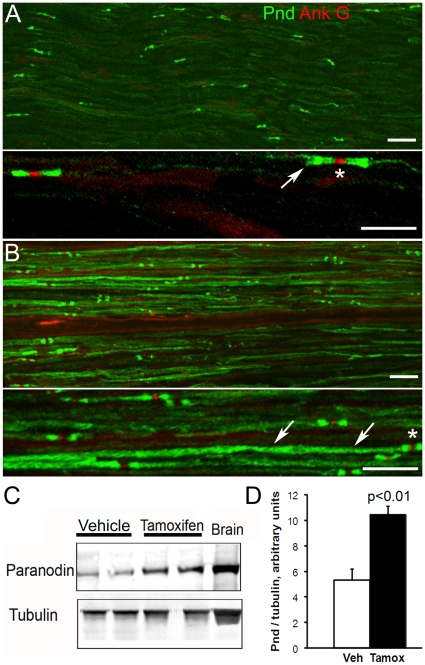
Chronic acquired neuropathies of unknown origin are classified as chronic inflammatory demyelinating polyneuropathies (CIDP) and chronic idiopathic axonal polyneuropathies (CIAP). The diagnosis can be very difficult, although it has important therapeutic implications since CIDP can be improved by immunomodulating treatment. The aim of this study was to examine the possible abnormalities of nodal and paranodal regions in these two types of neuropathies. Longitudinal sections of superficial peroneal nerves were obtained from biopsy material from 12 patients with CIDP and 10 patients with CIAP and studied by immunofluorescence and in some cases electron microscopy. Electron microscopy revealed multiple alterations in the nodal and paranodal regions which predominated in Schwann cells in CIDP and in axons in CIAP. In CIDP paranodin/Caspr immunofluorescence was more widespread than in control nerves, extending along the axon in internodes where it appeared intense. Nodal channels Nav and KCNQ2 were less altered but were also detected in the internodes. In CIAP paranodes, paranodin labeling was irregular and/or decreased. To test the consequences of acquired primary Schwann cells alteration on axonal proteins, we used a mouse model based on induced deletion of the transcription factor Krox-20 gene. In the demyelinated sciatic nerves of these mice we observed alterations similar to those found in CIDP by immunofluorescence, and immunoblotting demonstrated increased levels of paranodin. Finally we examined whether the alterations in paranodin immunoreactivity could have a diagnosis value. In a sample of 16 biopsies, the study of paranodin immunofluorescence by blind evaluators led to correct diagnosis in 70 ± 4% of the cases. This study characterizes for the first time the abnormalities of nodes of Ranvier in CIAP and CIDP, and the altered expression and distribution of nodal and paranodal proteins. Marked differences were observed between CIDP and CIAP and the alterations in paranodin immunofluorescence may be an interesting tool for their differential diagnosis.
原因不明的慢性获得性神经病分为慢性炎性脱髓鞘性多发性神经病(CIDP)和慢性特发性轴索性神经病(CIAP)。虽然诊断具有重要的治疗意义,因为 CIDP 可以通过免疫调节治疗得到改善,但诊断可能非常困难。本研究旨在研究这两种神经病的结状和结旁区可能存在的异常。从 12 例 CIDP 和 10 例 CIAP 患者的活检材料中获得腓肠神经的纵切片,并通过免疫荧光法进行研究,在某些情况下还通过电子显微镜进行研究。电子显微镜显示,结状和结旁区存在多种改变,在 CIDP 中主要存在于施万细胞,在 CIAP 中主要存在于轴突。在 CIDP 中,paranodin/Caspr 免疫荧光比对照神经更广泛,沿轴突在节间延伸,在节间表现出强烈的荧光。结区通道 Nav 和 KCNQ2 的改变较小,但也在节间检测到。在 CIAP 中,paranodes 的 paranodin 标记不规则和/或减少。为了测试获得的施万细胞原发性改变对轴突蛋白的影响,我们使用了一种基于诱导性缺失转录因子 Krox-20 基因的小鼠模型。在这些小鼠脱髓鞘的坐骨神经中,我们通过免疫荧光观察到与 CIDP 相似的改变,免疫印迹显示 paranodin 水平升高。最后,我们研究了 paranodin 免疫反应性的改变是否具有诊断价值。在 16 例活检样本的研究中,通过盲法评估者对 paranodin 免疫荧光的研究,在 70%±4%的病例中得出了正确的诊断。本研究首次描述了 CIAP 和 CIDP 中Ranvier 结的异常,以及结区和结旁区蛋白的表达和分布改变。CIDP 和 CIAP 之间观察到明显的差异,paranodin 免疫荧光的改变可能是其鉴别诊断的一个有趣工具。