Department of Ecology and Evolution, University of Chicago, Chicago, Illinois, United States of America.
PLoS One. 2011 Jan 25;6(1):e15720. doi: 10.1371/journal.pone.0015720.
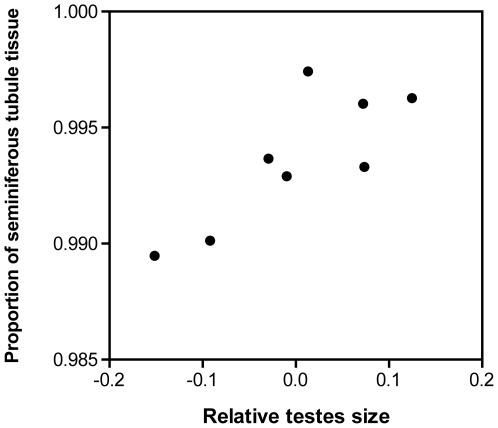
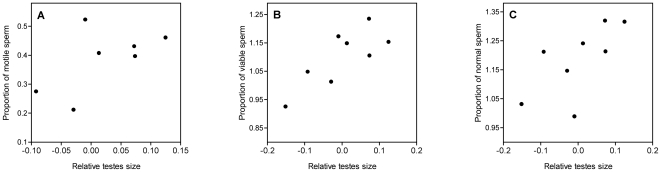
When ejaculates from rival males compete for fertilization, there is strong selection for sperm traits that enhance fertilization success. Sperm quantity is one such trait, and numerous studies have demonstrated a positive association between sperm competition and both testes size and the number of sperm available for copulations. Sperm competition is also thought to favor increases in sperm quality and changes in testicular morphology that lead to increased sperm production. However, in contrast to sperm quantity, these hypotheses have received considerably less empirical support and remain somewhat controversial. In a comparative study using the Australian Maluridae (fairy-wrens, emu-wrens, grasswrens), we tested whether increasing levels of sperm competition were associated with increases in both sperm quantity and quality, as well as an increase in the relative amount of seminiferous tubule tissue contained within the testes. After controlling for phylogeny, we found positive associations between sperm competition and sperm numbers, both in sperm reserves and in ejaculate samples. Additionally, as sperm competition level increased, the proportion of testicular spermatogenic tissue also increased, suggesting that sperm competition selects for greater sperm production per unit of testicular tissue. Finally, we also found that sperm competition level was positively associated with multiple sperm quality traits, including the proportion of motile sperm in ejaculates and the proportion of both viable and morphologically normal sperm in sperm reserves. These results suggest multiple ejaculate traits, as well as aspects of testicular morphology, have evolved in response to sperm competition in the Australian Maluridae. Furthermore, our findings emphasize the importance of post-copulatory sexual selection as an evolutionary force shaping macroevolutionary differences in sperm phenotype.
当来自竞争对手的雄性精液争夺受精机会时,那些能够增强受精成功率的精子特征会受到强烈的选择。精子数量就是这样一种特征,许多研究已经表明,精子竞争与睾丸大小和可用于交配的精子数量之间存在正相关关系。精子竞争也被认为有利于提高精子质量和改变睾丸形态,从而增加精子产量。然而,与精子数量相比,这些假设得到的实证支持要少得多,并且仍然存在一些争议。在一项使用澳大利亚 Maluridae(琴鸟、鸸鹋鸟、草鹨)的比较研究中,我们测试了精子竞争水平的增加是否与精子数量和质量的增加以及睾丸内包含的精小管组织的相对量的增加有关。在控制了系统发育后,我们发现精子竞争与精子数量之间存在正相关关系,无论是在精子储备中还是在精液样本中。此外,随着精子竞争水平的提高,睾丸生精组织的比例也增加了,这表明精子竞争选择了单位睾丸组织中更大的精子产量。最后,我们还发现,精子竞争水平与多个精子质量特征呈正相关,包括精液中活动精子的比例以及精子储备中存活和形态正常精子的比例。这些结果表明,多个精液特征以及睾丸形态的某些方面已经进化以应对澳大利亚 Maluridae 中的精子竞争。此外,我们的研究结果强调了种后性选择作为塑造精子表型宏观进化差异的进化力量的重要性。