Department of Biochemistry, University of Cambridge, Cambridge, United Kingdom.
PLoS One. 2011 Jan 24;6(1):e15873. doi: 10.1371/journal.pone.0015873.
Pea encodes eukaryotic translation initiation factor eIF4E (eIF4E(S)), which supports the multiplication of Pea seed-borne mosaic virus (PSbMV). In common with hosts for other potyviruses, some pea lines contain a recessive allele (sbm1) encoding a mutant eIF4E (eIF4E(R)) that fails to interact functionally with the PSbMV avirulence protein, VPg, giving genetic resistance to infection.
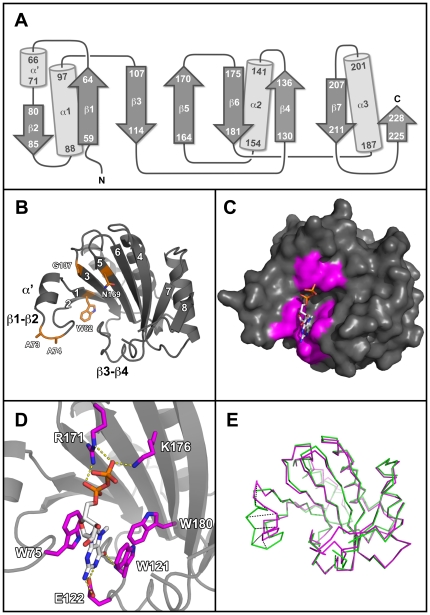
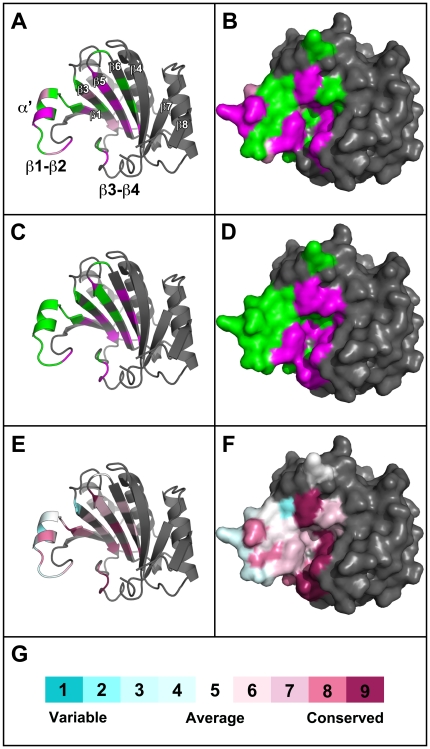
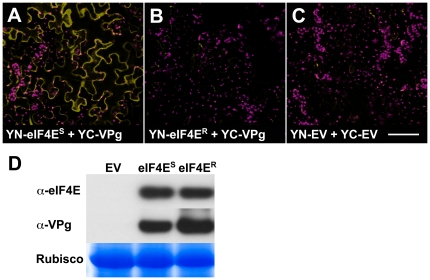
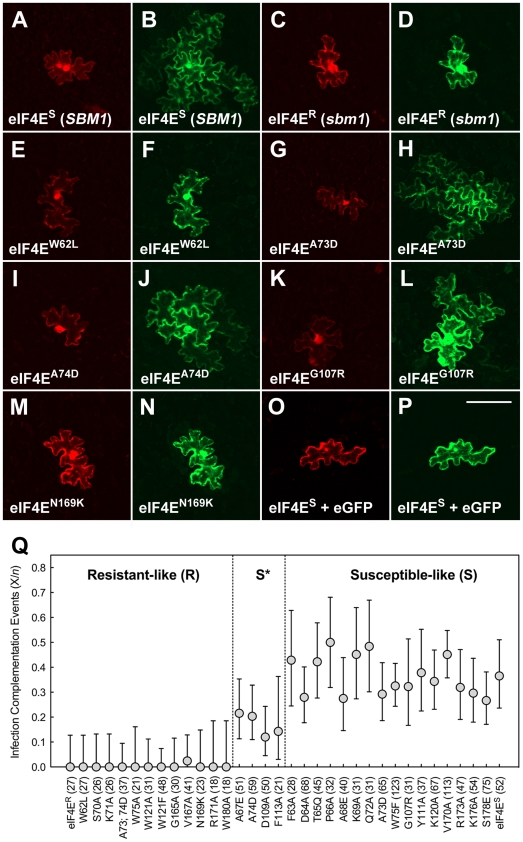
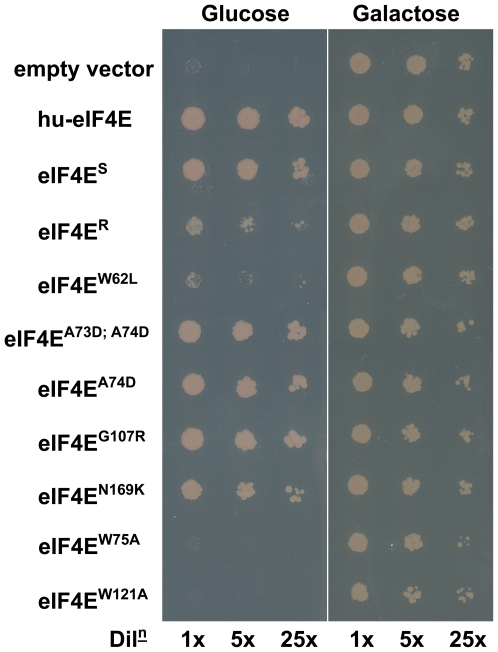
METHODOLOGY/PRINCIPAL FINDINGS: To study structure-function relationships between pea eIF4E and PSbMV VPg, we obtained an X-ray structure for eIF4E(S) bound to m(7)GTP. The crystallographic asymmetric unit contained eight independent copies of the protein, providing insights into the structurally conserved and flexible regions of eIF4E. To assess indirectly the importance of key residues in binding to VPg and/or m(7)GTP, an extensive range of point mutants in eIF4E was tested for their ability to complement PSbMV multiplication in resistant pea tissues and for complementation of protein translation, and hence growth, in an eIF4E-defective yeast strain conditionally dependent upon ectopic expression of eIF4E. The mutants also dissected individual contributions from polymorphisms present in eIF4E(R) and compared the impact of individual residues altered in orthologous resistance alleles from other crop species. The data showed that essential resistance determinants in eIF4E differed for different viruses although the critical region involved (possibly in VPg-binding) was conserved and partially overlapped with the m(7)GTP-binding region. This overlap resulted in coupled inhibition of virus multiplication and translation in the majority of cases, although the existence of a few mutants that uncoupled the two processes supported the view that the specific role of eIF4E in potyvirus infection may not be restricted to translation.
CONCLUSIONS/SIGNIFICANCE: The work describes the most extensive structural analysis of eIF4E in relation to potyvirus resistance. In addition to defining functional domains within the eIF4E structure, we identified eIF4E alleles with the potential to convey novel virus resistance phenotypes.
豌豆中 Pea 基因编码真核翻译起始因子 eIF4E(eIF4E(S)),它支持 Pea 种传花叶病毒(PSbMV)的增殖。与其他 potyvirus 的宿主一样,一些豌豆品系含有一个隐性等位基因(sbm1),该基因编码一种不能与 PSbMV 非毒性蛋白 VPg 进行功能相互作用的突变型 eIF4E(eIF4E(R)),从而赋予对感染的遗传抗性。
方法/主要发现:为了研究豌豆 eIF4E 和 PSbMV VPg 之间的结构-功能关系,我们获得了 eIF4E(S)与 m(7)GTP 结合的 X 射线结构。晶体学不对称单位包含了该蛋白的八个独立拷贝,提供了对 eIF4E 结构保守和灵活区域的深入了解。为了间接评估结合 VPg 和/或 m(7)GTP 的关键残基的重要性,我们测试了 eIF4E 的广泛点突变体,以评估它们在抗性豌豆组织中补充 PSbMV 增殖的能力,以及在 eIF4E 缺陷酵母菌株中的补充蛋白翻译的能力,该酵母菌株在异位表达 eIF4E 的条件下是有依赖性的。这些突变体还分别剖析了存在于 eIF4E(R)中的多态性的单个贡献,并比较了来自其他作物物种的同源抗性等位基因中改变的单个残基的影响。数据表明,eIF4E 中的不同病毒的关键抗性决定因素不同,尽管涉及的关键区域(可能在 VPg 结合中)是保守的,并且与 m(7)GTP 结合区域部分重叠。这种重叠导致在大多数情况下病毒增殖和翻译的耦合抑制,尽管存在一些使这两个过程解耦的突变体,这支持了 eIF4E 在 potyvirus 感染中的特定作用可能不限于翻译的观点。
结论/意义:这项工作描述了与 potyvirus 抗性相关的 eIF4E 的最广泛的结构分析。除了定义 eIF4E 结构中的功能域外,我们还鉴定了具有潜在赋予新病毒抗性表型的 eIF4E 等位基因。