Yale School of Public Health, Yale University School of Medicine, New Haven, Connecticut, USA.
mBio. 2011 Feb 1;2(1):e00245-10. doi: 10.1128/mBio.00245-10.
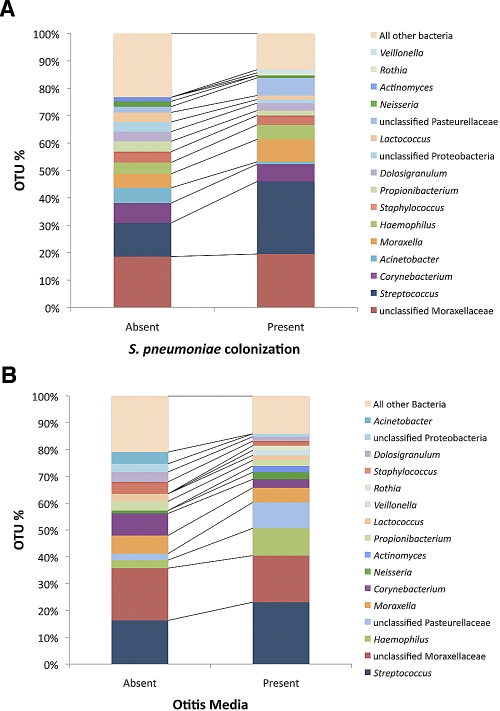
Streptococcus pneumoniae asymptomatically colonizes the upper respiratory tract of children and is a frequent cause of otitis media. Patterns of microbial colonization likely influence S. pneumoniae colonization and otitis media susceptibility. This study compared microbial communities in children with and without otitis media. Nasal swabs and clinical and demographic data were collected in a cross-sectional study of Philadelphia, PA, children (6 to 78 months) (n=108) during the 2008-2009 winter respiratory virus season. Swabs were cultured for S. pneumoniae. DNA was extracted from the swabs; 16S rRNA gene hypervariable regions (V1 and V2) were PCR amplified and sequenced by Roche/454 Life Sciences pyrosequencing. Microbial communities were described using the Shannon diversity and evenness indices. Principal component analysis (PCA) was used to group microbial community taxa into four factors representing correlated taxa. Of 108 children, 47 (44%) were colonized by S. pneumoniae, and 25 (23%) were diagnosed with otitis media. Microbial communities with S. pneumoniae were significantly less diverse and less even. Two PCA factors were associated with a decreased risk of pneumococcal colonization and otitis media, as follows: one factor included potentially protective flora (Corynebacterium and Dolosigranulum), and the other factor included Propionibacterium, Lactococcus, and Staphylococcus. The remaining two PCA factors were associated with an increased risk of otitis media. One factor included Haemophilus, and the final factor included Actinomyces, Rothia, Neisseria, and Veillonella. Generally, these taxa are not considered otitis media pathogens but may be important in the causal pathway. Increased understanding of upper respiratory tract microbial communities will contribute to the development of otitis media treatment and prevention strategies.
肺炎链球菌无症状地定植于儿童的上呼吸道,是中耳炎的常见病因。微生物定植模式可能影响肺炎链球菌定植和中耳炎易感性。本研究比较了中耳炎患儿和无中耳炎患儿的微生物群落。在 2008-2009 年冬季呼吸道病毒季节,对宾夕法尼亚州费城的儿童(6 至 78 个月)(n=108)进行了一项横断面研究,采集了鼻腔拭子和临床及人口统计学数据。对拭子进行了肺炎链球菌培养。从拭子中提取 DNA;通过罗氏/454 生命科学焦磷酸测序对 16S rRNA 基因高变区(V1 和 V2)进行 PCR 扩增和测序。使用 Shannon 多样性和均匀度指数描述微生物群落。主成分分析(PCA)用于将微生物群落分类群分为四个代表相关分类群的因子。在 108 名儿童中,有 47 名(44%)被肺炎链球菌定植,25 名(23%)被诊断为中耳炎。携带肺炎链球菌的微生物群落多样性和均匀度明显降低。两个 PCA 因子与降低肺炎链球菌定植和中耳炎的风险相关,如下所示:一个因子包括潜在的保护菌群(棒状杆菌和 Dolosigranulum),另一个因子包括丙酸杆菌、乳球菌和葡萄球菌。其余两个 PCA 因子与中耳炎风险增加相关。一个因子包括嗜血杆菌,最后一个因子包括放线菌、罗氏菌、奈瑟菌和韦荣球菌。一般来说,这些分类群不被认为是中耳炎的病原体,但可能在因果途径中很重要。对上呼吸道微生物群落的进一步了解将有助于制定中耳炎的治疗和预防策略。