MRC Human Nutrition Research, Elsie Widdowson Laboratory, Fulbourn Road, Cambridge CB1 9NL, UK.
Atherosclerosis. 2011 Apr;215(2):421-7. doi: 10.1016/j.atherosclerosis.2010.12.039. Epub 2011 Jan 19.
SNPs identified from genome-wide association studies associate with lipid risk markers of cardiovascular disease. This study investigated whether these SNPs altered the plasma lipid response to diet in the 'RISCK' study cohort.
Participants (n=490) from a dietary intervention to lower saturated fat by replacement with carbohydrate or monounsaturated fat, were genotyped for 39 lipid-associated SNPs. The association of each individual SNP, and of the SNPs combined (using genetic predisposition scores), with plasma lipid concentrations was assessed at baseline, and on change in response to 24 weeks on diets.
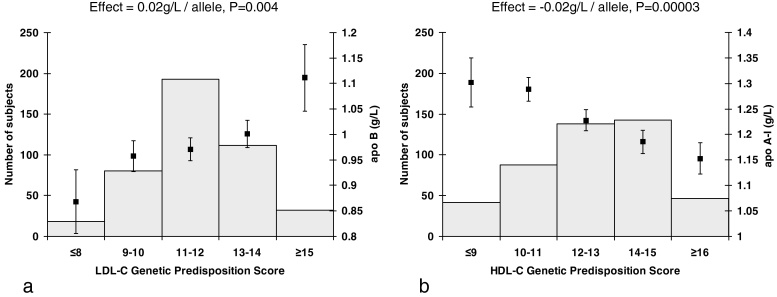
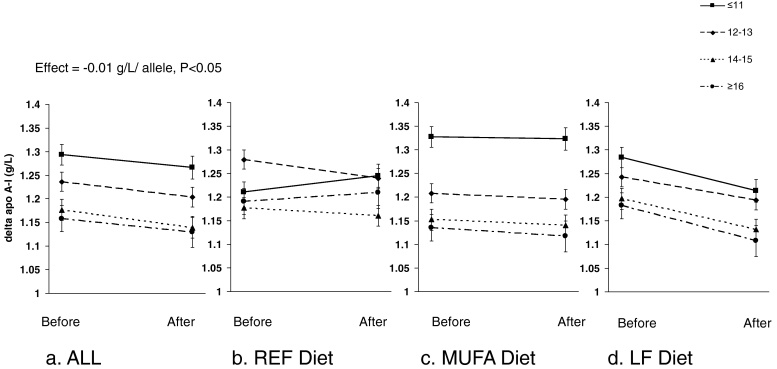
The associations between SNPs and lipid concentrations were directionally consistent with previous findings. The genetic predisposition scores were associated with higher baseline concentrations of plasma total (P=0.02) and LDL (P=0.002) cholesterol, triglycerides (P=0.001) and apolipoprotein B (P=0.004), and with lower baseline concentrations of HDL cholesterol (P<0.001) and apolipoprotein A-I (P<0.001). None of the SNPs showed significant association with the reduction of plasma lipids in response to the dietary interventions and there was no evidence of diet-gene interactions.
Results from this exploratory study have shown that increased genetic predisposition was associated with an unfavourable plasma lipid profile at baseline, but did not influence the improvement in lipid profiles by the low-saturated-fat diets.
全基因组关联研究中鉴定的 SNP 与心血管疾病的脂质风险标志物相关。本研究调查了这些 SNP 是否改变了“RISCK”研究队列中饮食对血浆脂质的反应。
通过用碳水化合物或单不饱和脂肪替代饱和脂肪来降低饱和脂肪的饮食干预研究中的 490 名参与者进行了 39 个与脂质相关的 SNP 基因分型。在基线和 24 周饮食反应变化时,评估每个 SNP 个体与血浆脂质浓度的关联,以及 SNP 组合(使用遗传易感性评分)与血浆脂质浓度的关联。
SNP 与脂质浓度之间的关联与先前的发现方向一致。遗传易感性评分与血浆总胆固醇(P=0.02)和 LDL 胆固醇(P=0.002)、甘油三酯(P=0.001)和载脂蛋白 B(P=0.004)的基线浓度升高相关,与 HDL 胆固醇(P<0.001)和载脂蛋白 A-I(P<0.001)的基线浓度降低相关。没有一个 SNP 与饮食干预后血浆脂质的减少有显著关联,也没有饮食-基因相互作用的证据。
这项探索性研究的结果表明,遗传易感性增加与基线时不利的血浆脂质谱相关,但不会影响低饱和脂肪饮食对脂质谱的改善。