Hugh Sinclair Unit of Human Nutrition, Department of Food and Nutritional Sciences, University of Reading, Reading, RG6 6DZ, UK.
The Institute for Food, Nutrition, and Health (IFNH), University of Reading, Reading, UK.
Curr Atheroscler Rep. 2022 Feb;24(2):119-132. doi: 10.1007/s11883-022-00987-y. Epub 2022 Jan 31.
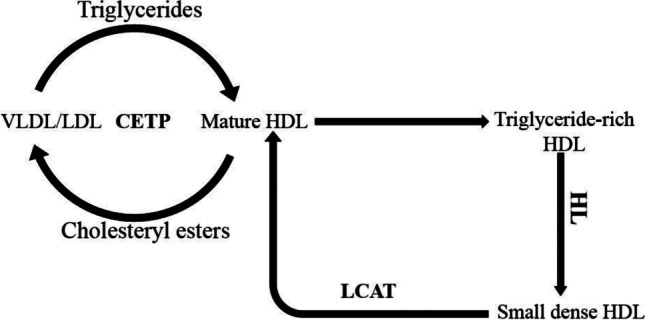
An abnormal lipid profile is considered a main risk factor for cardiovascular diseases and evidence suggests that single nucleotide polymorphisms (SNPs) in the cholesteryl ester transfer protein (CETP) gene contribute to variations in lipid levels in response to dietary intake. The objective of this review was to identify and discuss nutrigenetic studies assessing the interactions between CETP SNPs and dietary factors on blood lipids.
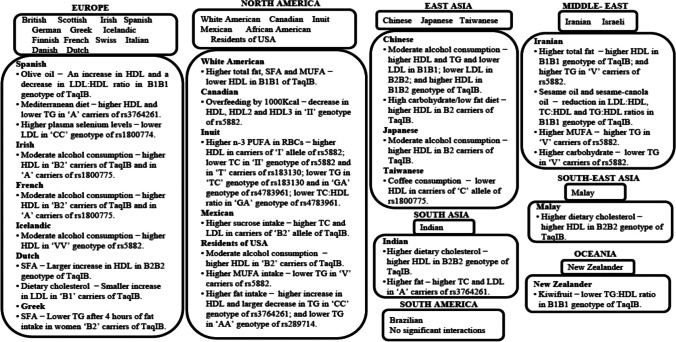
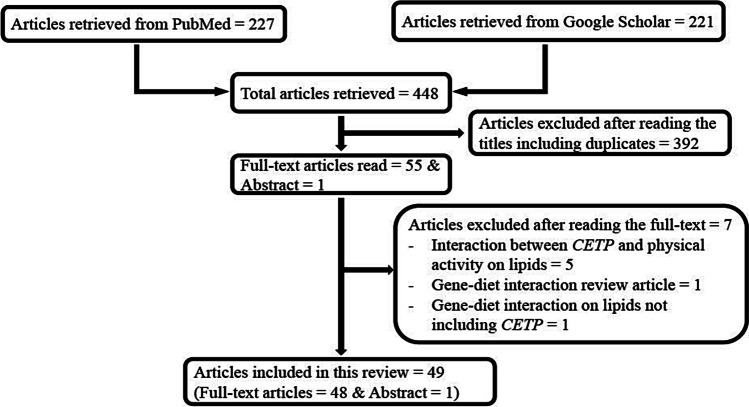
Relevant articles were obtained through a literature search of PubMed and Google Scholar through to July 2021. An article was included if it examined an interaction between CETP SNPs and dietary factors on blood lipids. From 49 eligible nutrigenetic studies, 27 studies reported significant interactions between 8 CETP SNPs and 17 dietary factors on blood lipids in 18 ethnicities. The discrepancies in the study findings could be attributed to genetic heterogeneity, and differences in sample size, study design, lifestyle and measurement of dietary intake. The most extensively studied ethnicities were those of Caucasian populations and majority of the studies reported an interaction with dietary fat intake. The rs708272 (TaqIB) was the most widely studied CETP SNP, where 'B1' allele was associated with higher CETP activity, resulting in lower high-density lipoprotein cholesterol and higher serum triglycerides under the influence of high dietary fat intake. Overall, the findings suggest that CETP SNPs might alter blood lipid profiles by modifying responses to diet, but further large studies in multiple ethnic groups are warranted to identify individuals at risk of adverse lipid response to diet.
异常的血脂谱被认为是心血管疾病的主要危险因素,有证据表明,胆固醇酯转移蛋白(CETP)基因中的单核苷酸多态性(SNP)导致血脂对饮食摄入的反应存在差异。本综述的目的是确定并讨论评估 CETP SNP 与饮食因素对血脂相互作用的营养遗传学研究。
通过对 PubMed 和 Google Scholar 进行文献检索,检索时间截至 2021 年 7 月,获取相关文章。如果文章研究了 CETP SNP 与饮食因素对血脂的相互作用,则将其纳入。从 49 项符合条件的营养遗传学研究中,有 27 项研究报道了 18 个种族中 8 个 CETP SNP 和 17 个饮食因素对血脂的显著相互作用。研究结果的差异可能归因于遗传异质性,以及样本量、研究设计、生活方式和饮食摄入测量的差异。研究最多的种族是白种人群体,大多数研究报告了与饮食脂肪摄入的相互作用。rs708272(TaqIB)是研究最多的 CETP SNP,其中'B1'等位基因与更高的 CETP 活性相关,在高饮食脂肪摄入的影响下,导致高密度脂蛋白胆固醇降低和血清甘油三酯升高。总的来说,这些发现表明,CETP SNP 可能通过改变对饮食的反应来改变血脂谱,但需要在多个种族群体中进行更大规模的研究,以确定对饮食不良血脂反应有风险的个体。