Department of Statistics, The Pennsylvania State University, University Park, PA, USA.
Hum Genet. 2011 Jun;129(6):629-39. doi: 10.1007/s00439-011-0960-6. Epub 2011 Feb 4.
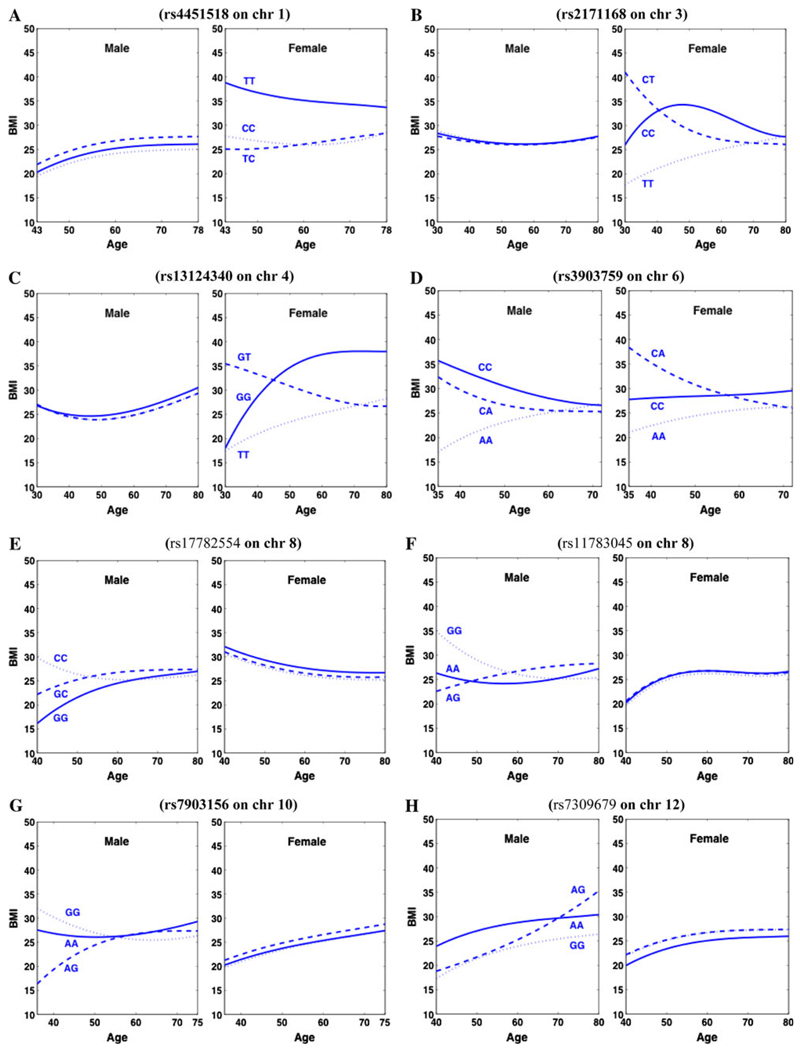
Although genome-wide association studies (GWAS) are widely used to identify the genetic and environmental etiology of a trait, several key issues related to their statistical power and biological relevance have remained unexplored. Here, we describe a novel statistical approach, called functional GWAS or fGWAS, to analyze the genetic control of traits by integrating biological principles of trait formation into the GWAS framework through mathematical and statistical bridges. fGWAS can address many fundamental questions, such as the patterns of genetic control over development, the duration of genetic effects, as well as what causes developmental trajectories to change or stop changing. In statistics, fGWAS displays increased power for gene detection by capitalizing on cumulative phenotypic variation in a longitudinal trait over time and increased robustness for manipulating sparse longitudinal data.
尽管全基因组关联研究(GWAS)被广泛用于识别性状的遗传和环境病因,但与它们的统计能力和生物学相关性相关的几个关键问题仍未得到探索。在这里,我们描述了一种新的统计方法,称为功能 GWAS 或 fGWAS,通过数学和统计桥梁将性状形成的生物学原理整合到 GWAS 框架中,从而分析性状的遗传控制。fGWAS 可以解决许多基本问题,例如遗传对发育的控制模式、遗传效应的持续时间,以及导致发育轨迹改变或停止改变的原因。在统计学中,fGWAS 通过利用纵向性状随时间的累积表型变异来提高基因检测的能力,并通过操纵稀疏的纵向数据来提高稳健性。