Margaret Dyson Vision Institute, Weill Cornell Medical College, 1300 York Avenue, New York, NY 10065, USA.
Hum Genomics. 2011 Jan;5(2):108-16. doi: 10.1186/1479-7364-5-2-108.
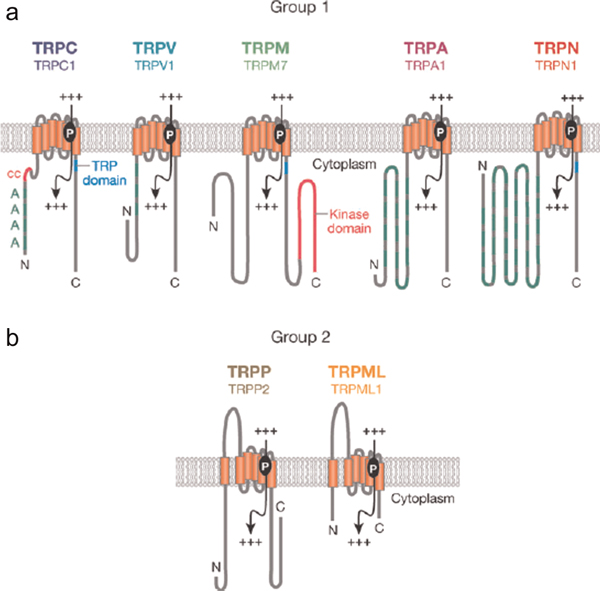
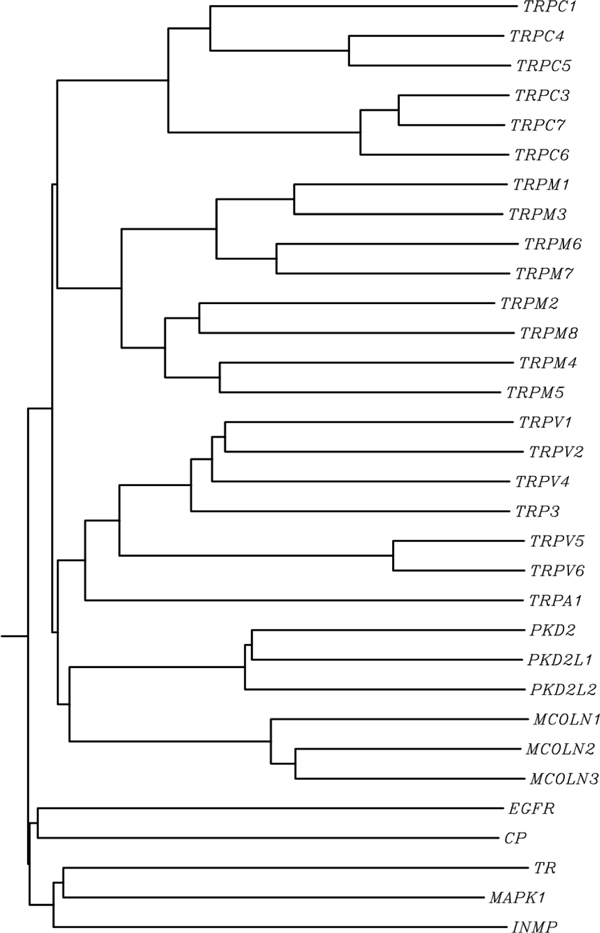
Transient receptor potential (TRP) non-selective cation channels constitute a superfamily, which contains 28 different genes. In mammals, this superfamily is divided into six subfamilies based on differences in amino acid sequence homology between the different gene products. Proteins within a subfamily aggregate to form heteromeric or homomeric tetrameric configurations. These different groupings have very variable permeability ratios for calcium versus sodium ions. TRP expression is widely distributed in neuronal tissues, as well as a host of other tissues, including epithelial and endothelial cells. They are activated by environmental stresses that include tissue injury, changes in temperature, pH and osmolarity, as well as volatile chemicals, cytokines and plant compounds. Their activation induces, via intracellular calcium signalling, a host of responses, including stimulation of cell proliferation, migration, regulatory volume behaviour and the release of a host of cytokines. Their activation is greatly potentiated by phospholipase C (PLC) activation mediated by coupled GTP-binding proteins and tyrosine receptors. In addition to their importance in maintaining tissue homeostasis, some of these responses may involve various underlying diseases. Given the wealth of literature describing the multiple roles of TRP in physiology in a very wide range of different mammalian tissues, this review limits itself to the literature describing the multiple roles of TRP channels in different ocular tissues. Accordingly, their importance to the corneal, trabecular meshwork, lens, ciliary muscle, retinal, microglial and retinal pigment epithelial physiology and pathology is reviewed.
瞬时受体电位(TRP)非选择性阳离子通道构成一个超家族,其中包含 28 个不同的基因。在哺乳动物中,根据不同基因产物之间氨基酸序列同源性的差异,该超家族分为六个亚家族。亚家族内的蛋白质聚集形成异源或同源的四聚体构型。这些不同的分组对钙离子与钠离子的通透性比值差异很大。TRP 的表达广泛分布于神经元组织以及许多其他组织中,包括上皮细胞和内皮细胞。它们被环境应激激活,包括组织损伤、温度变化、pH 值和渗透压变化以及挥发性化学物质、细胞因子和植物化合物。它们的激活通过细胞内钙信号诱导多种反应,包括刺激细胞增殖、迁移、调节体积行为和释放多种细胞因子。它们的激活通过偶联 GTP 结合蛋白和酪氨酸受体介导的磷脂酶 C(PLC)激活而大大增强。除了在维持组织内稳态方面的重要性外,这些反应中的一些可能涉及各种潜在疾病。鉴于描述 TRP 在非常广泛的不同哺乳动物组织中的生理学中的多种作用的文献丰富,本综述将其限制在描述 TRP 通道在不同眼部组织中的多种作用的文献。因此,综述了它们对角膜、小梁网、晶状体、睫状肌、视网膜、小胶质细胞和视网膜色素上皮的生理学和病理学的重要性。