Departament de Ciències Fisiològiques II, Universitat de Barcelona, IDIBELL, L'Hospitalet de Llobregat, Spain.
PLoS One. 2011 Jan 28;6(1):e16477. doi: 10.1371/journal.pone.0016477.
Bone morphogenetic proteins (BMPs) have been shown to participate in the patterning and specification of several tissues and organs during development and to regulate cell growth, differentiation and migration in different cell types. BMP-mediated cell migration requires activation of the small GTPase Cdc42 and LIMK1 activities. In our earlier report we showed that activation of LIMK1 also requires the activation of PAKs through Cdc42 and PI3K. However, the requirement of additional signaling is not clearly known.
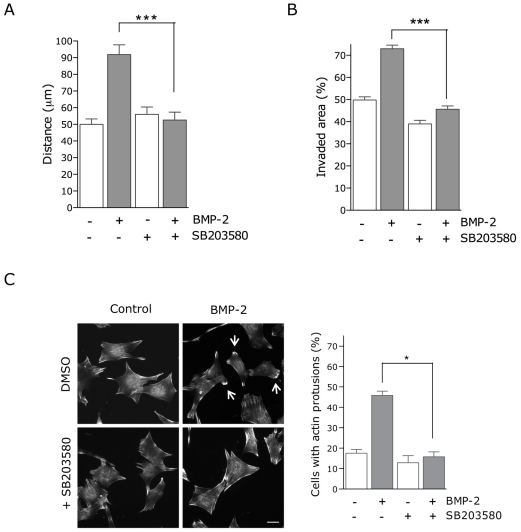
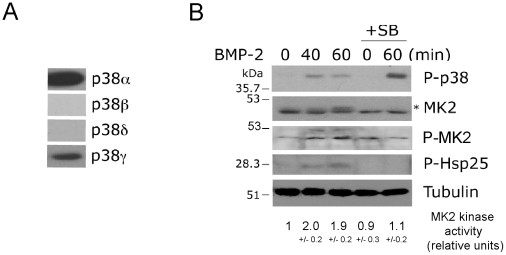
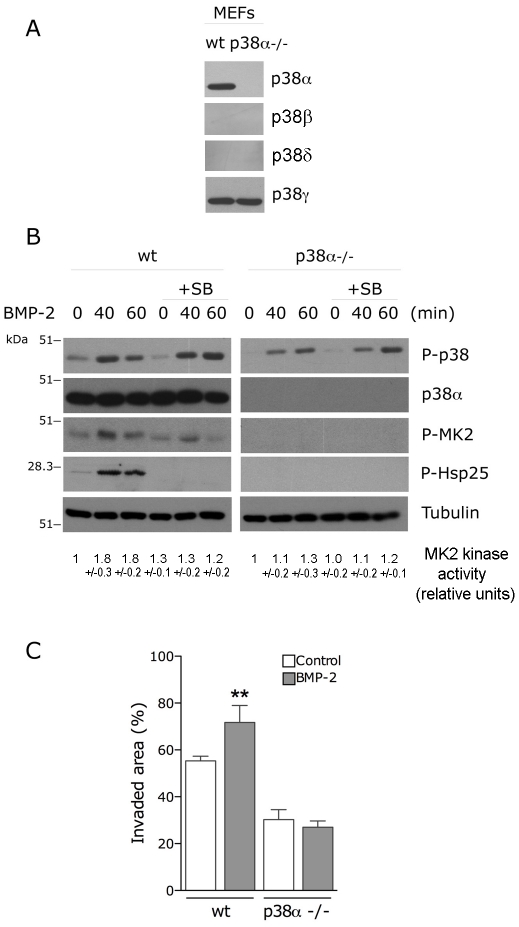
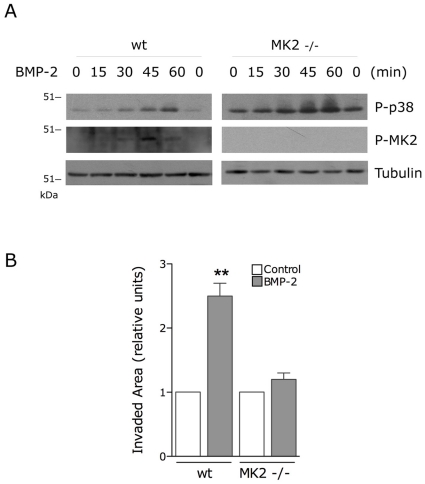
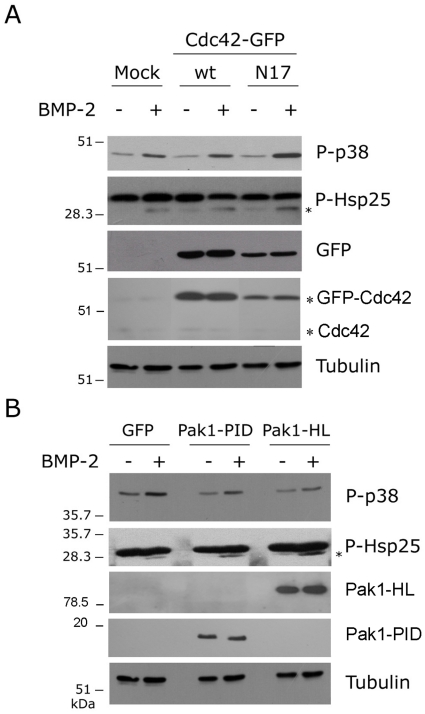
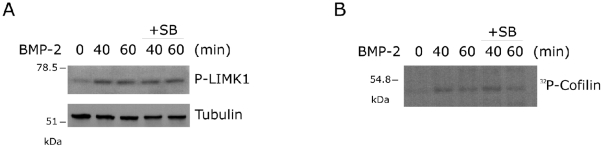
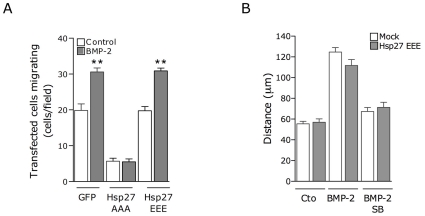
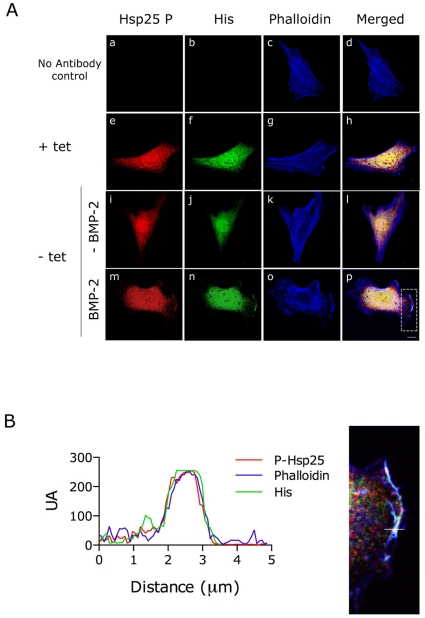
METHODOLOGY/PRINCIPAL FINDINGS: Activation of p38 MAPK has been shown to be relevant for a number of BMP-2's physiological effects. We report here that BMP-2 regulation of cell migration and actin cytoskeleton remodelling are dependent on p38 activity. BMP-2 treatment of mesenchymal cells results in activation of the p38/MK2/Hsp25 signaling pathway downstream from the BMP receptors. Moreover, chemical inhibition of p38 signaling or genetic ablation of either p38α or MK2 blocks the ability to activate the downstream effectors of the pathway and abolishes BMP-2-induction of cell migration. These signaling effects on p38/MK2/Hsp25 do not require the activity of either Cdc42 or PAK, whereas p38/MK2 activities do not significantly modify the BMP-2-dependent activation of LIMK1, measured by either kinase activity or with an antibody raised against phospho-threonine 508 at its activation loop. Finally, phosphorylated Hsp25 colocalizes with the BMP receptor complexes in lamellipodia and overexpression of a phosphorylation mutant form of Hsp25 is able to abolish the migration of cells in response to BMP-2.
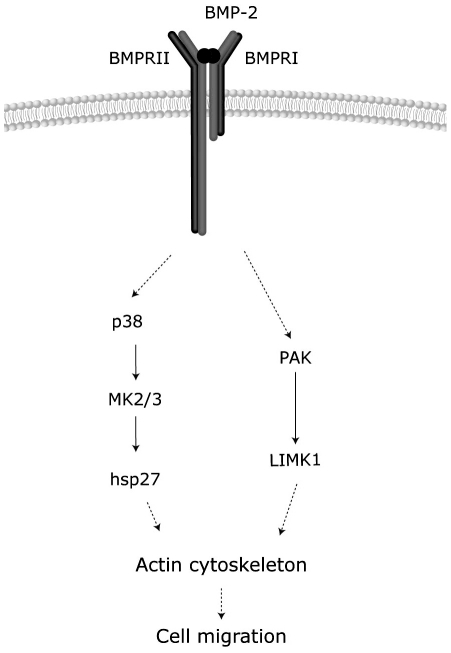
These results indicate that Cdc42/PAK/LIMK1 and p38/MK2/Hsp25 pathways, acting in parallel and modulating specific actin regulatory proteins, play a critical role in integrating responses during BMP-induced actin reorganization and cell migration.
骨形态发生蛋白(BMPs)已被证明在发育过程中参与了几种组织和器官的模式形成和特化,并调节不同细胞类型中的细胞生长、分化和迁移。BMP 介导的细胞迁移需要小 GTPase Cdc42 和 LIMK1 活性的激活。在我们之前的报告中,我们表明 LIMK1 的激活也需要通过 Cdc42 和 PI3K 激活 PAKs。然而,尚不清楚是否需要其他信号。
方法/主要发现:已经表明 p38 MAPK 的激活与许多 BMP-2 的生理效应有关。我们在这里报告,BMP-2 对细胞迁移和肌动蛋白细胞骨架重塑的调节依赖于 p38 活性。BMP-2 处理间充质细胞导致 BMP 受体下游的 p38/MK2/Hsp25 信号通路的激活。此外,化学抑制 p38 信号或基因敲除 p38α 或 MK2 会阻断激活该途径下游效应物的能力,并消除 BMP-2 诱导的细胞迁移。这些 p38/MK2/Hsp25 的信号效应不需要 Cdc42 或 PAK 的活性,而 p38/MK2 活性不会显著改变 LIMK1 的 BMP-2 依赖性激活,这可以通过激酶活性或用针对其激活环磷酸化苏氨酸 508 的抗体来测量。最后,磷酸化的 Hsp25 与 BMP 受体复合物在片状伪足中共定位,并且过表达磷酸化突变形式的 Hsp25 能够消除细胞对 BMP-2 的迁移。
这些结果表明,Cdc42/PAK/LIMK1 和 p38/MK2/Hsp25 途径平行作用并调节特定的肌动蛋白调节蛋白,在整合 BMP 诱导的肌动蛋白重排和细胞迁移过程中的反应中发挥关键作用。