Department of Internal Medicine and Cardiovascular Diseases, Hypertension Excellence Centre of the European Society of Hypertension, University Hospital Ospedali Riuniti, University Politecnica delle Marche, Ancona, Italy.
PLoS One. 2011 Jan 31;6(1):e16630. doi: 10.1371/journal.pone.0016630.
Overweight (Ow) and obesity (Ob) influence blood pressure (BP) and left ventricular hypertrophy (LVH). It is unclear whether the presence of metabolic syndrome (MetS) independently affects echocardiographic parameters in hypertension.
380 Ow/Ob essential hypertensive patients (age ≤ 65 years) presenting for referred BP control-related problems. MetS was defined according to NCEP III/ATP with AHA modifications and LVH as LVM/h(2.7) ≥ 49.2 g/m(2.7) in males and ≥ 46.7 g/m(2.7) in females. Treatment intensity score (TIS) was used to control for BP treatment as previously reported.
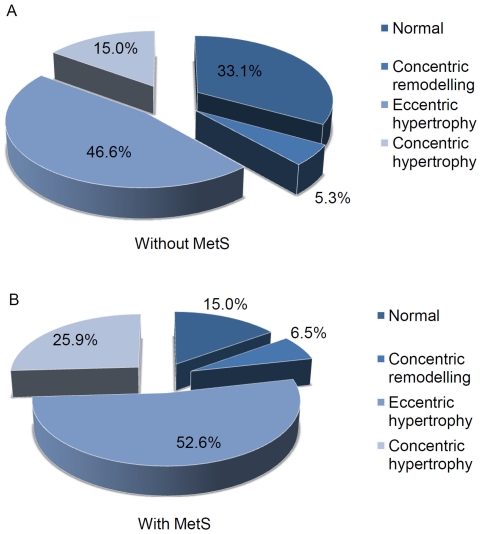
Hypertensive patients with MetS had significantly higher BMI, systolic and mean BP, interventricular septum and relative wall thickness and lower ejection fraction than those without MetS. LVM/h(2.7) was significantly higher in MetS patients (59.14 ± 14.97 vs. 55.33 ± 14.69 g/m(2.7); p = 0.022). Hypertensive patients with MetS had a 2.3-fold higher risk to have LVH/h(2.7) after adjustment for age, SBP and TIS (OR 2.34; 95%CI 1.40-3.92; p = 0.001), but MetS lost its independent relationship with LVH when BMI was included in the model.
In Ow/Ob hypertensive patients MetS maintains its role of risk factor for LVH independently of age, SBP, and TIS, resulting in a useful predictor of target organ damage in clinical practice. However, MetS loses its independent relationship when BMI is taken into account, suggesting that the effects on MetS on LV parameters are mainly driven by the degree of adiposity.
超重(Ow)和肥胖(Ob)会影响血压(BP)和左心室肥厚(LVH)。代谢综合征(MetS)是否独立影响高血压患者的超声心动图参数尚不清楚。
380 名Ow/Ob 原发性高血压患者(年龄≤65 岁)因血压控制相关问题就诊。MetS 按 NCEP III/ATP 标准伴 AHA 修正标准定义,左心室质量指数(LVM)/h(2.7)男性≥49.2 g/m(2.7),女性≥46.7 g/m(2.7)定义为 LVH。如既往报道,采用治疗强度评分(TIS)控制血压治疗。
伴有 MetS 的高血压患者的 BMI、收缩压和平均血压、室间隔和相对壁厚度更高,射血分数更低,与不伴有 MetS 的患者相比差异具有统计学意义。MetS 患者的 LVM/h(2.7)显著更高(59.14±14.97 比 55.33±14.69 g/m(2.7);p=0.022)。校正年龄、SBP 和 TIS 后,伴有 MetS 的高血压患者发生 LVH/h(2.7)的风险增加 2.3 倍(OR 2.34;95%CI 1.40-3.92;p=0.001),但当 BMI 纳入模型后,MetS 与 LVH 之间的独立关系消失。
在 Ow/Ob 高血压患者中,MetS 作为 LVH 的危险因素独立于年龄、SBP 和 TIS,是临床实践中评估靶器官损害的有用预测因子。然而,当考虑 BMI 时,MetS 与 LV 参数之间的独立关系消失,提示 MetS 对 LV 参数的影响主要由肥胖程度决定。