Department of Genetics, University of Leicester, Leicester LE1 7RH, UK.
The Department of Zoology, University of Oxford, South Parks Road, Oxford OX1 3SY, UK.
Microbiology (Reading). 2011 May;157(Pt 5):1446-1456. doi: 10.1099/mic.0.046946-0. Epub 2011 Feb 10.
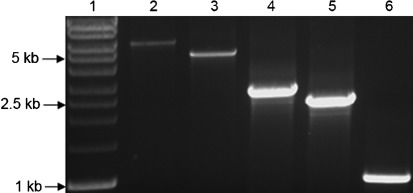
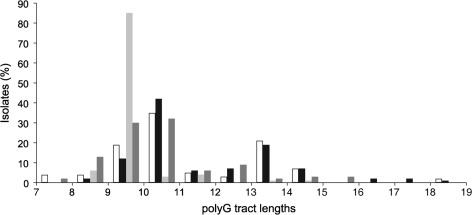
Neisseria meningitidis can utilize haem, haemoglobin and haemoglobin-haptoglobin complexes as sources of iron via two TonB-dependent phase variable haemoglobin receptors, HmbR and HpuAB. HmbR is over-represented in disease isolates, suggesting a link between haemoglobin acquisition and meningococcal disease. This study compared the distribution of HpuAB and phase variation (PV) status of both receptors in disease and carriage isolates. Meningococcal disease (n = 214) and carriage (n = 305) isolates representative of multiple clonal complexes (CCs) were investigated for the distribution, polyG tract lengths and ON/OFF status of both haemoglobin receptors, and for the deletion mechanism for HpuAB. Strains with both receptors or only hmbR were present at similar frequencies among meningococcal disease isolates as compared with carriage isolates. However, >90 % of isolates from the three CCs CC5, CC8 and CC11 with the highest disease to carriage ratios contained both receptors. Strains with an hpuAB-only phenotype were under-represented among disease isolates, suggesting selection against this receptor during systemic disease, possibly due to the receptor having a high level of immunogenicity or being inefficient in acquisition of iron during systemic spread. Absence of hpuAB resulted from either complete deletion or replacement by an insertion element. In an examination of PV status, one or both receptors were found in an ON state in 91 % of disease and 71 % of carriage isolates. We suggest that expression of a haemoglobin receptor, either HmbR or HpuAB, is of major importance for systemic spread of meningococci, and that the presence of both receptors contributes to virulence in some strains.
脑膜炎奈瑟菌可以通过两种依赖 TonB 的相变体血红蛋白受体 HmbR 和 HpuAB 将血液、血红蛋白和血红蛋白结合珠蛋白复合物用作铁源。HmbR 在疾病分离株中过度表达,表明血红蛋白获取与脑膜炎奈瑟菌疾病之间存在联系。本研究比较了疾病和带菌分离株中 HpuAB 和相变体 (PV) 状态的分布。研究了代表多个克隆复合体 (CC) 的脑膜炎奈瑟菌疾病 (n = 214) 和带菌 (n = 305) 分离株,以研究两种血红蛋白受体的分布、多 G 区长度和 ON/OFF 状态,以及 HpuAB 的缺失机制。与带菌分离株相比,疾病分离株中同时存在两种受体或仅存在 hmbR 的菌株的频率相似。然而,在疾病与带菌比例最高的三个 CC(CC5、CC8 和 CC11)中,>90%的分离株同时含有这两种受体。在疾病分离株中,仅含有 hpuAB 的菌株较少,这表明在全身性疾病期间该受体受到选择,这可能是由于该受体具有高度的免疫原性或在全身性传播期间对铁的获取效率较低。hpuAB 的缺失是由于完全缺失或插入元件的替换。在检查 PV 状态时,在 91%的疾病和 71%的带菌分离株中发现一个或两个受体处于 ON 状态。我们认为,血红蛋白受体(HmbR 或 HpuAB)的表达对脑膜炎奈瑟菌的全身性传播至关重要,并且在某些菌株中存在两种受体有助于其毒力。