Leibniz Institute for Neurobiology, Magdeburg, Germany.
PLoS One. 2011 Feb 2;6(2):e15820. doi: 10.1371/journal.pone.0015820.
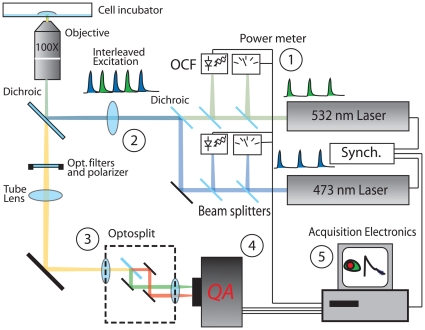
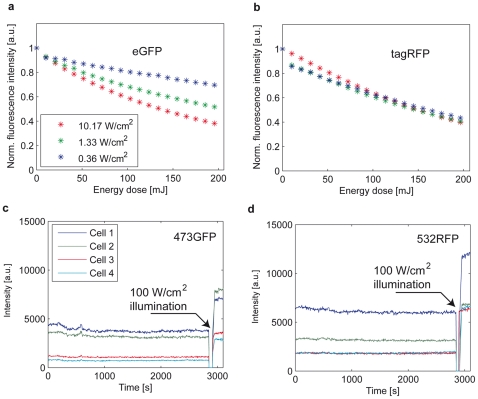
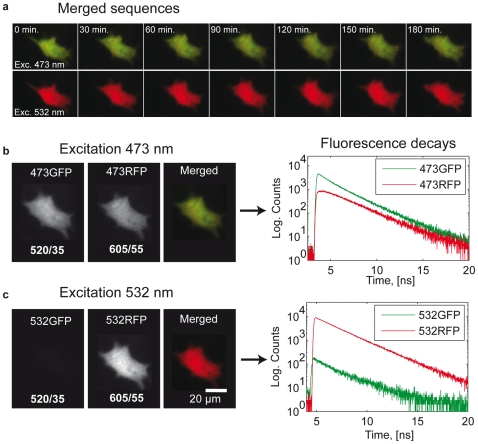
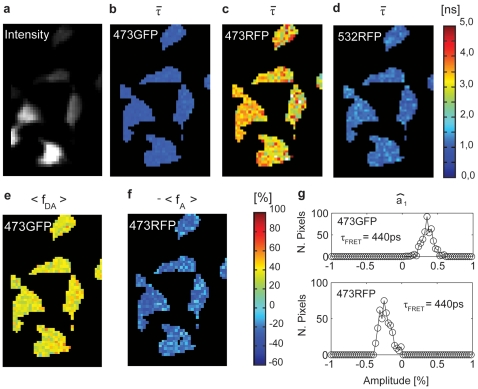
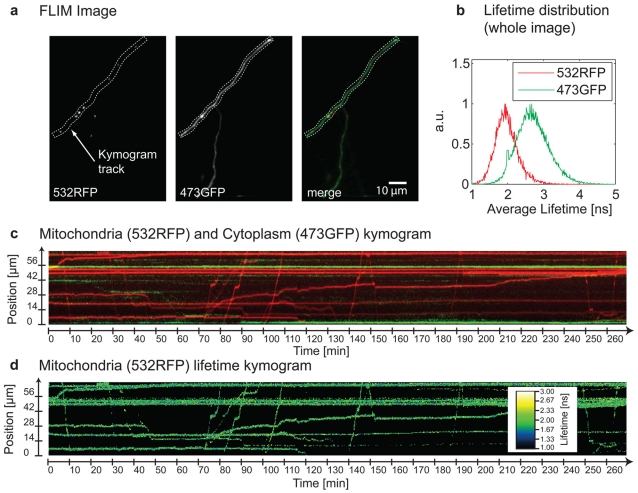
Time-domain Fluorescence Lifetime Imaging Microscopy (FLIM) is a remarkable tool to monitor the dynamics of fluorophore-tagged protein domains inside living cells. We propose a Wide-Field Multi-Parameter FLIM method (WFMP-FLIM) aimed to monitor continuously living cells under minimum light intensity at a given illumination energy dose. A powerful data analysis technique applied to the WFMP-FLIM data sets allows to optimize the estimation accuracy of physical parameters at very low fluorescence signal levels approaching the lower bound theoretical limit. We demonstrate the efficiency of WFMP-FLIM by presenting two independent and relevant long-term experiments in cell biology: 1) FRET analysis of simultaneously recorded donor and acceptor fluorescence in living HeLa cells and 2) tracking of mitochondrial transport combined with fluorescence lifetime analysis in neuronal processes.
时域荧光寿命成像显微镜(FLIM)是一种监测活细胞内荧光标记蛋白结构域动力学的卓越工具。我们提出了一种宽场多参数 FLIM 方法(WFMP-FLIM),旨在以给定的照明能量剂量下,在最低光强下连续监测活细胞。将一种强大的数据分析技术应用于 WFMP-FLIM 数据集,可在非常低的荧光信号水平(接近理论下限)下优化物理参数的估计精度。我们通过展示细胞生物学中的两个独立且相关的长期实验,证明了 WFMP-FLIM 的效率:1)在活 HeLa 细胞中同时记录供体和受体荧光的 FRET 分析,以及 2)与神经元过程中的荧光寿命分析相结合的线粒体运输跟踪。