Chen Sigeng, Owens Geoffrey C, Edelman David B
The Neurosciences Institute, San Diego, California, United States of America.
PLoS One. 2008 Jul 30;3(7):e2804. doi: 10.1371/journal.pone.0002804.
The trafficking of mitochondria within neurons is a highly regulated process. In an earlier study, we found that serotonin (5-HT), acting through the 5-HT1A receptor subtype, promotes axonal transport of mitochondria in cultured hippocampal neurons by increasing Akt activity, and consequently decreasing glycogen synthase kinase (GSK3beta) activity. This finding suggests a critical role for neuromodulators in the regulation of mitochondrial trafficking in neurons. In the present study, we investigate the effects of a second important neuromodulator, dopamine, on mitochondrial transport in hippocampal neurons.
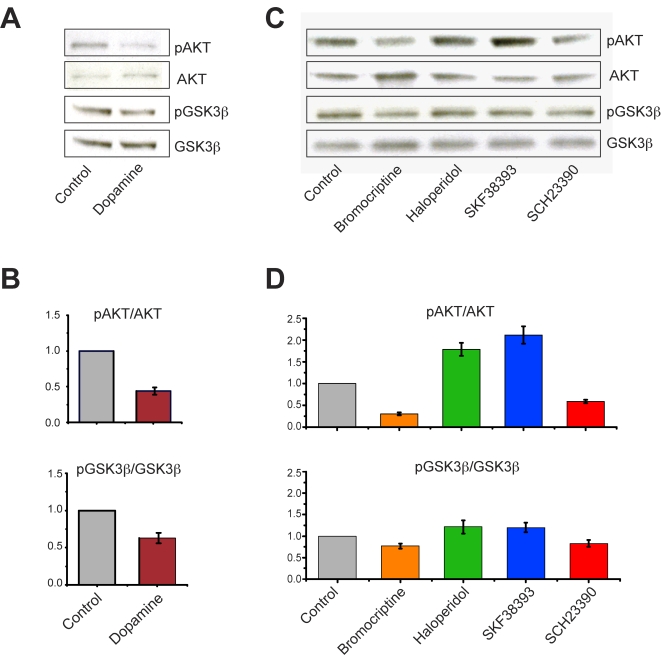
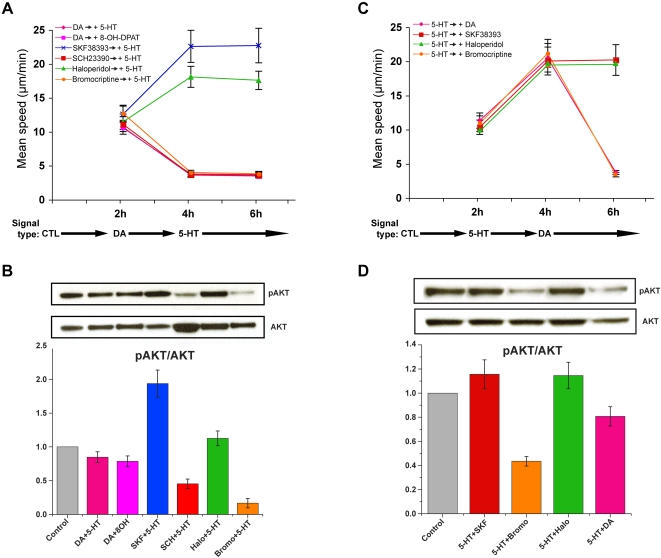
METHODOLOGY/PRINCIPAL FINDINGS: Here, we show that dopamine, like 5-HT, regulates mitochondrial motility in cultured hippocampal neurons through the Akt-GSK3beta signaling cascade. But, in contrast to the stimulatory effect of 5-HT, administration of exogenous dopamine or bromocriptine, a dopamine 2 receptor (D2R) agonist, caused an inhibition of mitochondrial movement. Moreover, pretreatment with bromocriptine blocked the stimulatory effect of 5-HT on mitochondrial movement. Conversely, in cells pretreated with 5-HT, no further increases in movement were observed after administration of haloperidol, a D2R antagonist. In contrast to the effect of the D2R agonist, addition of SKF38393, a dopamine 1 receptor (D1R) agonist, promoted mitochondrial transport, indicating that the inhibitory effect of dopamine was actually the net summation of opposing influences of the two receptor subtypes. The most pronounced effect of dopamine signals was on mitochondria that were already moving directionally. Western blot analysis revealed that treatment with either a D2R agonist or a D1R antagonist decreased Akt activity, and conversely, treatment with either a D2R antagonist or a D1R agonist increased Akt activity.
CONCLUSIONS/SIGNIFICANCE: Our observations strongly suggest a role for both dopamine and 5-HT in regulating mitochondrial movement, and indicate that the integrated effects of these two neuromodulators may be important in determining the distribution of energy sources in neurons.
神经元内线粒体的运输是一个高度受调控的过程。在早期研究中,我们发现血清素(5-羟色胺,5-HT)通过5-HT1A受体亚型发挥作用,通过增加Akt活性,进而降低糖原合酶激酶(GSK3β)活性,促进培养的海马神经元中线粒体的轴突运输。这一发现表明神经调质在调节神经元线粒体运输中起关键作用。在本研究中,我们探究了另一种重要的神经调质多巴胺对海马神经元线粒体运输的影响。
方法/主要发现:在此,我们表明多巴胺与5-HT一样,通过Akt-GSK3β信号级联调节培养的海马神经元中线粒体的运动性。但是,与5-HT的刺激作用相反,给予外源性多巴胺或溴隐亭(一种多巴胺2受体(D2R)激动剂)会抑制线粒体运动。此外,用溴隐亭预处理可阻断5-HT对线粒体运动的刺激作用。相反,在用5-HT预处理的细胞中,给予D2R拮抗剂氟哌啶醇后,未观察到运动进一步增加。与D2R激动剂的作用相反,添加多巴胺1受体(D1R)激动剂SKF38393可促进线粒体运输,表明多巴胺的抑制作用实际上是两种受体亚型相反影响的净总和。多巴胺信号最显著的作用是对已经定向移动的线粒体。蛋白质免疫印迹分析显示,用D2R激动剂或D1R拮抗剂处理会降低Akt活性,相反,用D2R拮抗剂或D1R激动剂处理会增加Akt活性。
结论/意义:我们的观察结果强烈表明多巴胺和5-HT在调节线粒体运动中均起作用,并表明这两种神经调质的综合作用可能在确定神经元中能量来源的分布方面很重要。