Laboratorio de Genética Bioquímica (LAGENBIO), Facultad de Veterinaria, Universidad de Zaragoza, Miguel Servet 177, 50013 Zaragoza, Spain.
Vet Res. 2011 Jan 24;42(1):13. doi: 10.1186/1297-9716-42-13.
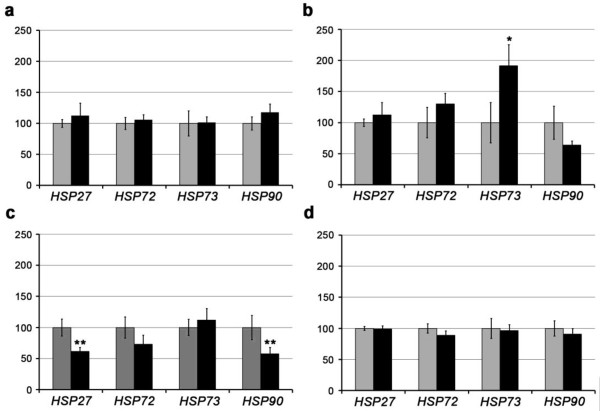
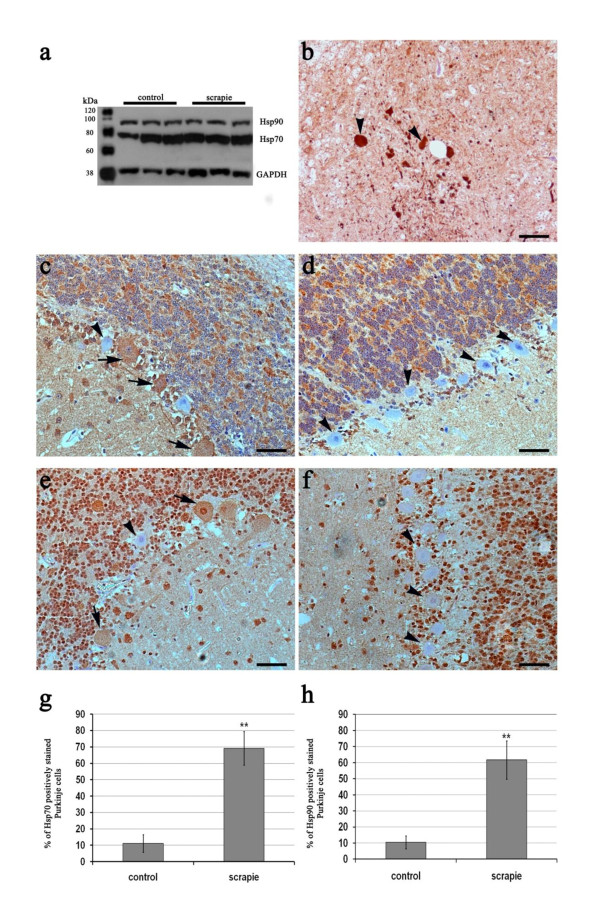
Heat shock proteins (Hsp) perform cytoprotective functions such as apoptosis regulation and inflammatory response control. These proteins can also be secreted to the extracellular medium, acting as inflammatory mediators, and their chaperone activity permits correct folding of proteins and avoids the aggregation of anomalous isoforms. Several studies have proposed the implication of Hsp in prion diseases. We analysed the gene expression and protein distribution of different members of the Hsp27, Hsp70, and Hsp90 families in the central nervous system of sheep naturally infected with scrapie. Different expression profiles were observed in the areas analysed. Whereas changes in transcript levels were not observed in the cerebellum or medulla oblongata, a significant decrease in HSP27 and HSP90 was detected in the prefrontal cortex. In contrast, HSP73 was over-expressed in diencephalons of scrapie animals. Western blotting did not reveal significant differences in Hsp90 and Hsp70 protein expression between scrapie and control animals. Expression rates identified by real-time RT-PCR and western blotting were compared with the extent of classical scrapie lesions using stepwise regression. Changes in Hsp gene and protein expression were associated with prion protein deposition, gliosis and spongiosis rather than with apoptosis. Finally, immunohistochemistry revealed intense Hsp70 and Hsp90 immunolabelling in Purkinje cells of scrapie sheep. In contrast, controls displayed little or no staining in these cells. The observed differences in gene expression and protein distribution suggest that the heat shock proteins analysed play a role in the natural form of the disease.
热休克蛋白 (Hsp) 具有细胞保护功能,如调节细胞凋亡和控制炎症反应。这些蛋白质也可以分泌到细胞外基质中,作为炎症介质发挥作用,其伴侣活性允许蛋白质正确折叠,并避免异常同工型的聚集。几项研究提出了 Hsp 在朊病毒病中的作用。我们分析了天然感染羊瘙痒病的绵羊中枢神经系统中 Hsp27、Hsp70 和 Hsp90 家族不同成员的基因表达和蛋白质分布。在分析的区域观察到不同的表达谱。虽然小脑或延髓的转录水平没有变化,但在额前皮质中检测到 HSP27 和 HSP90 的显著减少。相比之下,HSP73 在瘙痒病动物的间脑过度表达。Western blot 未显示瘙痒病和对照动物之间 Hsp90 和 Hsp70 蛋白表达的显著差异。通过实时 RT-PCR 和 Western blot 鉴定的表达率与使用逐步回归的经典瘙痒病病变的程度进行了比较。Hsp 基因和蛋白质表达的变化与朊病毒蛋白沉积、神经胶质增生和海绵状变性相关,而与细胞凋亡无关。最后,免疫组织化学显示瘙痒病绵羊的浦肯野细胞中存在强烈的 Hsp70 和 Hsp90 免疫标记。相比之下,对照在这些细胞中显示出很少或没有染色。观察到的基因表达和蛋白质分布差异表明,所分析的热休克蛋白在疾病的天然形式中发挥作用。