Departamento de Biología Celular y Desarrollo, Instituto de Fisiología Celular, Universidad Nacional Autónoma de México, Apartado Postal 70-242, 04510, México, D.F., México.
Mol Microbiol. 2011 Apr;80(2):436-54. doi: 10.1111/j.1365-2958.2011.07581.x. Epub 2011 Mar 1.
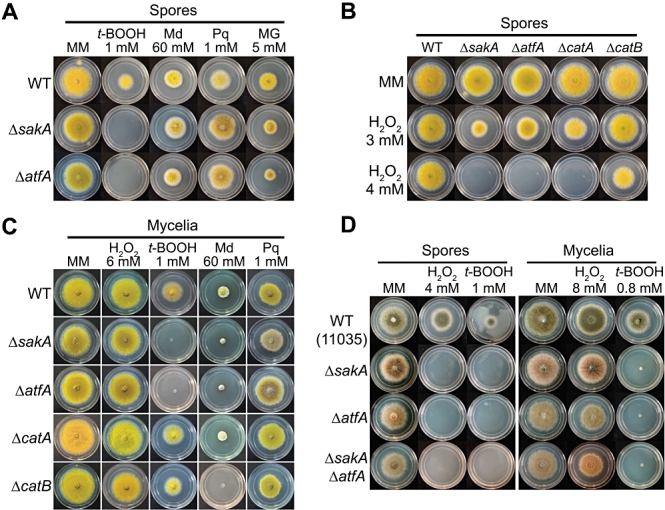
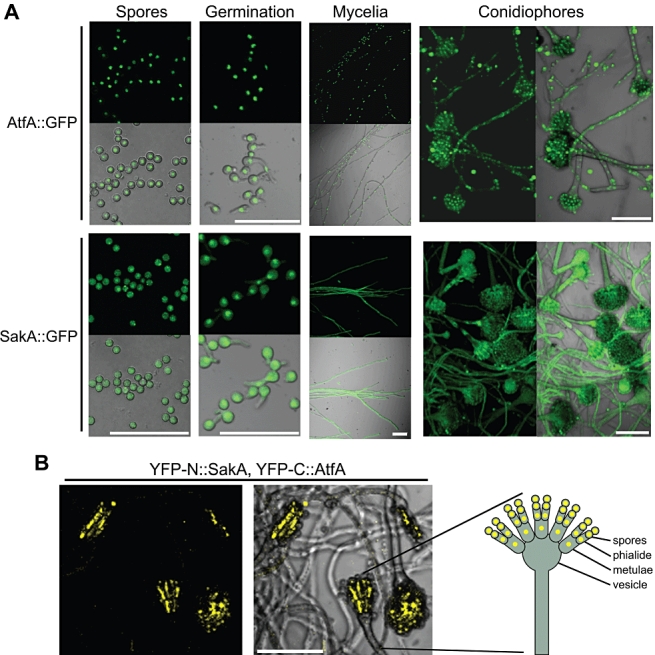
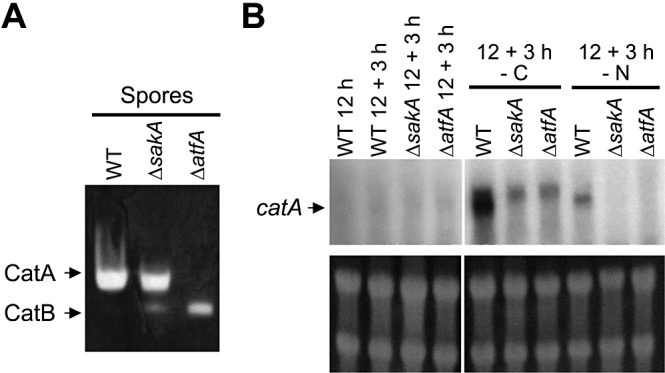
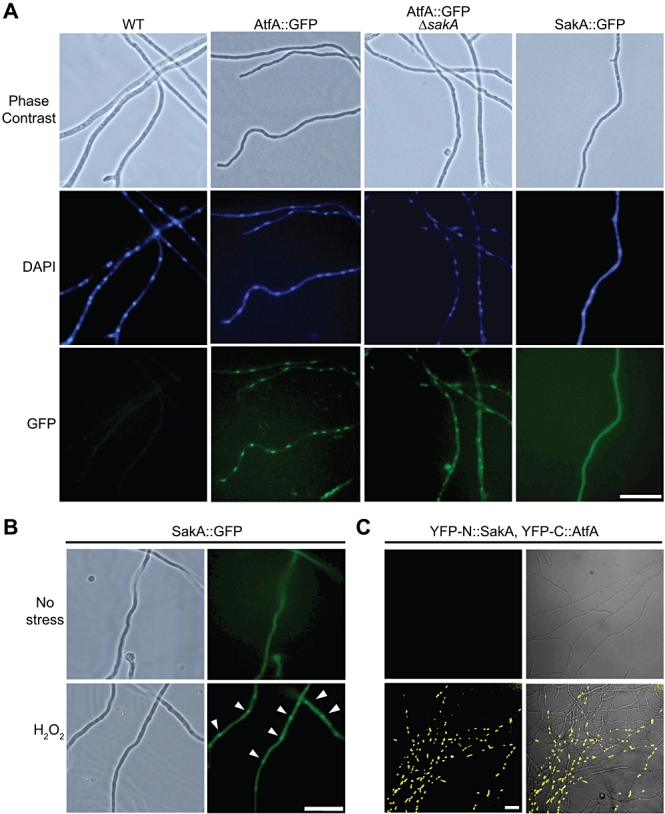
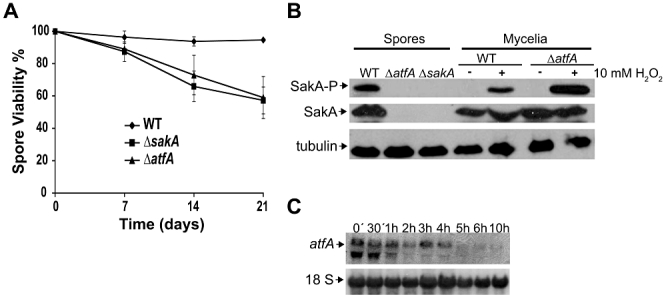
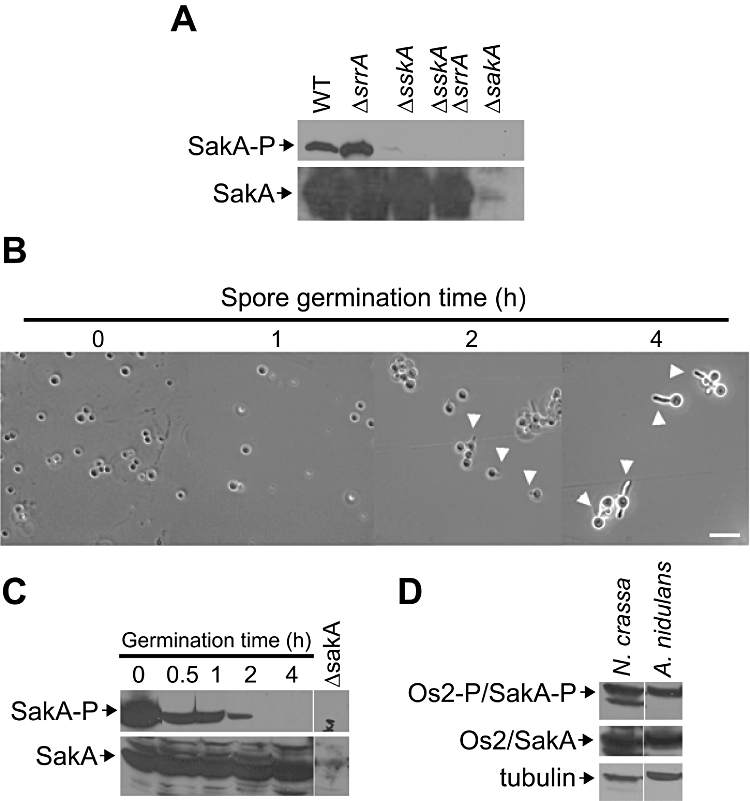
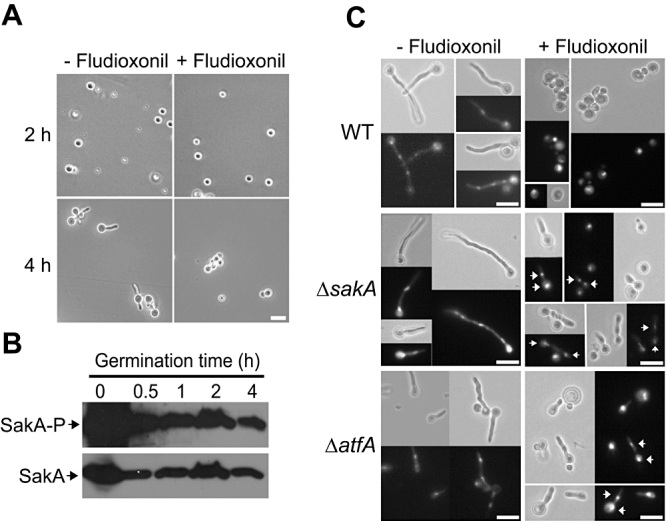
Fungi utilize a phosphorelay system coupled to a MAP kinase module for sensing and processing environmental signals. In Aspergillus nidulans, response regulator SskA transmits osmotic and oxidative stress signals to the stress MAPK (SAPK) SakA. Using a genetic approach together with GFP tagging and molecular bifluorescence we show that SakA and ATF/CREB transcription factor AtfA define a general stress-signalling pathway that plays differential roles in oxidative stress responses during growth and development. AtfA is permanently localized in the nucleus, while SakA accumulates in the nucleus in response to oxidative or osmotic stress signals or during normal spore development, where it physically interacts with AtfA. AtfA is required for expression of several genes, the conidial accumulation of SakA and the viability of conidia. Furthermore, SakA is active (phosphorylated) in asexual spores, remaining phosphorylated in dormant conidia and becoming dephosphorylated during germination. SakA phosphorylation in spores depends on certain (SskA) but not other (SrrA and NikA) components of the phosphorelay system. Constitutive phosphorylation of SakA induced by the fungicide fludioxonil prevents both, germ tube formation and nuclear division. Similarly, Neurospora crassa SakA orthologue OS-2 is phosphorylated in intact conidia and gets dephosphorylated during germination. We propose that SakA-AtfA interaction regulates gene expression during stress and conidiophore development and that SAPK phosphorylation is a conserved mechanism to regulate transitions between non-growing (spore) and growing (mycelia) states.
真菌利用磷酸接力系统与 MAP 激酶模块结合,用于感应和处理环境信号。在构巢曲霉中,应答调节子 SskA 将渗透和氧化应激信号传递给应激 MAPK(SAPK)SakA。我们采用遗传方法结合 GFP 标记和分子双荧光技术,表明 SakA 和 ATF/CREB 转录因子 AtfA 定义了一个通用的应激信号通路,该通路在生长和发育过程中的氧化应激反应中发挥不同的作用。AtfA 永久定位于细胞核中,而 SakA 在应对氧化或渗透应激信号或在正常孢子发育过程中积累在细胞核中,在那里它与 AtfA 发生物理相互作用。AtfA 是表达几个基因所必需的,包括 SakA 的分生孢子积累和分生孢子的活力。此外,SakA 在无性孢子中具有活性(磷酸化),在休眠的分生孢子中保持磷酸化,并在萌发过程中去磷酸化。孢子中 SakA 的磷酸化依赖于磷酸接力系统的某些(SskA)但不是其他(SrrA 和 NikA)成分。杀菌剂氟啶酮诱导的 SakA 组成性磷酸化既阻止了芽管的形成,也阻止了核分裂。类似地,Neurospora crassa SakA 同源物 OS-2 在完整的分生孢子中被磷酸化,并在萌发过程中去磷酸化。我们提出,SakA-AtfA 相互作用调节应激和产孢结构发育过程中的基因表达,而 SAPK 磷酸化是调节非生长(孢子)和生长(菌丝体)状态之间转换的保守机制。