Allavena P, Chieppa M, Bianchi G, Solinas G, Fabbri M, Laskarin G, Mantovani A
Deptartment Immunology & Inflammation, IRCCS Clinical Institute Humanitas, Rozzano, 20089 Milan, Italy.
Clin Dev Immunol. 2010;2010:547179. doi: 10.1155/2010/547179. Epub 2011 Feb 9.
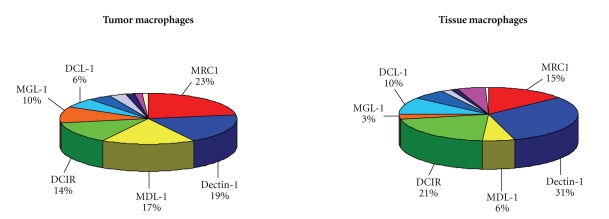
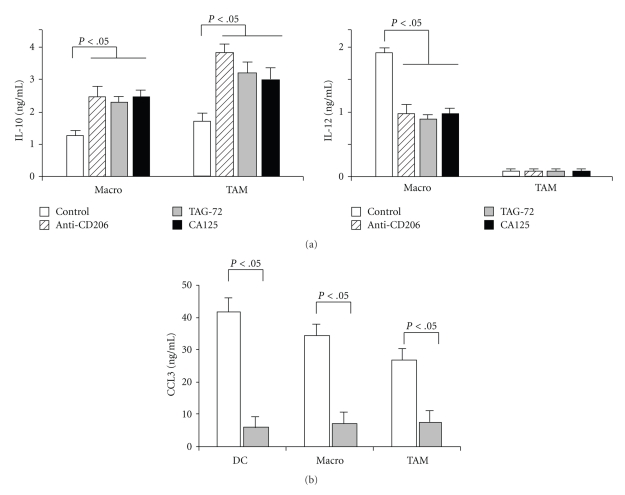
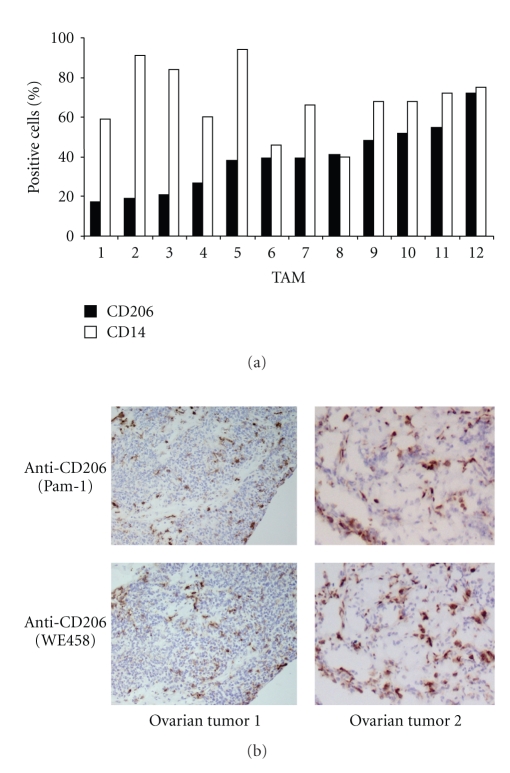
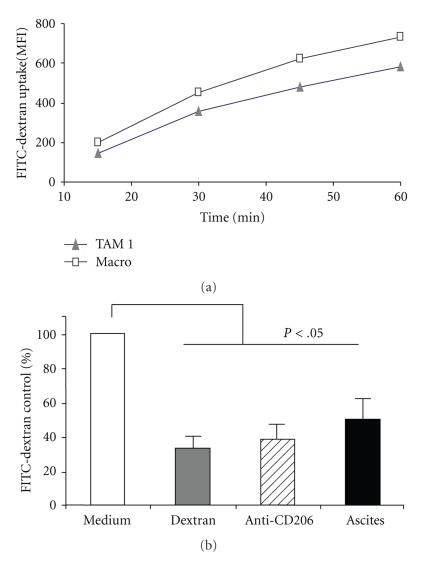
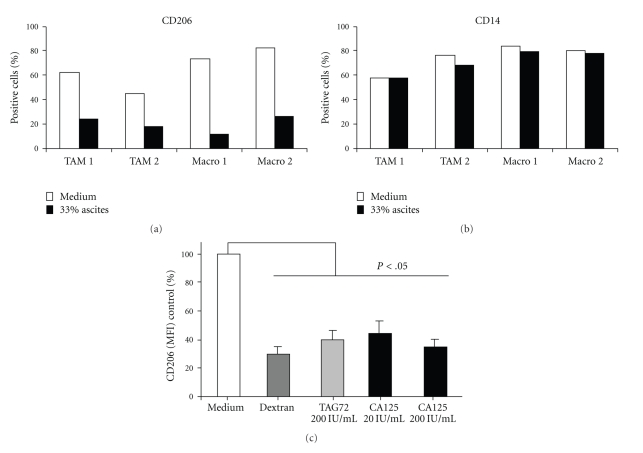
Tumor-Associated Macrophages (TAMs) are abundantly present in the stroma of solid tumors and modulate several important biological processes, such as neoangiogenesis, cancer cell proliferation and invasion, and suppression of adaptive immune responses. Myeloid C-type lectin receptors (CLRs) constitute a large family of transmembrane carbohydrate-binding receptors that recognize pathogens as well as endogenous glycoproteins. Several lines of evidence demonstrate that some CLRs can inhibit the immune response. In this study we investigated TAM-associated molecules potentially involved in their immune suppressive activity. We found that TAMs isolated from human ovarian carcinoma samples predominantly express the CLRs Dectin-1, MDL-1, MGL, DCIR, and most abundantly the Mannose Receptor (MR). Components of carcinomatous ascites and purified tumoral mucins (CA125 and TAG-72) bound the MR and induced its internalization. MR engagement by tumoral mucins and by an agonist anti-MR antibody modulated cytokine production by TAM toward an immune-suppressive profile: increase of IL-10, absence of IL-12, and decrease of the Th1-attracting chemokine CCL3. This study highlights that tumoral mucin-mediated ligation of the MR on infiltrating TAM may contribute to their immune suppressive phenotype.
肿瘤相关巨噬细胞(TAM)大量存在于实体瘤的基质中,并调节多种重要的生物学过程,如新生血管生成、癌细胞增殖和侵袭以及适应性免疫反应的抑制。髓样C型凝集素受体(CLR)构成了一个识别病原体以及内源性糖蛋白的跨膜碳水化合物结合受体大家族。多项证据表明,一些CLR可抑制免疫反应。在本研究中,我们调查了可能与其免疫抑制活性有关的TAM相关分子。我们发现,从人卵巢癌样本中分离出的TAM主要表达CLR中的Dectin-1、MDL-1、MGL、DCIR,其中甘露糖受体(MR)表达最为丰富。癌性腹水成分和纯化的肿瘤粘蛋白(CA125和TAG-72)与MR结合并诱导其内化。肿瘤粘蛋白和抗MR激动剂抗体与MR结合后,可调节TAM的细胞因子产生,使其向免疫抑制方向发展:IL-10增加,IL-12缺失,吸引Th1的趋化因子CCL3减少。本研究强调,肿瘤粘蛋白介导的浸润性TAM上MR的结合可能有助于其免疫抑制表型的形成。