Centre for Functional Magnetic Resonance Imaging of the Brain (FMRIB), Nuffield Department of Clinical Neurosciences, University of Oxford, Oxford, UK.
Centre for Functional Magnetic Resonance Imaging of the Brain (FMRIB), Nuffield Department of Clinical Neurosciences, University of Oxford, Oxford, UK; Department of Biomedical Engineering, Johns Hopkins University School of Medicine, 720 Rutland Avenue, Baltimore, MD 21205, USA.
Neuropsychologia. 2011 Apr;49(5):800-804. doi: 10.1016/j.neuropsychologia.2011.02.009. Epub 2011 Feb 16.
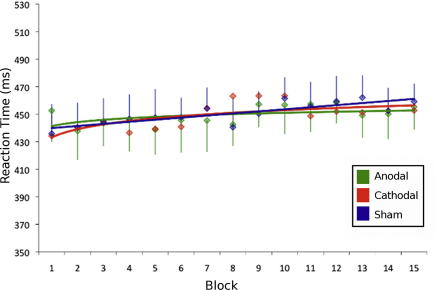
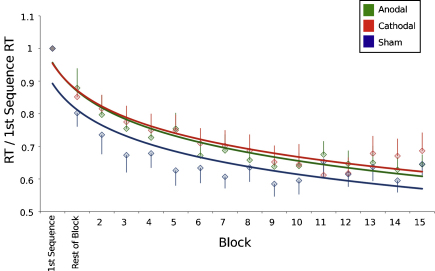
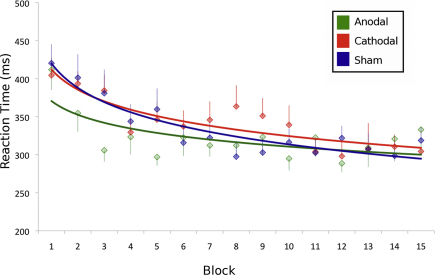
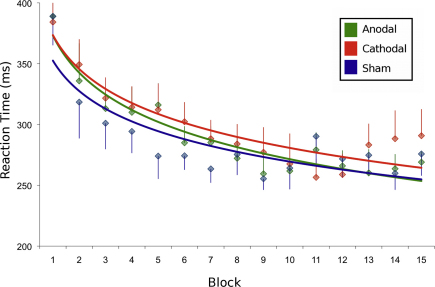
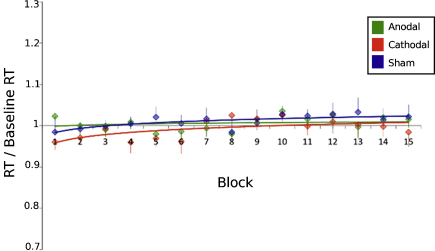
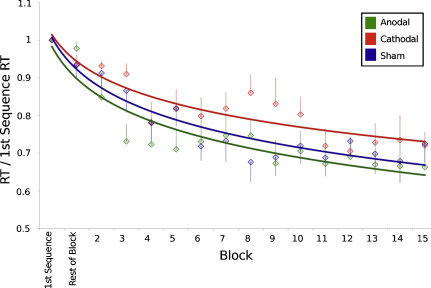
Transcranial direct current stimulation (tDCS) is attracting increasing interest as a therapeutic tool for neurorehabilitation, particularly after stroke, because of its potential to modulate local excitability and therefore promote functional plasticity. Previous studies suggest that timing is important in determining the behavioural effects of brain stimulation. Regulatory metaplastic mechanisms exist to modulate the effects of a stimulation intervention in a manner dependent on prior cortical excitability, thereby preventing destabilization of existing cortical networks. The importance of such timing dependence has not yet been fully explored for tDCS. Here, we describe the results of a series of behavioural experiments in healthy controls to determine the importance of the relative timing of tDCS for motor performance. Application of tDCS during an explicit sequence-learning task led to modulation of behaviour in a polarity specific manner: relative to sham stimulation, anodal tDCS was associated with faster learning and cathodal tDCS with slower learning. Application of tDCS prior to performance of the sequence-learning task led to slower learning after both anodal and cathodal tDCS. By contrast, regardless of the polarity of stimulation, tDCS had no significant effect on performance of a simple reaction time task. These results are consistent with the idea that anodal tDCS interacts with subsequent motor learning in a metaplastic manner and suggest that anodal stimulation modulates cortical excitability in a manner similar to motor learning.
经颅直流电刺激(tDCS)作为神经康复的一种治疗工具,越来越受到关注,特别是在中风后,因为它具有调节局部兴奋性的潜力,从而促进功能可塑性。先前的研究表明,时间在确定脑刺激的行为效果方面很重要。存在调节性超塑机制,可以根据先前的皮质兴奋性来调节刺激干预的效果,从而防止现有皮质网络的不稳定性。对于 tDCS,这种时间依赖性的重要性尚未得到充分探索。在这里,我们描述了一系列在健康对照者中进行的行为实验的结果,以确定 tDCS 对运动表现的相对时间的重要性。在明确的序列学习任务期间应用 tDCS 以极性特异性的方式调节行为:与假刺激相比,阳极 tDCS 与更快的学习相关,而阴极 tDCS 与更慢的学习相关。在执行序列学习任务之前应用 tDCS 导致无论是阳极还是阴极 tDCS 后学习速度都变慢。相比之下,无论刺激的极性如何,tDCS 对简单反应时间任务的表现都没有显著影响。这些结果与阳极 tDCS 以超塑的方式与随后的运动学习相互作用的观点一致,并表明阳极刺激以类似于运动学习的方式调节皮质兴奋性。