The Beatson Institute for Cancer Research, Glasgow, UK.
J Mol Med (Berl). 2011 Mar;89(3):237-45. doi: 10.1007/s00109-011-0735-5. Epub 2011 Feb 23.
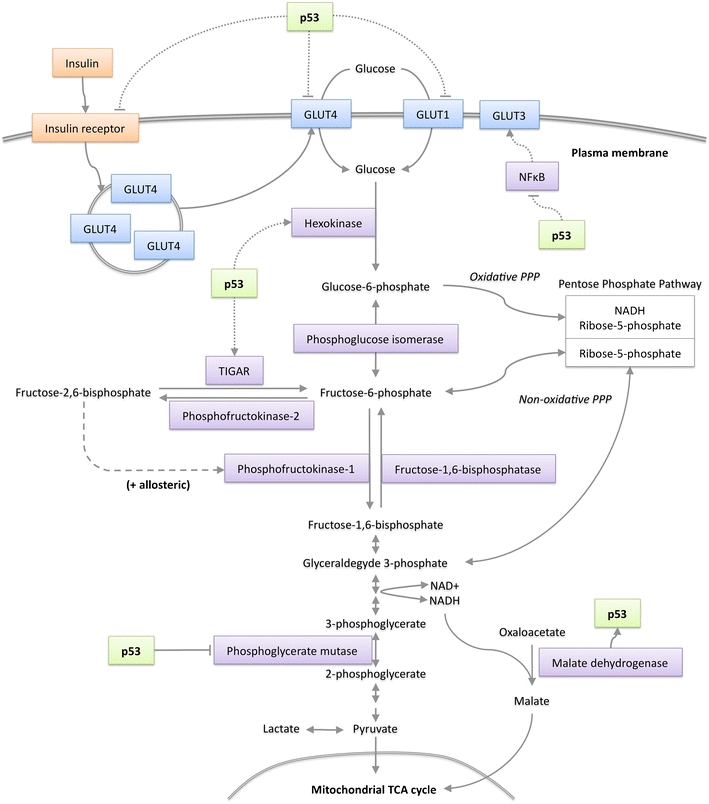
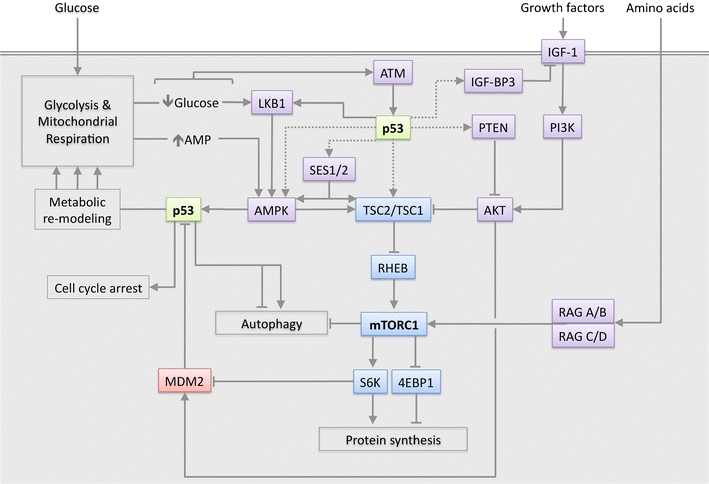
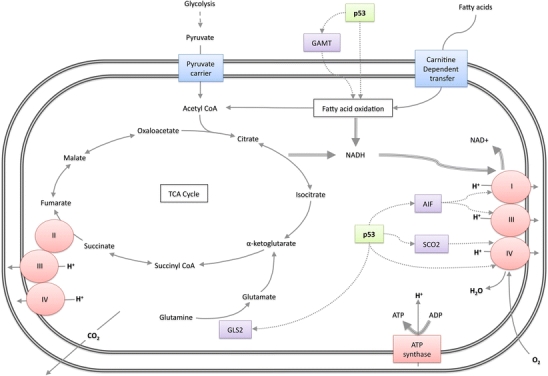
We are increasingly aware that cellular metabolism plays a vital role in diseases such as cancer, and that p53 is an important regulator of metabolic pathways. By transcriptional activation and other means, p53 is able to contribute to the regulation of glycolysis, oxidative phosphorylation, glutaminolysis, insulin sensitivity, nucleotide biosynthesis, mitochondrial integrity, fatty acid oxidation, antioxidant response, autophagy and mTOR signalling. The ability to positively and negatively regulate many of these pathways, combined with feedback signalling from these pathways to p53, demonstrates the reciprocal and flexible nature of the regulation, facilitating a diverse range of responses to metabolic stress. Intriguingly, metabolic stress triggers primarily an adaptive (rather than pro-apoptotic) p53 response, and p53 is emerging as an important regulator of metabolic homeostasis. A better understanding of how p53 coordinates metabolic adaptation will facilitate the identification of novel therapeutic targets and will also illuminate the wider role of p53 in human biology.
我们越来越意识到细胞代谢在癌症等疾病中起着至关重要的作用,而 p53 是代谢途径的重要调节因子。通过转录激活和其他方式,p53 能够促进糖酵解、氧化磷酸化、谷氨酰胺分解、胰岛素敏感性、核苷酸生物合成、线粒体完整性、脂肪酸氧化、抗氧化反应、自噬和 mTOR 信号的调节。p53 能够正向和负向调节许多这些途径,加上这些途径对 p53 的反馈信号,表明了调节的相互和灵活的性质,促进了对代谢应激的多样化反应。有趣的是,代谢应激主要引发适应性(而非促凋亡)的 p53 反应,而 p53 正成为代谢稳态的重要调节因子。更好地理解 p53 如何协调代谢适应将有助于确定新的治疗靶点,并阐明 p53 在人类生物学中的更广泛作用。