Department of Cardiovascular Physiology, Institute of Physiology, Ruhr University Bochum, MA 3/56, 44780, Bochum, Germany.
Pflugers Arch. 2011 Jul;462(1):143-54. doi: 10.1007/s00424-011-0938-1. Epub 2011 Feb 25.
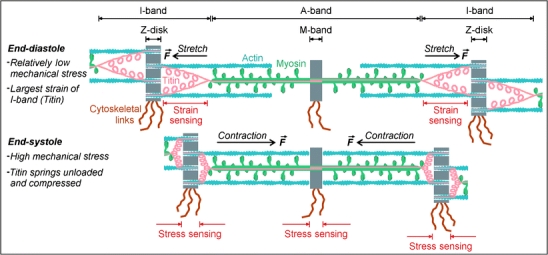
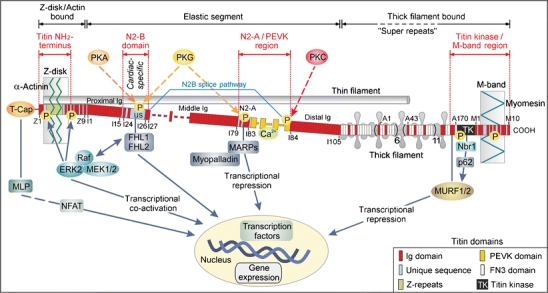
The giant filamentous protein titin is ideally positioned in the muscle sarcomere to sense mechanical stimuli and transform them into biochemical signals, such as those triggering cardiac hypertrophy. In this review, we ponder the evidence for signaling hotspots along the titin filament involved in mechanosensory control mechanisms. On the way, we distinguish between stress and strain as triggers of mechanical signaling events at the cardiac sarcomere. Whereas the Z-disk and M-band regions of titin may be prominently involved in sensing mechanical stress, signaling hotspots within the elastic I-band titin segment may respond primarily to mechanical strain. Common to both stress and strain sensor elements is their regulation by conformational changes in protein domains.
巨大的丝状蛋白titin 理想地位于肌肉肌节中,以感知机械刺激并将其转化为生化信号,例如触发心脏肥大的信号。在这篇综述中,我们思考了与机械感觉控制机制相关的 titin 丝上的信号热点的证据。在这个过程中,我们将应力和应变区分开来,作为心肌节机械信号事件的触发因素。虽然 titin 的 Z 盘和 M 带区域可能主要参与感知机械应力,但弹性 I 带 titin 段内的信号热点可能主要对机械应变做出反应。无论是应力还是应变传感器元件,它们的共同点都是由蛋白质结构域的构象变化来调节。