Department of Cardiology, Beijing Anzhen Hospital of Capital Medical University, Beijing, China.
Cardiovasc Diabetol. 2011 Feb 25;10:19. doi: 10.1186/1475-2840-10-19.
Glucose variability is one of components of the dysglycemia in diabetes and may play an important role in development of diabetic vascular complications. The objective of this study was to assess the relationship between glycemic variability determined by a continuous glucose monitoring (CGM) system and the presence and severity of coronary artery disease (CAD) in patients with type 2 diabetes mellitus (T2DM).
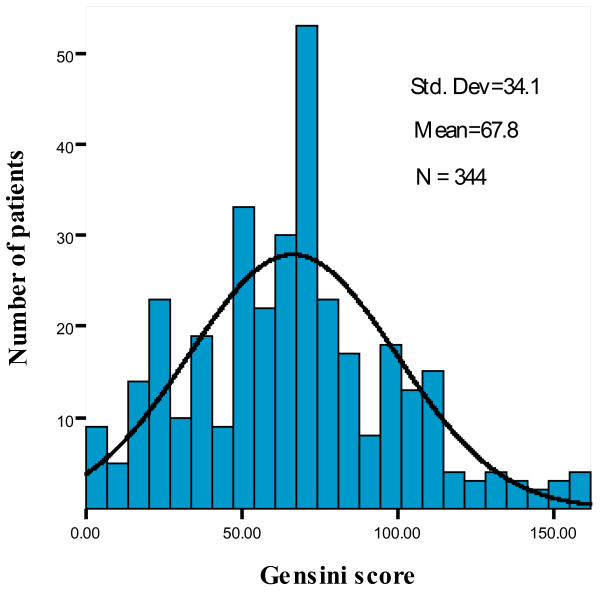
In 344 T2DM patients with chest pain, coronary angiography revealed CAD (coronary stenosis ≥ 50% luminal diameter narrowing) in 252 patients and 92 patients without CAD. Gensini score was used to assess the severity of CAD. All participants' CGM parameters and biochemical characteristics were measured at baseline.
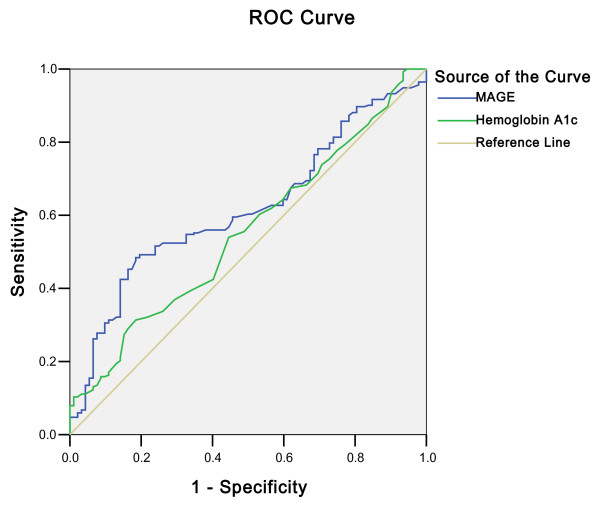
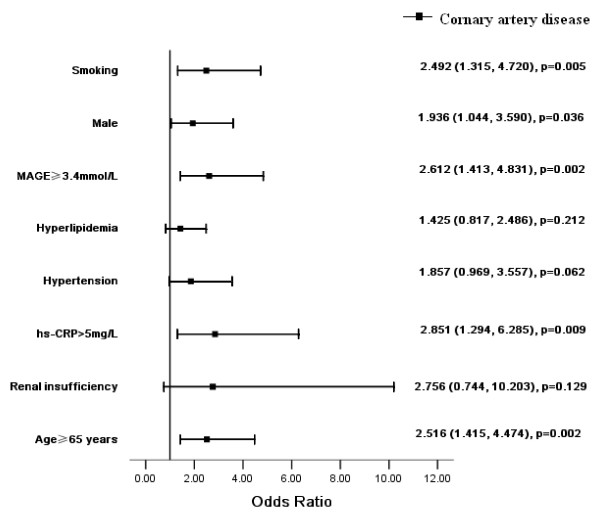
Diabetic patients with CAD were older, and more were male and cigarette smokers compared with the controls. Levels of the mean amplitude of glycemic excursions (MAGE) (3.7 ± 1.4 mmol/L vs. 3.2 ± 1.2 mmol/L, p < 0.001), postprandial glucose excursion (PPGE) (3.9 ± 1.6 mmol/L vs. 3.6 ± 1.4 mmol/L, p = 0.036), serum high-sensitive C-reactive protein (hs-CRP) (10.7 ± 12.4 mg/L vs. 5.8 ± 6.7 mg/L, p < 0.001) and creatinine (Cr) (87 ± 23 mmol/L vs. 77 ± 14 mmol/L, p < 0.001) were significantly higher in patients with CAD than in patients without CAD. Gensini score closely correlated with age, MAGE, PPGE, hemoglobin A1c (HbA1c), hs-CRP and total cholesterol (TC). Multivariate analysis indicated that age (p < 0.001), MAGE (p < 0.001), serum levels of HbA1c (p = 0.022) and hs-CRP (p = 0.005) were independent determinants for Gensini score. Logistic regression analysis revealed that MAGE ≥ 3.4 mmol/L was an independent predictor for CAD. The area under the receiver-operating characteristic curve for MAGE (0.618, p = 0.001) was superior to that for HbA1c (0.554, p = 0.129).
The intraday glycemic variability is associated with the presence and severity of CAD in patients with T2DM. Effects of glycemic excursions on vascular complications should not be neglected in diabetes.
血糖变异性是糖尿病患者糖代谢紊乱的一个组成部分,可能在糖尿病血管并发症的发展中发挥重要作用。本研究的目的是评估通过连续血糖监测(CGM)系统确定的血糖变异性与 2 型糖尿病(T2DM)患者冠状动脉疾病(CAD)的存在和严重程度之间的关系。
在 344 例胸痛的 T2DM 患者中,冠状动脉造影显示 252 例患者存在 CAD(冠状动脉狭窄≥50%管腔直径狭窄),92 例患者无 CAD。采用 Gensini 评分评估 CAD 的严重程度。所有参与者在基线时测量 CGM 参数和生化特征。
与对照组相比,患有 CAD 的糖尿病患者年龄较大,男性和吸烟者更多。平均血糖波动幅度(MAGE)(3.7±1.4mmol/L 与 3.2±1.2mmol/L,p<0.001)、餐后血糖波动(PPGE)(3.9±1.6mmol/L 与 3.6±1.4mmol/L,p=0.036)、血清高敏 C 反应蛋白(hs-CRP)(10.7±12.4mg/L 与 5.8±6.7mg/L,p<0.001)和肌酐(Cr)(87±23mmol/L 与 77±14mmol/L,p<0.001)在 CAD 患者中明显更高。Gensini 评分与年龄、MAGE、PPGE、糖化血红蛋白(HbA1c)、hs-CRP 和总胆固醇(TC)密切相关。多变量分析表明,年龄(p<0.001)、MAGE(p<0.001)、血清 HbA1c 水平(p=0.022)和 hs-CRP(p=0.005)是 Gensini 评分的独立决定因素。Logistic 回归分析显示,MAGE≥3.4mmol/L 是 CAD 的独立预测因子。MAGE(0.618,p=0.001)的受试者工作特征曲线下面积优于 HbA1c(0.554,p=0.129)。
日内血糖变异性与 T2DM 患者 CAD 的存在和严重程度相关。在糖尿病中,血糖波动对血管并发症的影响不容忽视。