Division of Gastroenterology and Hepatology, Department of Internal Medicine, Keio University School of Medicine, 35 Shinanomachi, Shinjuku-ku, Tokyo 160-8582, Japan.
J Clin Biochem Nutr. 2011 Mar;48(2):122-5. doi: 10.3164/jcbn.10-16GFR. Epub 2010 Apr 29.
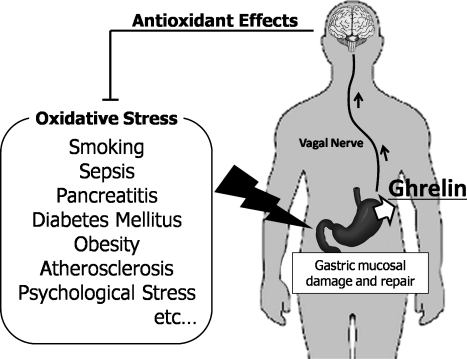
Oxidative stress is a major cause of the gastrointestinal damage under physical or psychological stress. Ghrelin exhibits gastroprotective effects and they are supposed to be derived from antioxidant effects. In gastroduodenal mucosal injury, the plasma ghrelin levels increase in response to the demand for gastroduodenal cytoprotection. However, in the condition of Helicobacter pylori-induced gastric mucosal severe atrophy, the plasma ghrelin concentration shifted to lower levels. In diabetic gastroparesis, the regulation of ghrelin secretion is impaired with vagal nerve dysfunction. Selective ghrelin agonist is expected to represent a new class of prokinetic agent. In addition, the plasma ghrelin levels are also enhanced by systemic oxidative stress, and ghrelin exhibits antioxidant effects in many organs, such as heart, pancreas, and lung. This suggests that ghrelin would be an important player as a sensor of systemic oxidative stress.
氧化应激是物理或心理应激下胃肠道损伤的主要原因。胃饥饿素具有胃保护作用,其作用可能源于抗氧化作用。在胃十二指肠黏膜损伤中,为了满足胃十二指肠细胞保护的需求,血浆胃饥饿素水平升高。然而,在幽门螺杆菌引起的胃黏膜严重萎缩的情况下,血浆胃饥饿素浓度转移到较低水平。在糖尿病性胃轻瘫中,迷走神经功能障碍导致胃饥饿素分泌调节受损。选择性胃饥饿素激动剂有望成为一类新的促动力药物。此外,全身氧化应激也会增加血浆胃饥饿素水平,胃饥饿素在心脏、胰腺和肺等许多器官中具有抗氧化作用。这表明胃饥饿素可能是作为全身氧化应激传感器的重要角色。